Working Drawings 134
dimension, lines, dimensions, fig, inches, circle and placed
To make the print, the tracing or inked drawing is placed face up on the sensitized side of the prepared paper; the two are put in a printing frame, and exposed to the sunlight or a powerful electric light. The light acts on the prepared surface, changing it to a permanent blue color except where the surface is covered by the inked lines. The time needed for the ex posure will vary according to the intensity of the light and the speed of the paper—from less than a minute to half an hour or more.
After exposure, the print is taken from the frame, and placed in a tank of running water, which dissolves and washes away the parts of the coating that were protected by the inked lines above, but which has no effect on the parts that have been acted upon and fixed by the action of the light. The sheet is next taken from the tank, hung up to dry, and is then ready for use.
140. Dimensioning. Dimensions are usually placed on a drawing so as to read from the bot tom and from the right hand. Clearness is of great importance in dimensioning; and on this account, if for no other reason, the figures should be plainly made and heavy enough so as to stand out somewhat from the drawing. There must be no confused tangle of dimensions; dimension lines should not needlessly cross, and the dimensions must be separated enough so as to be clearly read. Arrow-heads are used at the ends of the dimension lines (with one or two ex ceptions), to show exactly between what two points or lines the given dimension applies..
Dimensions are expressed on a drawing in inches, or in feet and inches, depending upon the distance and also on the choice of the draftsman. In some drafting rooms, dimensions up to two feet are expressed as inches; and above that, in feet and inches. In others, any distance over twelve inches is indicated in feet and inches.
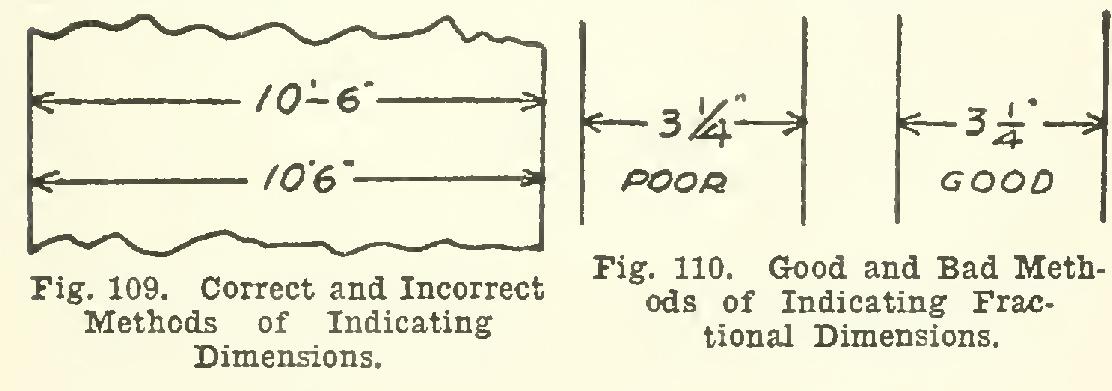
Where the dimension is stated in feet and inches, a short dash should always be placed be tween the feet and the inches, that no mistake may be made in reading it. Fig. 109 shows the upper dimension correct, written with the dash; and the lower one wrong, without it. The dash line between the arrows is the dimension line.
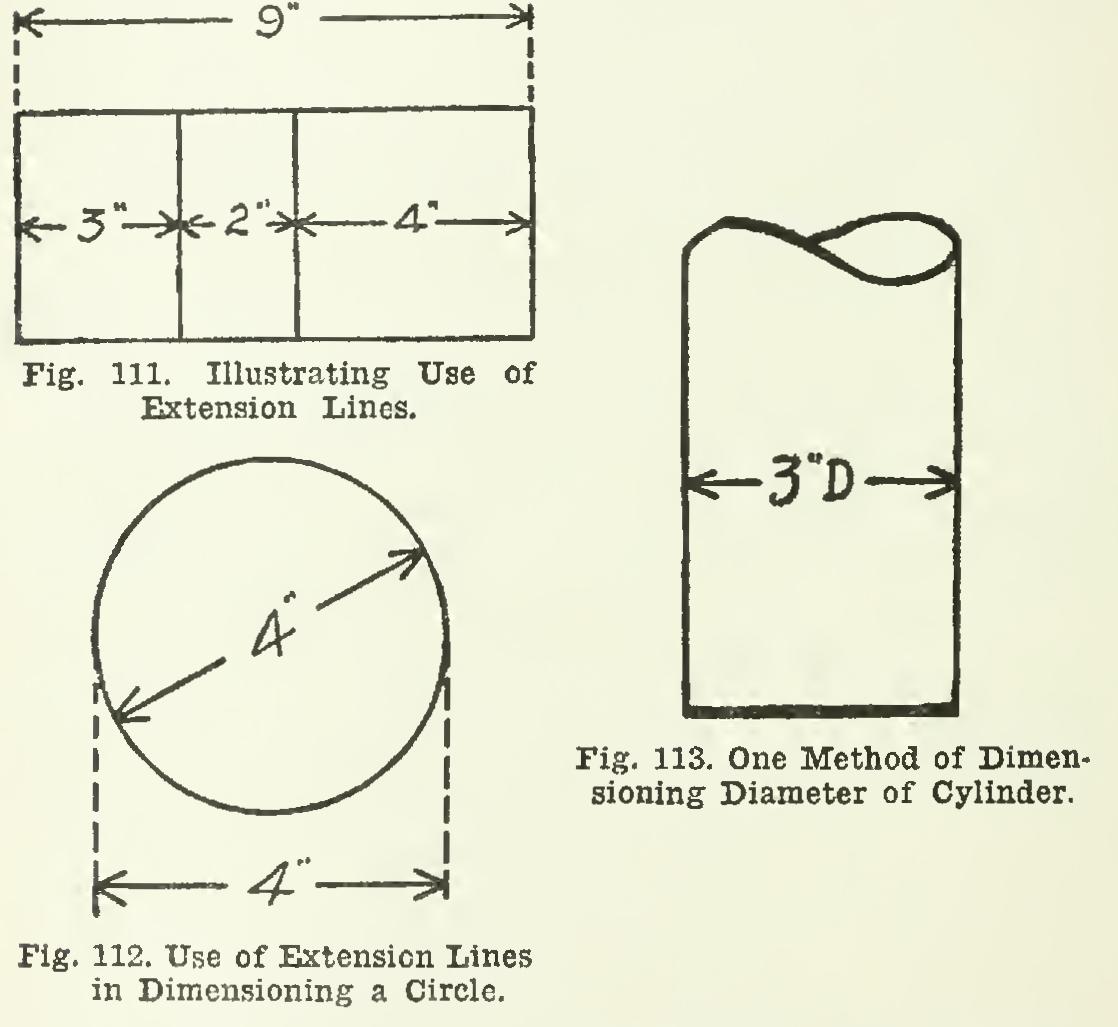
Fig. 110 illustrates a good and a bad way of showing a fractional dimension. The line of the fraction should always be parallel to the dimen sion line, never inclined.
Extension Lines.
In Fig. 111, the short-clash lines extending above the figure at either end are extension lines. Extension lines are used for the extension of lines between which a dimension is to be placed, so that the dimension may be given outside of the figure. In this way, confusion is often avoided. Extension lines are also often used in dimensioning a circle or cir cular piece, as shown in Fig. 112. Fig. 112 also shows the circle dimensioned inside.
Where a whole circle is drawn, the diameter should always be given, rather than the radius; and the dimension line should pass through the center.
If, as in Fig. 113, the diameter of a rounded piece, as a cylinder, is given elsewhere than on the end view, the dimension figure should be followed by D or Dia. (for "Diameter").
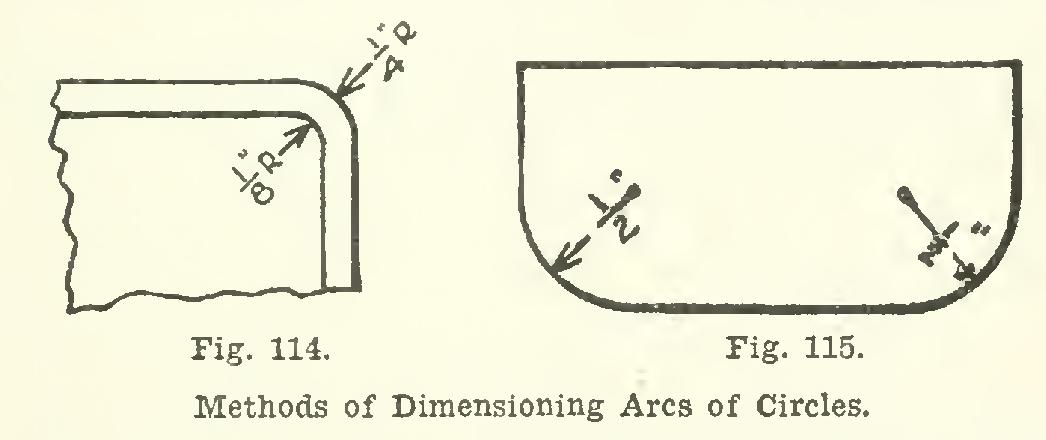
Where an arc of a circle is given, indicate the radius instead of the diameter, as shown in Figs. 114 and 115. Where there is sufficient room, the center of the arc should be enclosed in a small freehand circle, and the dimension placed between the center and the arc as in Fig. 115; otherwise the length of radius should be given as in Fig. 114, followed by the letter R to denote "Radius." When an arc is given, use only one arrow head.
When a number of holes are equally spaced around a circle, give the diameter of circle pass ing through centers, as in Fig. 116. If the holes are all of equal size, it is sufficient to give the diameter of one or two.
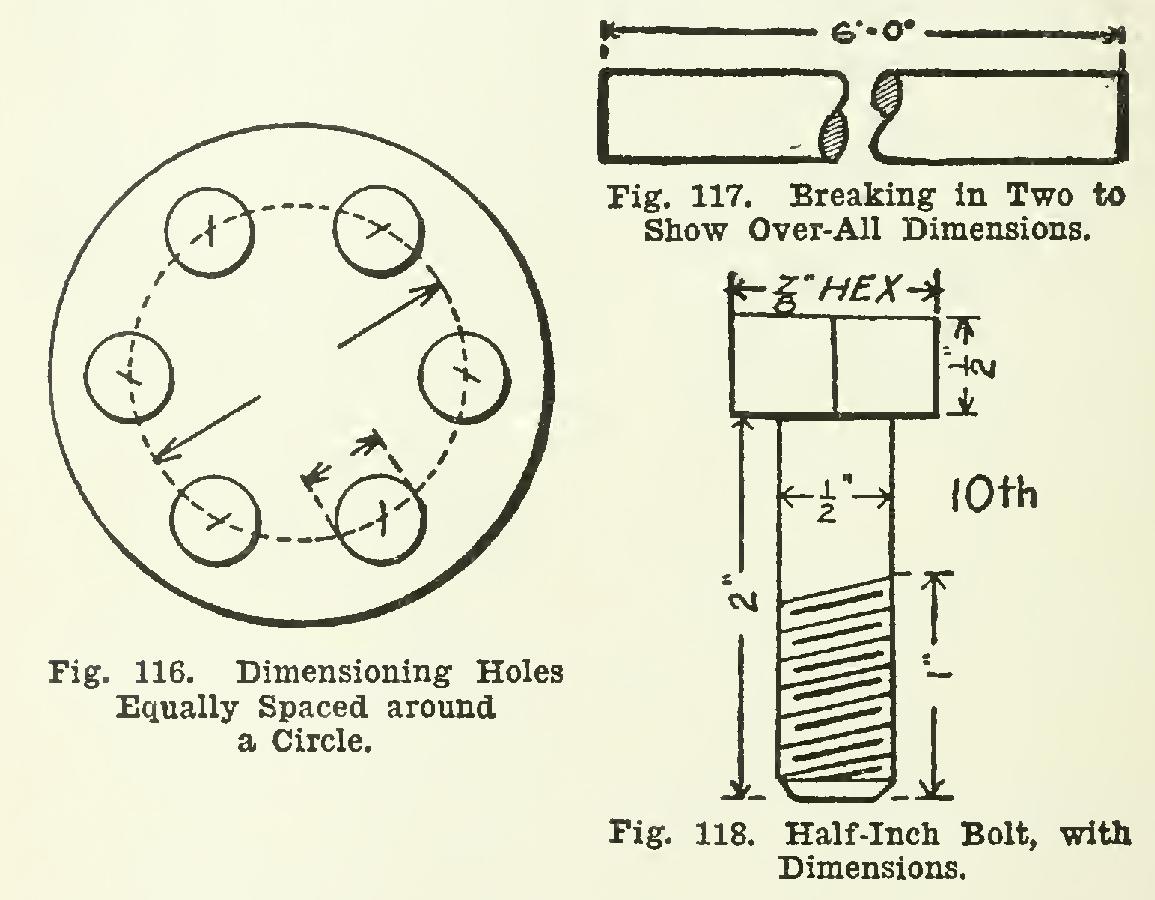
Besides the necessary dimensions of all the different parts of the object represented, the extreme outside dimensions should usually be given. These are known as over-all dimensions, and should be given so that the workman will not be obliged to add the several dimensions in order to obtain the required size. If a very long piece is to be shown, it may be represented as broken in two, and therefore drawn less in length than would otherwise be necessary, the dimension being given as if the whole length were shown (see Fig. 117).
Distribution of Dimensions. Where there are several views of an object on one sheet, the appearance will be improved and the drawing will be easier to read, if the dimensions are dis tributed among the different views. In any case, how ever, where there would be likelihood of error, the same dimension should be placed on more than one view.