A Linen Chest
inches, one-quarter, pieces, length, stiles, width and inch
A LINEN CHEST A chest of plain but rather pleasing design is shown in Plate 19, and detailed in Fig. 91. It is intended primarily as a dower chest, but will be found useful for a variety of purposes.
In olden times, a bride-to-be was given a well-filled chest upon leaving the home roof. This pretty custom is coming in favor again, and perhaps some father may find the accom panying design useful.
Quartered white oak is well-suited. It should be thoroughly seasoned, and should be clear of checks, sap, etc. Red oak, plain-sawed, will make a very satisfactory appearance if white oak cannot be procured.
Time will be saved, and a good piece of work be more easily accomplished, if the differ ent pieces are ordered mill-planed on four sur faces as far as practicable. Of course, if no mill is at hand, the pieces can be squared to dimen sions in the usual manner. Stock mill-planed on two surfaces to thickness, can be obtained at almost any lumber yard.
The following stock bill gives the exact di mensions; in ordering, allowance must be made for waste in squaring up: For the top, one piece seven-eighths by nine teen and one-half by thirty-nine inches. For the cleats under the top, two pieces three-quar ters, by three, by fifteen inches; also, one piece of the same thickness and length, with a width of four and one-half inches. The bottom of the chest will require a piece three-quarters by sev enteen and five-eighths, by thirty-five and five eighths inches. For the rails, four pieces three quarters by two and one-quarter, by thirty-three and three-eighths inches; four pieces of the same thickness and width, with a length of fifteen and three-eighths inches. For the stiles, eight pieces three-quarters by two and one-quarter, by thir teen and one-quarter inches; also four pieces of the same thickness and length, with a width of three inches. The panels will require four pieces one-quarter by seven and five-eighths, by thirteen and one-quarter inches; two pieces of the same thickness and length, with a width of eight inches; also, two pieces with a width of ten and one-quarter inches. For posts, get four pieces one and seven-eighths inches square, with a length of twenty inches.
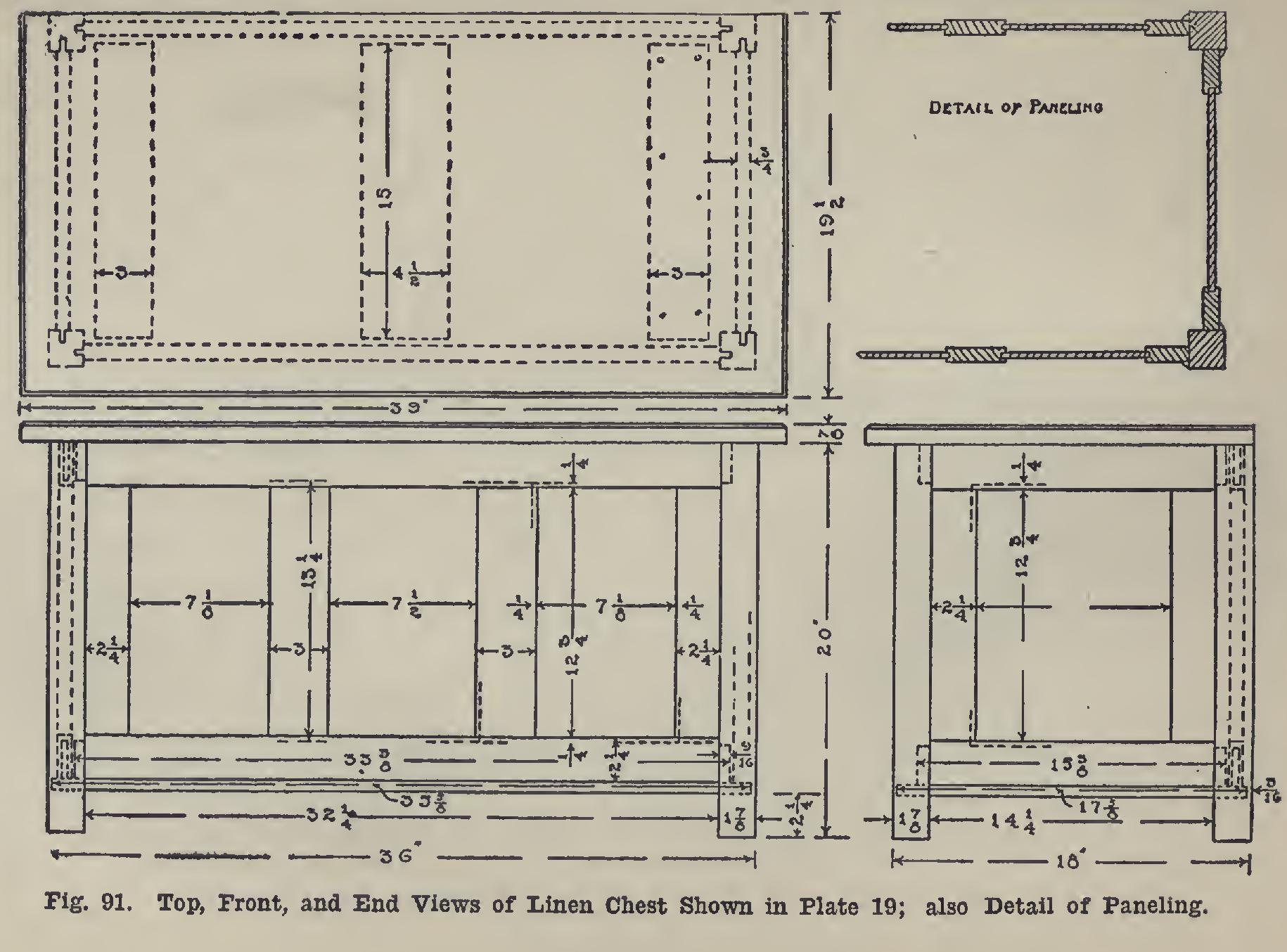
Begin work by making the paneling. First, see that rails and stiles of the required number are squared to the dimensions given above. Set the smoothing plane very shallow, and remove all the mill marks. The eight stiles, which are three-quarters by two and one-quarter by thir teen and one-quarter inches, are to be plowed with a one-quarter-inch groove to a depth of one-quarter of an inch. The groove is to be placed in the middle and on one edge only of each.
These grooves might be cut by means of a chisel; but a panel plow does the work so much easier and better that it should be used. Almost every shop has one, and a little investigation will soon show the manner of setting the fence so that the cutter will make the groove in the middle of the edge. A one-quarter-inch cutter should be inserted, and the fence set so that it will be one-quarter of an inch away from the cutter edge of the cutter. Make a trial cut, and lay the rule across to see that the groove is in the middle. Set the depth gauge to one-quarter of an inch.
The rails, of which there are eight, should be plowed in a similar manner—on one edge only. The edges plowed should be the joint-edges. They are most likely to be square and straight, therefore most likely to fit up properly when joined.
The four middle stiles should be grooved on both edges of each.
If these grooves must be cut with a chisel, gauge from the face sides with the gauge set to one-quarter of an inch, then to one-half an inch. Chisel between these lines.
Next, lay out and cut the tenons on the stiles. Lay the eight pieces of equal width on the bench, and even the ends with the try-square. Mark off the distance between the shoulders—twelve and three-quarters inches—so that there will be tenons one-quarter inch long at each end. Square knife lines across the edges of all while they are together with their ends evened. In like manner lay off the other stiles, keeping the same distance between the shoulders, and the same length of tenons. Square knife lines around the four sides of each piece, at the points marked for shoulders.