A Linen Chest
gauge, mortises, posts, inch, mark, tenons and lines
Gauge across the end of each piece, setting the gauge so that it will make a tenon of one quarter-inch width to correspond with the grooves of the edge. Rip and crosscut carefully to gauge and knife lines.
Place the four short rails on the bench, even the ends, mark the distance between shoulders at fourteen and one-quarter inches. This should leave a tenon nine-sixteenths inch long at each end. Separate the pieces, and square the shoul der lines around the four surfaces. Gauge for a tenon one-quarter inch thick at each end. Rip and crosscut to these lines. These tenons, like those of the stiles, will be the full width of the piece, except as the grooves make them narrower.
The panels may now be glued up. Clean all the parts, using scraper and fine sandpaper. Glue size; that is, put a preliminary coating of glue on the ends of the tenon, and allow it to set. This is to fill the pores of the wood. Put a sec ond coating of glue on the tenons of the stiles, place the panels, adjust the parts, and clamp at each stile. Do not put any glue in the grooves into which the panels fit. It is the .better part of wisdom to put the parts together dry first, to see that all fit perfectly.
If the wood is not thoroughly seasoned, the panels may be made just the size called for in the stock bill. They will shrink and loosen, but will not swell. If the lumber is seasoned so that it is dry, it will be well to plane the panels just a little narrower than the sizes called for, to allow for swelling. In this case care must be taken to space the stiles properly before the glue has had time to set.
See that the faces of the pieces all lie on the same side of the frame, and that the surfaces are kept level in clamping. Use blocks of waste wood between the clamps and the rails, to keep from marring the edges of the rails.
The posts should be surfaced just enough to clear off the mill marks—provided they were mill-planed to the correct width and thickness. Square the ends so that each will have a length of twenty inches. Stand the four posts up in their relative positions in the chest, and mark with the pencil the approximate locations of the mortises. The faces are to be turned "in;" the
mortises will therefore come on the face surfaces.
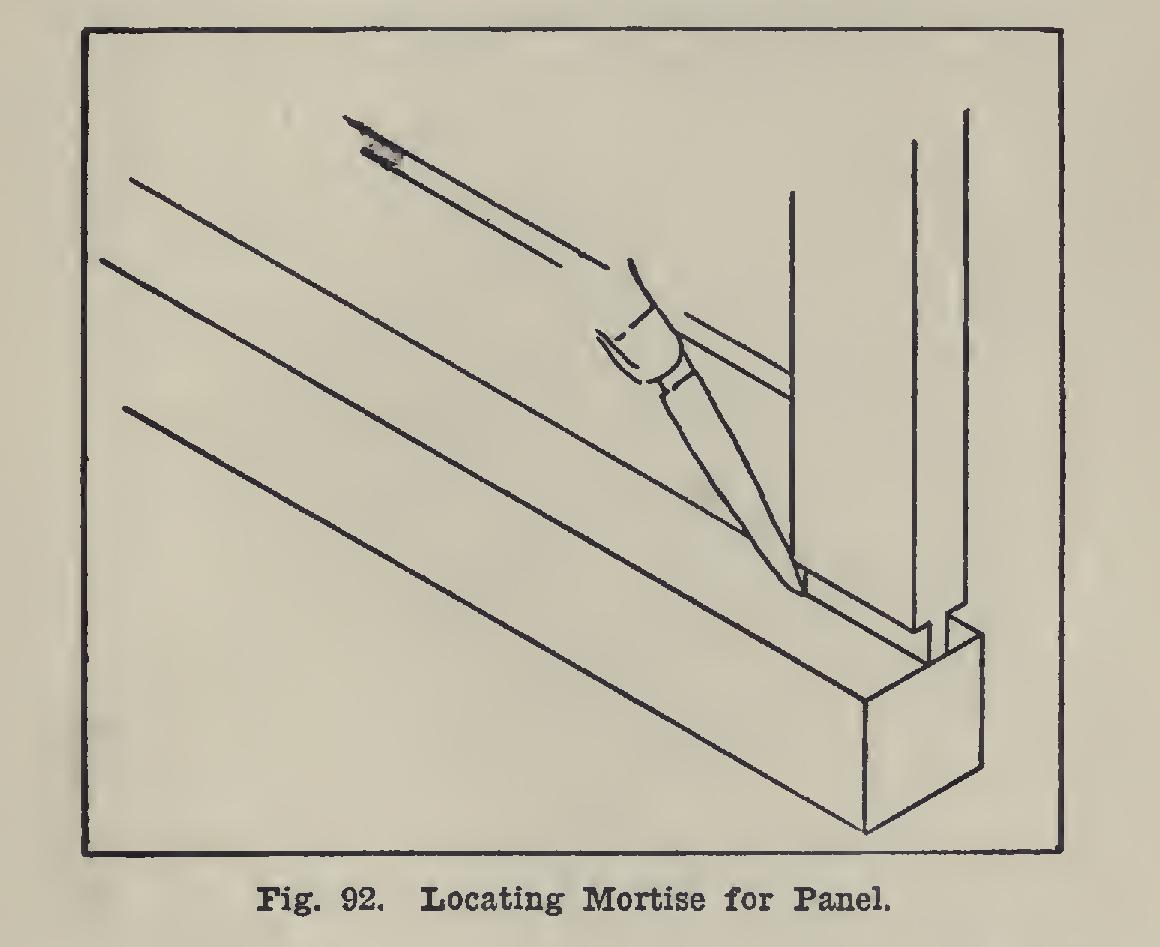
The mortises would better be located by su perposition than by measuring with the rule. Determine what tenons are to fit into the posts, and mark tenon and post with the same number or letter. Hold the panels on the posts so that the top of the panel will be even with the top of the posts. With a knife, mark from the tenons the ends of the mortises (Fig. 92). A try-square should be used to get lines square across the posts at these points.
Set the gauge first to one inch (Fig. 93), and gauge for the first side of the mortise. Hold the head of the gauge against one or other of the faces—the inside surfaces. Again, set the gauge to one and one-quarter; hold the gauge head against the same surfaces as before, and mark the second side of the mortises. It is a good plan to mark the ends of all the mortises first, then gauge the first side of all mortises, then the second side.
These mortises can be cut most easily by using a chisel of the same width as the mortises —one-quarter inch. Chisel them to a depth of nine-sixteenths of an inch.
The lower shelf should be set into the posts so that when it shrinks it will show no cracks. The upper edge of the gains will be on the same level as the lower end of the lower mortise, the lower edge of the gain will be three-quarters of an inch from• this point, measured toward the lower end of the post. Use the try-square and knife to mark these lines, and place them across both faces. Set the gauge to one and eleven sixteenths inches, or so that the spur reaches to within three-sixteenths of an inch of the outside edge when the head is held against the face or inside edge; gauge between the two cross-lines just drawn. Gauge to indicate the depth of gain—one-quarter of an inch will be sufficient. Chisel carefully to these lines.
The front and back of the chest may have the tenons of the rails glued and inserted into the mortises of the respective posts. Adjust the clamps so that the faces of the posts into which the tenons enter will be at right angles to the face of the panel.