Arches - Centers - Windows and Door-Heads
arch, called, fig, construct, segmental, stones and shown
ARCHES - CENTERS - WINDOWS AND DOOR-HEADS As it is also the business of the carpenter to prepare patterns for masons and stone cutters by which they are to cut stones to fit arches, and to construct centers for windows, door-heads, and bridge arches, as well as the falsework used in the erection of steel bridges and those temporary structures known as forms which are necessary to hold concrete in place and shape during the process of placing and setting, it is necessary that the carpenter should have a clear conception of what an arch really is. For, if the arch principle is not well under stood, the carpenter cannot design or construct an arch with safety.
Let us then state once for all that not every curved covering over an opening is necessarily an arch. Thus, for example, the stone which rests on the piers shown in Fig. 57 is not in reality an arch, being merely a stone hewn out in an arch-like shape; for at its top, the very point A at which strength is required, it is the weakest, and would be fractured the moment any great weight was placed upon it, whereas an arch is specially designed to withstand the stresses of superimposed loads.
It is not the province of this work to enter 49 into a scientific discussion on the arch, but some of its properties must be known to the mechanic before he will be able to construct centers under standingly; and the general principles here laid down will help the workman materially to form correct ideas concerning the work in hand.
The Arch
is an arrangement for spanning large openings so arranged that they may, by mutual pressure, support not only each other, but any weight that may be placed upon them. The leading principles in the construction of an arch are : 1.—That all the stones of which it is formed shall be of the form of wedges ; that is, narrower at the inner than the outer end.
2.—That all the joints formed by the meeting of the slanting sides of the wedges should be radii of the circle, circles, or ellipse, forming the inner curve of the arch ; and will, therefore, converge to the center or centers from which these are struck. As a rule, the arch answers the same pur pose as the beam, but it is widely different in its action and in the effect that it has upon the ap pearance of a building.
A beam exerts merely a vertical force upon its supports, but the arch exerts both a vertical load and an outward thrust.
Before taking up the construction of the arch, we will define the terms relating to it.
Fig. 58 shows the different parts of an arch. The distance AB is called the span of the arch; the under surface, ADB, is called the intrados, and the outer the extrados; the distance, DC, is the rise; F is the keystone, the blocks X, X, of which the arch itself is composed are called voussoirs, and the lowest ones S, S, the springers. In arches whose intrados are not complete semi circles the springers rest upon two stones E, E, which have their upper surface cut to receive them; these stones are called skewbacks. The highest point in the intrados is called the vertex or crown, and the spaces between the vertex and the springing line AB are called the haunches.
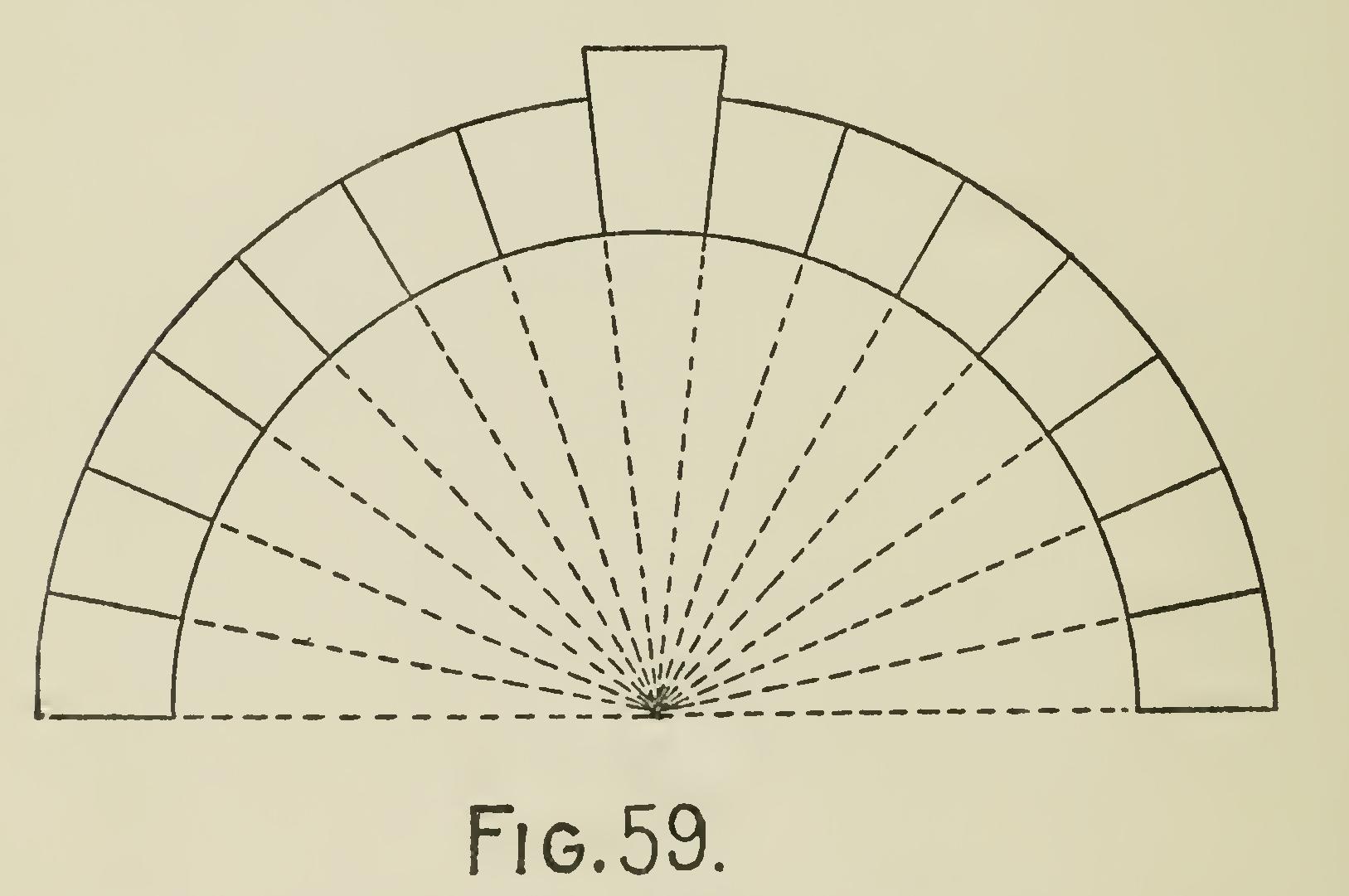
Fig. 59 is the semi=circle arch, and was that principally used by the Romans, who employed it largely in their aqueducts and triumphal arches. The semi-circular and segmental arches are the best as regards stability, and are the simplest to construct.
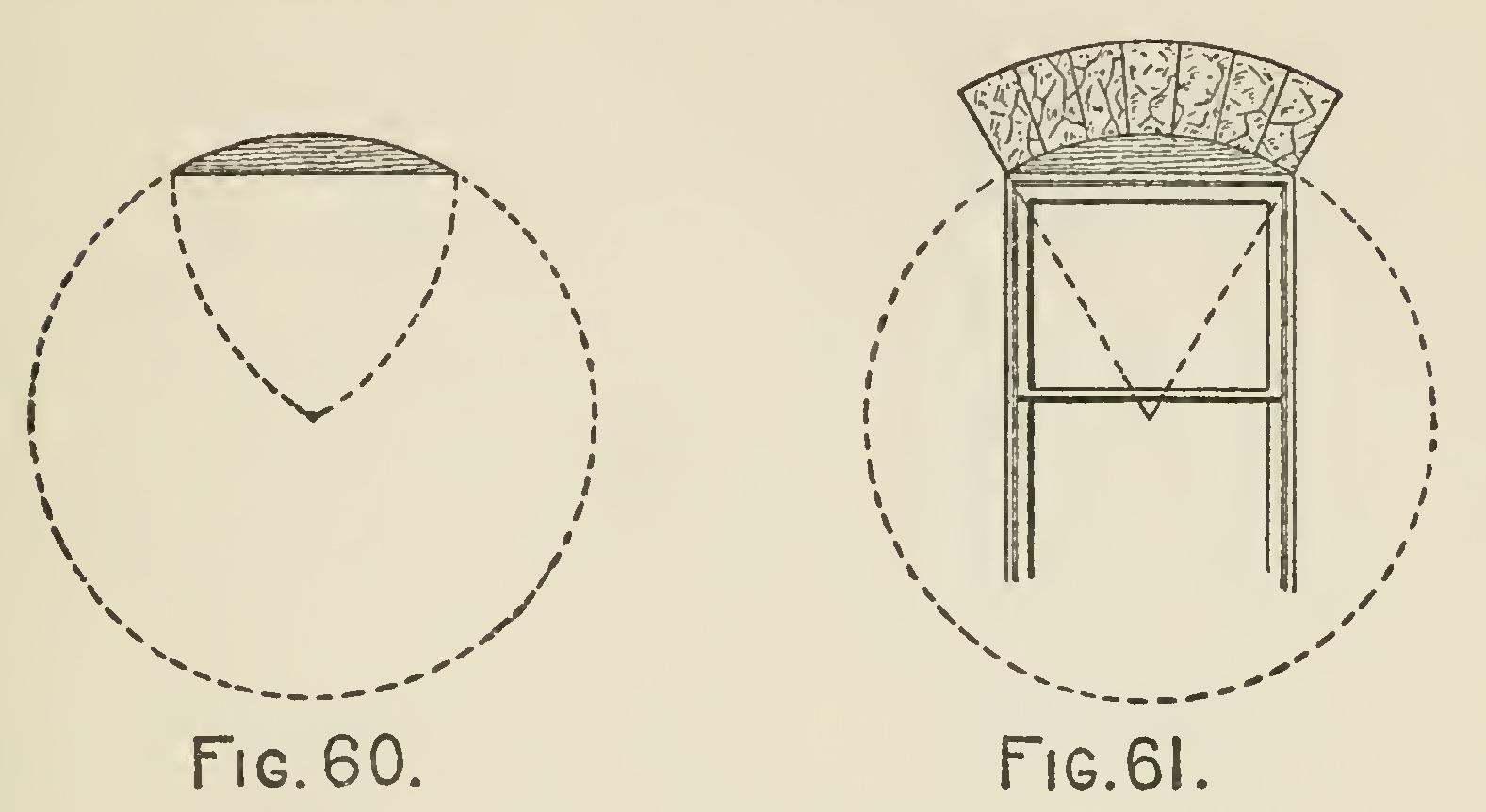
Fig. 60 is a segmental arch, and is extensively used over window heads. A true segmental arch is one-sixth of the circumference of a circle, as shown in the figure.
Fig. 61 is an illustration of a segmental arch shown in connection with a window opening.
The Horse=shoe Arch.—This is almost re stricted to the Arabian or Moorish style of archi tecture. In this form of arch the curve is carried below the line of center or centers, for in some cases the arch is struck from one center, and in others from two, as in Fig. 62.
Now it must be supposed that the real bearing of the arch is at the impost A A; for if this were really so, it must be seen that any weight or pres sure on the crown of the arch would cause it to break at B; but the fact is simply that the real bearings of the arch are at B B, and the prolonga tion of the arch beyond these points is merely a matter of form and has no structural significancy. The Horse-shoe arch belongs especially to the Mo hammedan architecture, from its having origi nated with that faith and from its having been used exclusively by its followers.