How to Roof a Circular Bay
heat, blade, degrees, figures, method, snow and ridge
dius—the larger the better, for the more accu rate will be the final result. Divide this arc into nine equal parts, and these divisions will be five degrees apart, as shown by the figures opposite the divisions. Now, to find the figures on the blade for the degrees wanted, as 40, draw a line from A to 40 on the arc, and the line will pass at 10.06, or practically 10 1-12 inches on the blade, which will represent the figures to use on that member for either 40 or 50 degrees, the blade giving the plumb cut in the former and the tongue in the latter.
Vice versa for the seat cut. The changing point is at 45 degrees, and as 40 is less than 45, the blade gives the plumb cut. On the other hand, 50 being more than 45, the tongue gives the cut.
The reason that 12 and 10 1-12 also gives the cuts for 50 degrees is because 50 is the comple ment degree of 40, or, in other words, the sum of the two equals 90. Thus it will be seen that this diagram is all that is necessary to find any angle on the square.
Suppose we wish to find the figures for degrees. Then divide the space from 20 to 25 into five equal parts, and these will be one degree apart, and by drawing a line from A to 221/2 on the arc, the line will be found to pass practically 5 on the blade.
Having found what figures to use on the blade for any desired degree, the procedure in roof framing is the same as in framing by the proportion of the span or per inch rise to the foot in run of the common rafter.
To Prevent a Ridge from Sagging. A method of construction such as is illustrated in Fig. 67 is at times desirable. It keeps the ridge from sagging, or plates from bulging out on the sides. The board, 1 by 8 inch, nailed on under side of rafter, will prevent roof from sagging. No collar beams are required. The board ex tends. from end of plate at corner of building diagonally to center of ridge.

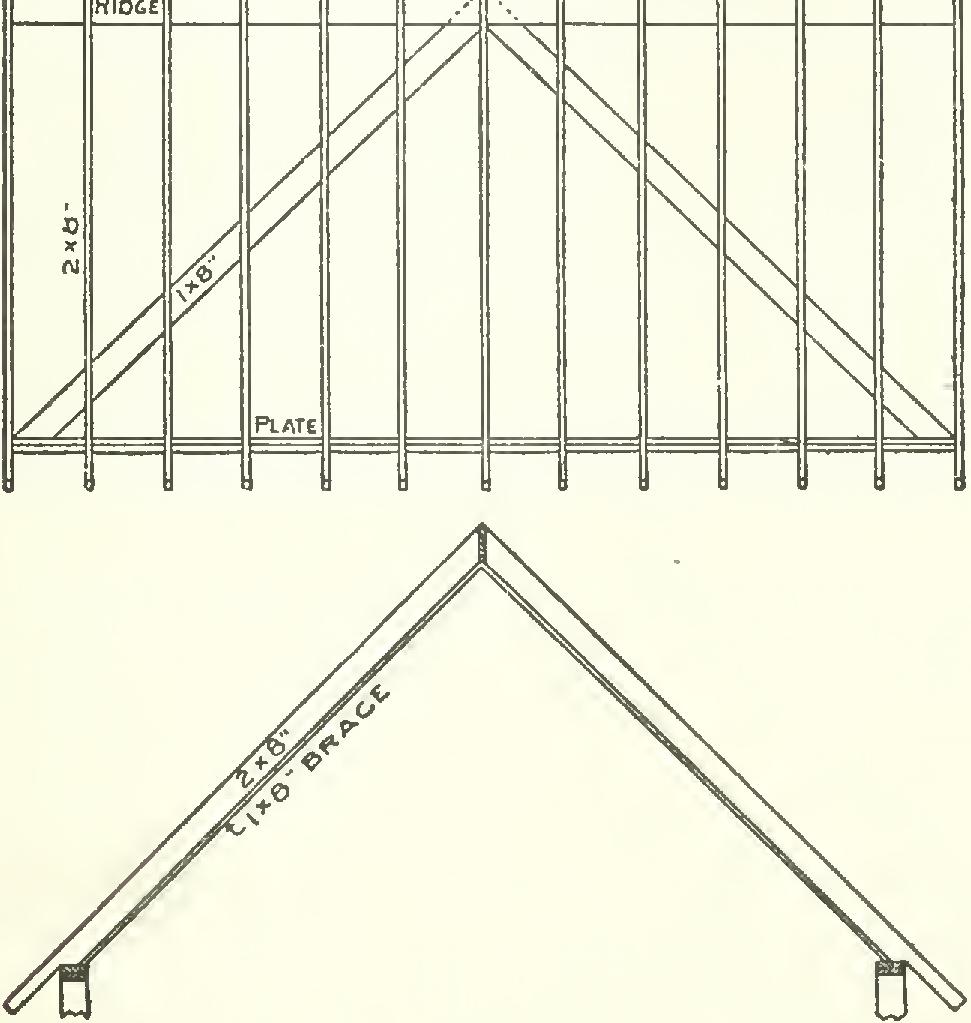
Fig. 67. Good Brace for Ridge.
Roof Construction to Prevent Formation of Ice on Eaves. This is a most important matter in many parts of the country, especially in the North.
Before suggesting a method of construction, it may be well to examine into the causes of this very prevalent trouble, which annoys many a householder winter after winter.
When a body of snow several inches thick lies on a roof, it forms a very effective non-con ductor of heat. The warmth of the attic pene
trates or radiates through the boarding and shingles (wood or metal alike), and cannot pass off into the air, on account of the layer of snow acting as a sort of blanket to retain the heat. In consequence, the under part of the layer of snow is melted slightly, and trickles down until it reaches the eaves. As the eaves overhang the walls, the internal heat of the house does not affect this part of the roof, which is in conse quence quite cold. The water, trickling down the surface of the roof, freezes at once on reach ing this cold zone of roof, and gradually accumu lates a mass of ice ranging from two or three inches to a foot or more in thickness. This serves to back up the water over the warm part of the roof, and hence the leaks which are the worst effects of this condition of things.
It should also be observed that when the snow melts from the outside—that is, from the heat of the sun—no trouble ocean at the eaves, the resulting water running freely down off the roof. Seeing, then, that the cause of the trouble is the radiation, through the roof itself, of the internal heat of the house, the remedy evidently lies in preventing such radiation.
This may be done in two ways, either of which is fairly effective alone; but for first-class work and to insure the very best results it would be well to use both methods in combination.
The first method consists in thoroughly deadening the ceilings of all the upper rooms of the building—that is, to form a dead air space through which the heat of the rooms cannot es cape. It cannot be too widely known by build ers throughout the colder regions of this conti nent, that a lath and plaster ceiling allows a tre mendous lot of heat to escape into the attic of a building; and, if for no other reason than the saving of fuel, this should be prevented. An effective method is to lay rough boarding on fil lets near the upper edge of the ceiling joists, and to cover the same with some composition to ren der it air-proof. Fig. 68 shows the details of this method, which calls for slightly deeper joists to carry the extra weight of the deadening.
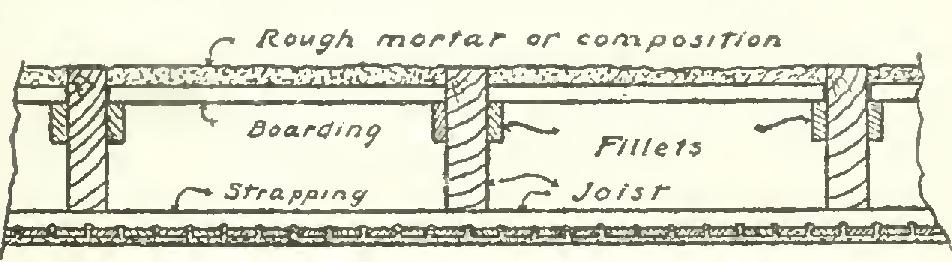
Fig. 68. Ceiling Construction to Prevent Heat Losses.