How to Roof a Circular Bay
deadening, effective and laid
There are, of course, several pugging compo sitions sold for deadening purposes, but an en tirely effective one is a mixture of coarse mill sawdust and plaster of Paris. The sawdust and plaster are mixed together and made into a mor tar with water in the ordinary way, and a coat ing laid on the boarding, about one inch in depth.
Care must be taken that the spaces between the ends of the joists over the wall-plates are prop erly filled, either by lath and plaster or by a piece of board cut tightly in between and nailed in position. This is important, for the effective ness of any dead air space as a non-conductor of heat (or cold) depends upon its being absolutely tight everywhere.
Many buildings, such as churches, halls, and schools, have no attics, but are open to the roof Pig. 69. Roof Construction to Prevent Heat Losses.
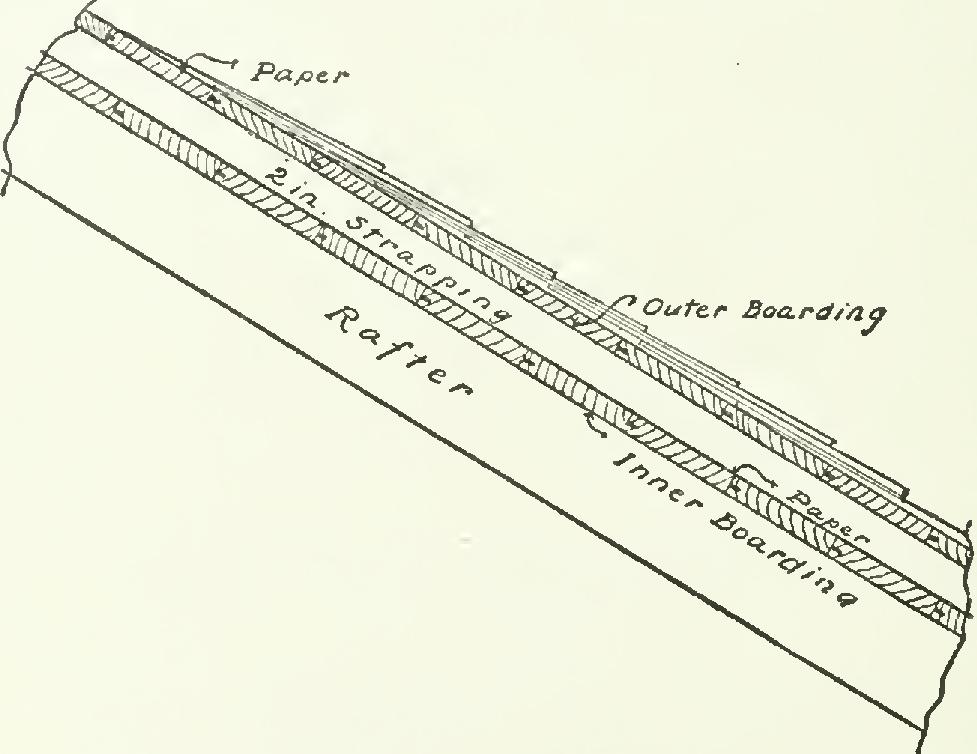
timbers, and obviously the foregoing would not apply in such cases. For the prevention of heat radiation in roofs of this class, a double roof is the only effective remedy. A detail of this is shown in Fig. 69, from which it will be seen that
the sheathing is laid on the rafters in the usual way, and then covered with good building paper.
Two-inch strapping is then applied, and upon this a second layer of sheathing is laid. This is covered with paper and shingles in the regular manner, thus forming a dead air space as de sired. Such an arrangement will also prevent the condensation of moisture upon the inside of the roof, and the consequent annoyance from water dropping, which is so often experienced in churches and halls when well-warmed inside dining zero temperatures out of doors.
As remarked earlier in this discussion, to be absolutely sure of preventing the formation of ice near the eaves, it would be well to adopt both the deadening of the ceilings and the doubling of the roof. It will be found, however, that the thorough deadening of the ceilings will generally be sufficient; and very few architects specify both methods, except in the most expensive structures.