Tile Veneer for Frame Buildings
time, wall, shown, brick, arch, story and mouldings
TILE VENEER FOR FRAME BUILDINGS.
As modern buildings supersede the old-style frame buildings, it often becomes a question how to remodel them. An effort to imitate the new is seldom successful; but if the old buildings are improved in their own way, the results may be very good. Designs of this sort have been lack ing because the new students in art give no attention to the work of the old-timers in their own localities.
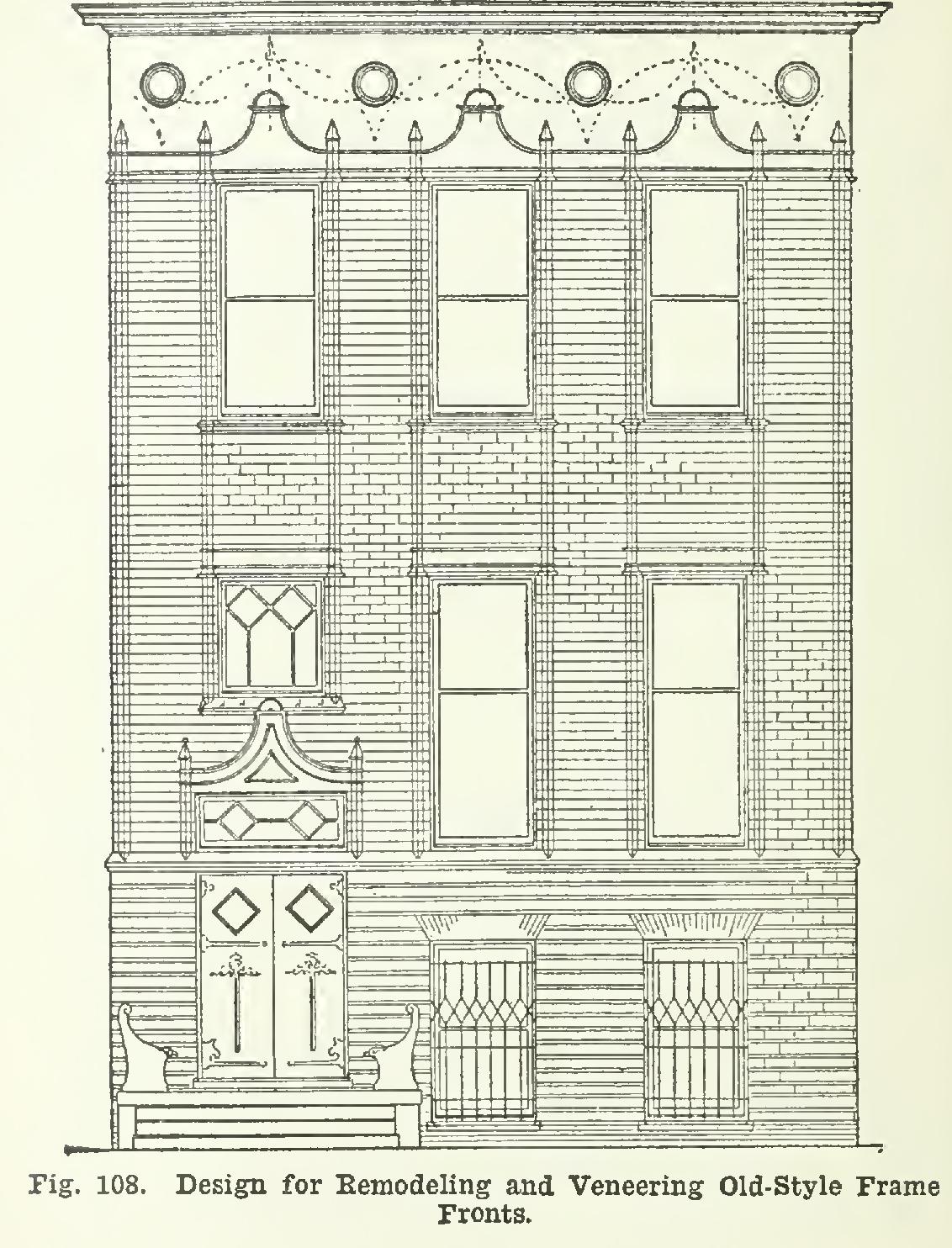
The accompanying design, Fig. 108, was made for a typical front in the old style of car pentry work. The ceilings of the main story were very high. The basement was a full story. An outside flight of steps led to the front door On the second-floor level.
The new entrance was to be brought down to within a few feet of the grade. A half-flight of stairs was to lead from the vestibule down to the dining room, and another half-flight up to the parlor floor.
Heavy mouldings around the windows, of course, had to be removed. It was also neces sary to see that foundations were good, and the walls and jambs plumb.
The design chosen for the remodeling calls for a veneer of glazed or enameled tile. Such a front would lead the fashion for a long time to come. The designer introduced a number of years ago enameled tile on exteriors, since which time it has become very popular. It is durable, always clean and cheerfully light, besides being elegant in appearance. This makes it well worth the expense.
The dimensions of the diagrams are suitable also for Roman brick, flatwise, so that that material can be used with terra-cotta mouldings. These mouldings are so constructed that a thin veneer may be used.
The veneering may also be of cast concrete blocks of the same sizes. It is this choice of materials and adaptability of these same forms to different dimensions, that makes the design economically practical.
The V-shaped vertical members of terra cotta, Fig. 109, stiffen the veneer at the corners and windows. These are anchored to the wall, and overlap the wall covering, holding it in place. This also covers the ragged joint where the tile has to be clipped. This is shown in the section of the first and second story wall.
The basement is in Richardson courses; only, instead of stone, the brick is laid alter nately flat and edgewise. The vacant space is filled with concrete, as shown in the section (Fig. 109).
It is not enough to drive spikes into the wall for anchors. They must hook firmly around the sheathing or another spike at right angles. The window head requires a small angle as shown on the diagram. It must be bolted to the frame work.
The space between the veneer and the siding should be not less than an inch, and well filled with cement mortar.
The frieze can be made of plain veneer, or constructed of cement plaster on wire lath.
A plaster frieze can be modeled with good effect. It should be done offhand while being laid onto the metal lath. The centers and group ing of the pattern should first be indicated as shown on the elevation. Then the carving can be quickly modeled from a sketch. It is not necessary to have all the details correspond exactly if the symmetrical outline is preserved. Fine detail should be avoided.
A tendency to pull down old buildings that are substantial, in order to build up new ones, depreciates the value of building improvements, for it increases the expense in the long run, enormously. Owners hesitate when such a prob ability presents itself in considering new work.
There is the owner's waste of time, incon venience, and, most of all, the neglect of other affairs to be considered. Hence the most desira ble mode of building is one which can be easily kept in repair, and improved from time to time.
Segmental Arches in Brick Walls. The word segment means a portion or part, and a seg mental curve is one whose curve is a part of a circle. In point of fact, any arch struck from one center, and being less than a semicircle, is properly termed "segmental." The most common use of the segmental arch is, perhaps, as a relieving arch over the lintel of an opening for a door or window in a brick wall. In such cases no better proportion can be taken than one-sixth of a circle. There is, however, an important point of construction involved, and one that is often neglected.