Slabs Floors
fig, shown, system, floor, construction and slab
FLOORS, SLABS, AND ROOFS When some one of the materials for rein forcement already described is placed in a con struction in parallel rows, spaced equally and covered with concrete, the result is a reinforced slab. If these rows run only one way, the con struction is called an independent bar reinforce ment. If they cross transversely, the result is a latticed reinforcement. Latticed reinforce ment is well adapted to floor and roof work as the transverse members of the reinforcement prevent shrinkage cracks.
Examples of independent bar construction are shown in the plain I-beam reinforcement illustrated in Fig. 4 (next volume) ; also in many of the bar constructions, such as the Ransome in Fig. 61 or the Kahn in Plate 14.
The latticed construction is shown in the use of plain rods laid transversely in a slab, as in Fig. 82; in the use of wire fabrics consisting of rods connected transversely by lighter rods or wires, as in Fig. 58; or in the use of expanded metal as in Fig. 53. The crossed rods in the floor slabs of the Turner, Barton, and Cowles systems might also come under this heading.
Reinforced concrete floor construction may again be divided into three classes: (1) Those constructions which serve simply as a fill ing between the girders and beams of a floor framework of steel; (2) Those in which the girders and beams are them selves reinforced concrete; (3) Those in which the girders and beams are done away with.
The first class may be divided again into flat slab and arched slab constructions. As examples of the flat slab floor construction, we have the Roebling system (Fig. 75), the Merrick system (Fig. 74), the Vaughan system (Fig. 79), the National system (Fig. 80), the Kahn system (Fig. 96), and numerous other systems based on the use of expanded metal or woven wire fabrics.
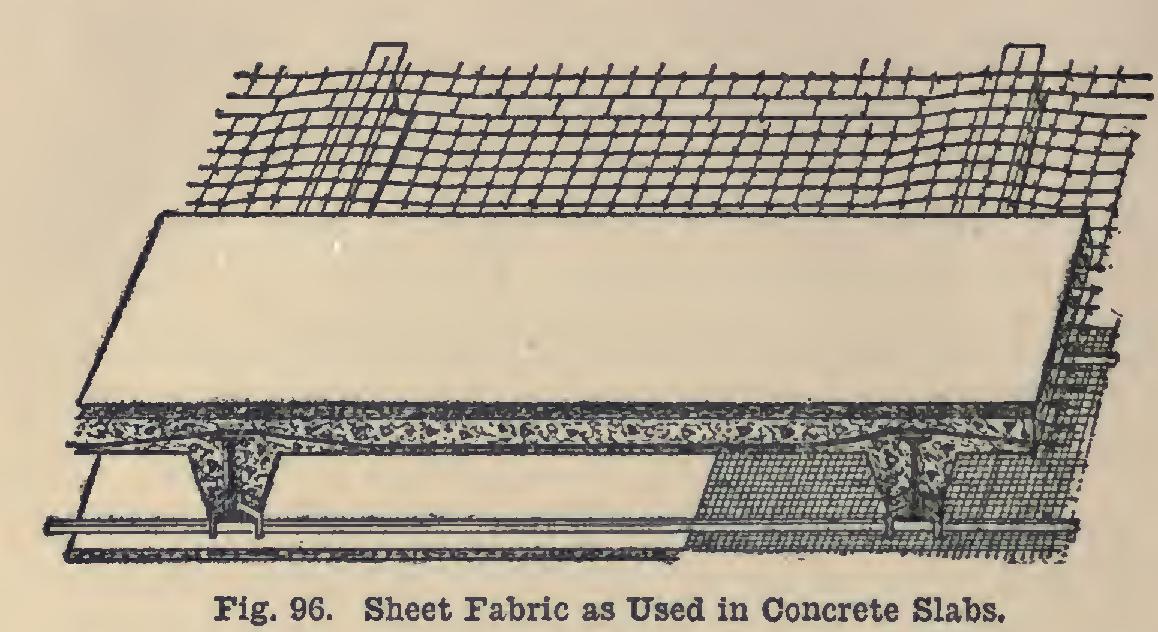
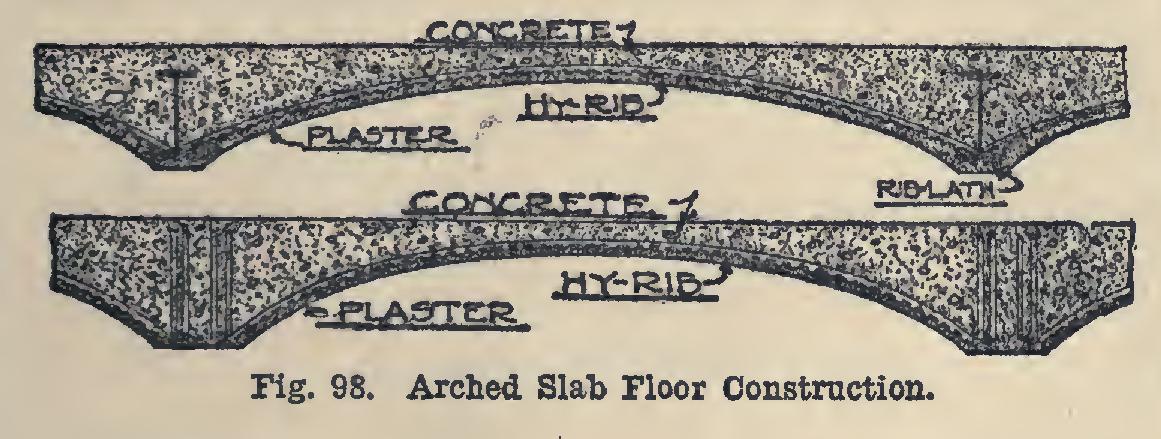
As examples of the arched slab construction, see Fig. 97 and Fig. 98. Both of these figures illustrate the use of a closely meshed reinforcing agent which in many cases proves of great as sistance in constructive work. With a small mesh material, the concrete may be dumped di rectly in upon the previously bent up forms, just enough of the concrete passing through the meshes to provide a rough surface for plastering on the ceiling formed by the under side of the arch. Ends of the bent-up sheets of reinforcing
rest upon the flanges of the I-beams shown, or are fastened to the beam reinforcing rods in case of the construction shown in the lower part of Fig. 98. No centering or forms for the arch are necessary in this construction.
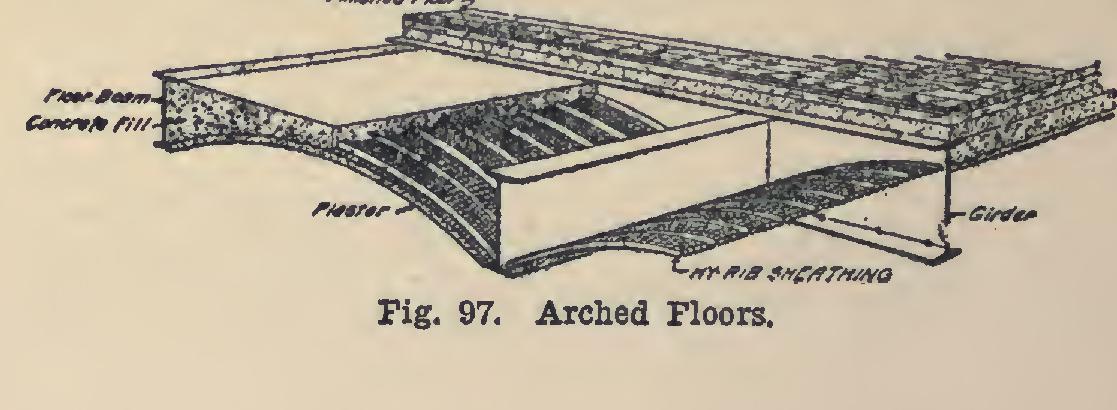
In case a reinforcing agent of such a nature were used that it would not hold the wet con crete mixture in place, forms would have to be employed as in regular floor construction, and the reinforcement placed in them in the usual manner. The arched type of floor is used for carrying heavy loads.
In these structures of the first class, the floor slab either rests on top of the beam or girder, embeds the top flange, or rests upon the bottom flange.
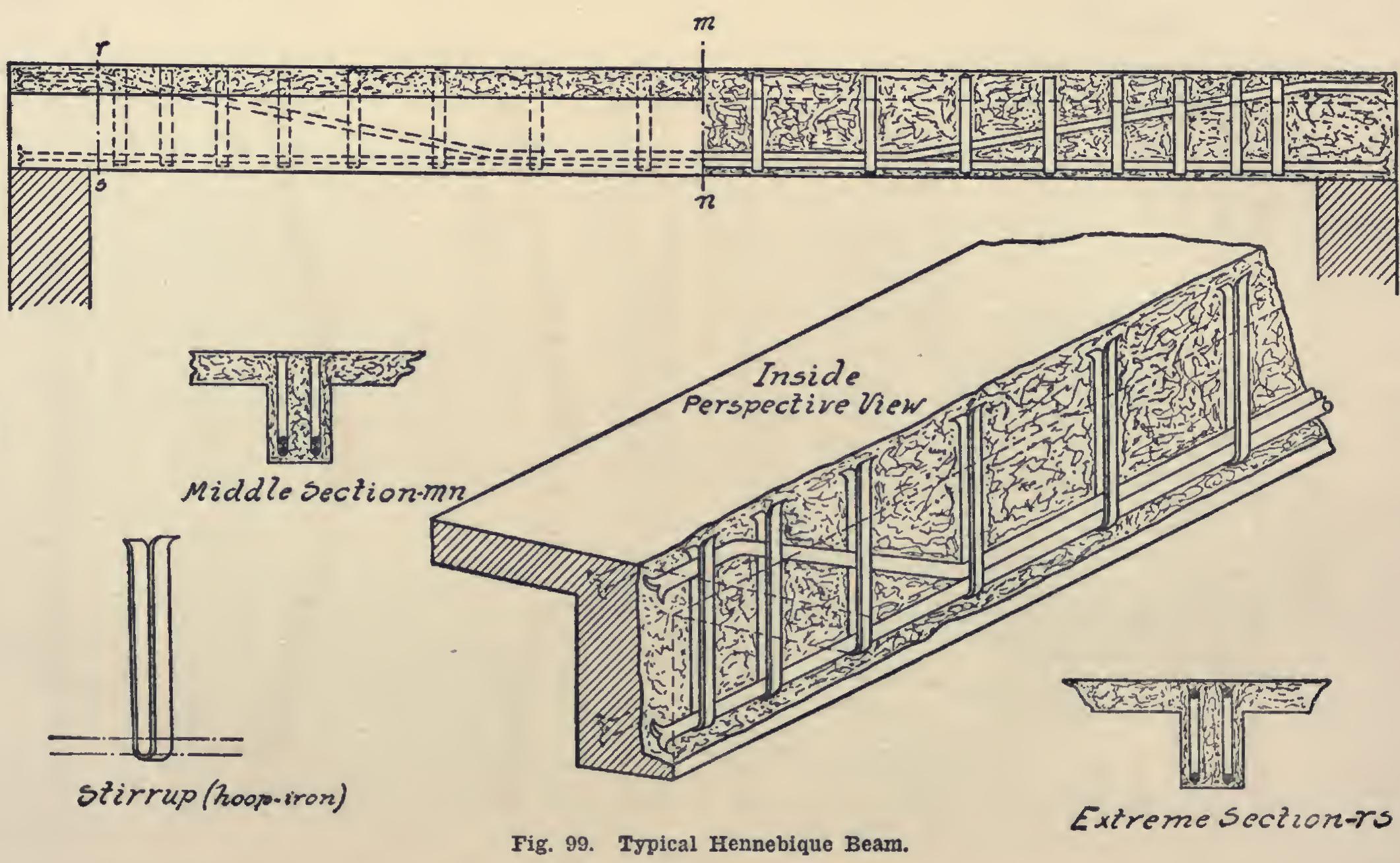
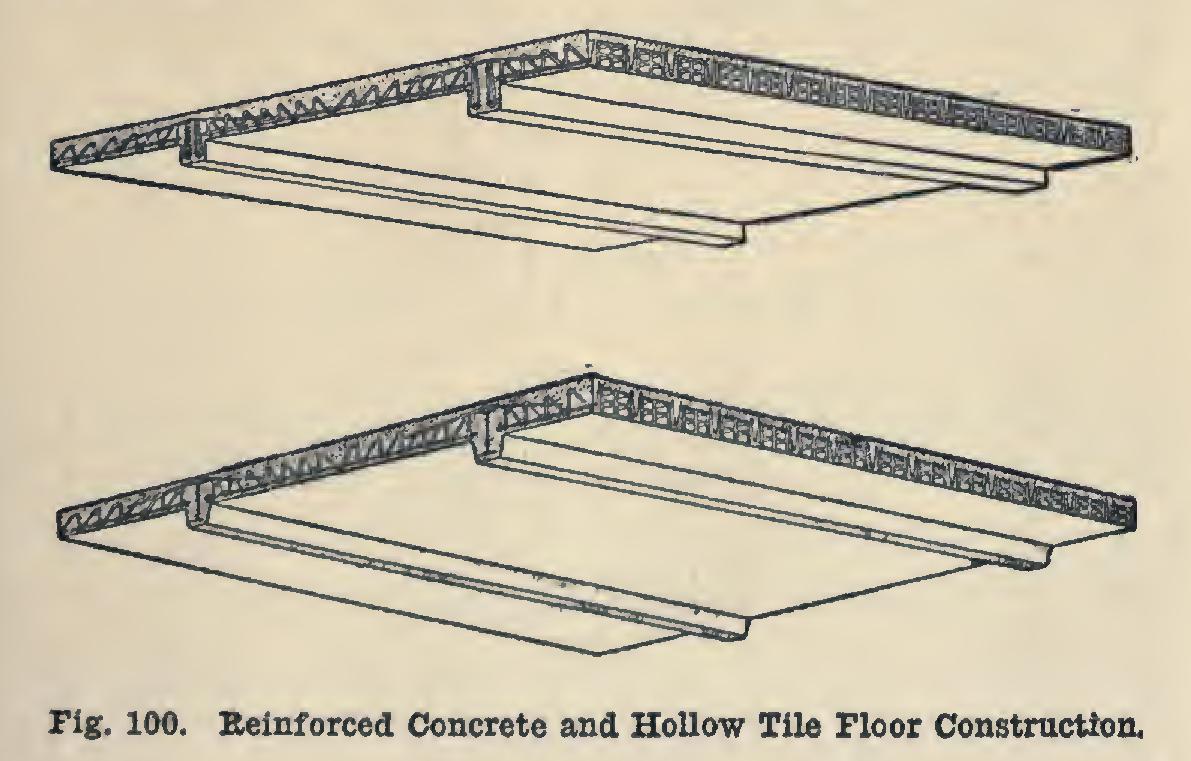
The second class comprises floors of such a construction that the girders and beams really constitute ribs for strengthening the slabs. These are monolithic constructions. As ex amples of this type, we have the Hennebique system shown in Figs. 99 and 99A; the Gabriel system shown in upper part of Fig. 100; the Kahn system shown in Plate 15; the American system shown in Fig. 78; the Unit-girder sys tems, and many others shown in the previous pages.
The third class, comprising those monolithic structures in which the beams and girders do not project, are illustrated by the Turner Mushroom system shown in Plate 16; the Barton Spider web system shown in Plate 17 (general floor layout); the Cowles Umbrella system shown in Figs. 66A and 66B; and the Smith Girderless Floor Construction shown in Fig. 101.
A brief description of the Smith system is as follows : A unit-column consisting of spiral wire column rein forcing; four brackets to each column, also made up of spiral wire ; and a continuous floor fabric made of a size of wire and mesh to take care of the conditions which may arise on each building.