Concrete Arch Bridges
ft, bridge, span, highway, wide, width and abutments
It is interesting to note that in 1885 a design for a reinforced concrete bridge was submitted to the Bridge Commissioners of New York City for the Washington Bridge over the Harlem, by the late Thomas C. Clarke. This bridge was to consist of three 285-ft. arches built of concrete, with a rock face, and reinforced slightly at the haunches and crown with iron beams. Although the design was at first accepted by the Commis sioners, it was afterward rejected on account of its extreme novelty.
One of the earliest, if not the earliest, speci mens of the concrete arch bridge on this side the Atlantic, is on the Ewarton branch of the Jamaica Railway, Jamaica, W. I. This bridge, which is one of three viaducts, all somewhat similar, consists of four full-centered 50-ft. plain concrete arches. It was built in 1881. It is of remarkably good design, even measuring by present-day standards.
The short lapse of time from the 25-ft. span across Pennypack Creek to its 232-ft. span neighbor across the Wissahickon, at Walnut Lane, is indicative of the rapidity with which the art of concrete bridge building has advanced.
Highway Arch Bridges.
Highway arch bridges are usually low and flat, and vary in span length from 20 to 100 feet. The ordinary type consists of an arch-barrel and spandrel walls, with an earth filling between the walls. Ornamental concrete parapets are often used, although ordinary gaspipe railing is very com mon. The width of these bridges ranges from 14 feet for small creek crossings, to 60 feet or over for structures carrying city streets.
Plate 3 (A) illustrates a typical highway arch of 95-foot span.
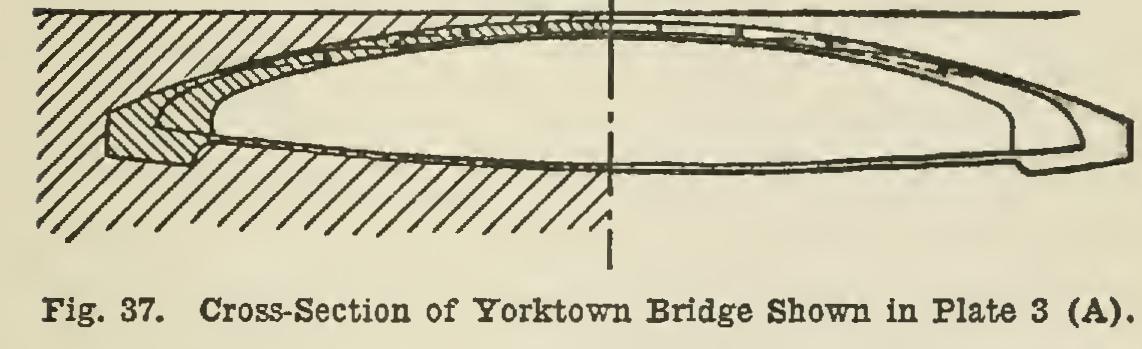
Fig. 37 gives a cross-section of the same arch. This bridge was built in 1904, at Yorktown, In diana. It has a span of 95 ft.; a rise of 11 ft. 1 in.; a height of opening of 15 ft. 7 in., and crown thickness of 26 inches. The roadway is 16 ft. wide. The arch-rods are in. square, spaced 6 inches. The parapets are monolithic concrete, 18 in. by 3 ft. high. The design was made for a 20-ton roller, or 200 pounds per sq. ft.
Another typical arch highway bridge is shown in Plate 3 (B). The rise of the arch is 7 ft. 6 in., and the width 19 ft. 6 in., from outside to outside wall. The arch-ring is only 12 in. thick
at the crown, and 21 in. at the haunches. A moving load of 100 pounds per square foot, plus an 8-ton traction engine, is provided for.
For ordinary highway construction where long spans are required, and where heavy loads such as traction engines and their accompanying machines or where heavy earth-fills will occur, an arch of this type is especially suitable. The construction has all the strength of the masonry arch, with much greater elasticity. In case of settlement of the abutments, the reinforcing steel will take strains that would cause large cracks in ordinary masonry.
In cities and towns where it is necessary to have the streets cross a stream, the reinforced concrete arch not only insures strength and sta bility, but is capable of such varied artistic treat ment that it is being almost universally adopted in municipal work.
The Walnut Lane arch in Fairmount Park, Philadelphia, Pa., is the largest concrete arch in the United States at the present day. It carries a boulevard which will connect the suburbs of Germantown and Roxborough. The contract price was $253,551. See Fig. 38.
The bridge is 585 ft. over all and consists of a main arch of 232 ft. between abutments, approached on one side by two and on the other by three arches of 53-ft. span. The roadway is 40 ft. wide with two 10-ft. side walks. The whole structure is built throughout of con crete, and, except in some walls and columns hereafter mentioned, is not reinforced. It is designed to carry highway traffic.
The main arch, which is a three-centered curve 232 ft. span, at springing line, 70 ft. 3 in. rise, is made up of twin arch-rings each 21 ft. 6 in. wide and 9 ft. 6 in. thick at the haunch, and 18 ft. wide and 5 ft. 6 in. thick at the crown. These twin arches spring from abutments 25 ft. 6 in. wide, founded some 12 ft. below the surface on stepped-footings reaching to solid rock. The main piers or main arch abutments are solid for the width of the bridge or main arch abutments are solid for the width of the bridge to a point immediately above the springing line of the arches, above which point they divide into two parts each of the same width as the arch-rings, and joined to gether at the top by a small counter-arch.