Concrete Bridges
bridge, beam, arch, economical, carry, road and supports
CONCRETE BRIDGES Classification of Bridges in General. A bridge is a structure which furnishes a passage way from one side of an opening or depression to the other side. A bridge may be needed to cross a valley, gulch, stream, canal, road, or rail way track. If the bridge is supported at the two ends only, it is said to be a bridge of one span, and the end supports are called abutments; if the bridge has one or more intermediate supports, it is a bridge of two or more spans, and the inter mediate supports are known as piers. The abut ments and piers compose the substructure; and the remainder of the bridge, the superstructure. The superstructure may be of any one of several forms, and bridges are classified accordingly, as beam bridges, arch bridges, and suspension bridges. The difference in the types is in the manner in which the structures carry the loads that come upon them, and, consequently, in their external form.
Beam bridges are described in the word beam, which signifies a member under a bending stress, having compression in the top, and ten sion in the bottom. Beam bridges are the most generally used, and are particularly adapted for short spans, although the modern steel truss bridge is a beam bridge.
A log laid across a creek was probably the first bridge of any kind, and embodies the essen tials of the beam bridge of to-day.
Arch bridges carry the load in direct com pression throughout the arch ring, and transmit the pressure downward and outward against the abutment. The ancient Romans utilized the arch extensively when they found that the principal building material they had on hand—stone—was not adapted either in its properties or in its form for the construction of beams of any length.
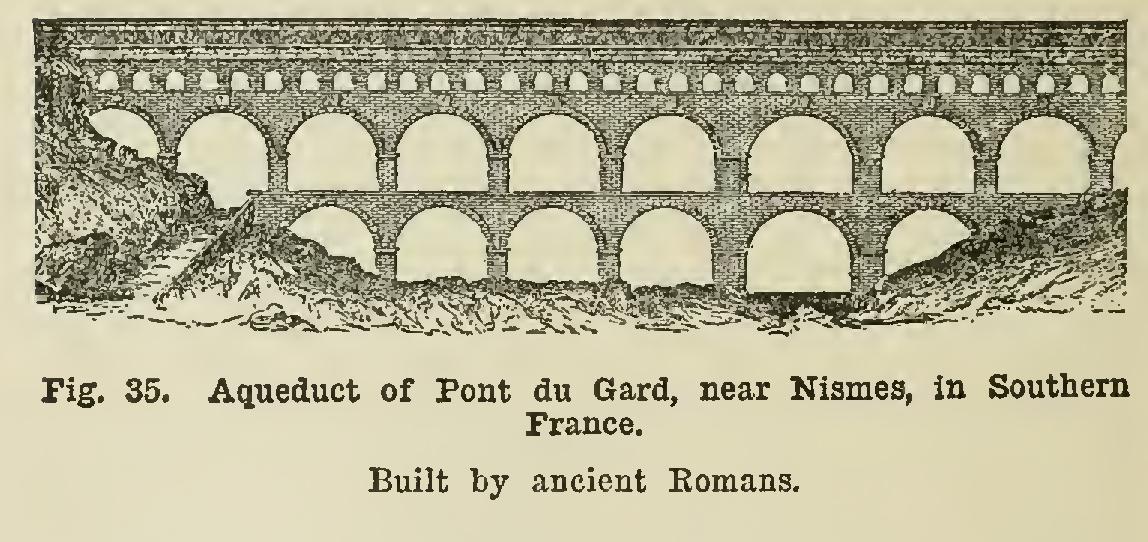
Fig. 35 is an illustration of the Pont du Gard, an arch structure built by the Romans in South ern France in the first century after Christ, showing the wonderful engineering skill of the ancients.
Suspension bridges are designed to support the loads that come upon them, by means of ropes or cables which are either fastened to the banks above the ends of the bridge, or laid over towers and anchored in the ground. This type of bridge has made it possible to span tremen dous distances, but is not very desirable for or dinary lengths.
Bridges are essential to communication and commerce between nations and communities, and have been developed with the advance of civili zation. The greatest strides in bridge construc tion were taken in the days when the steam rail road came into being. A footpath or a wagon road can follow the contour of the ground to a certain extent, but the tracks of a railroad must be reasonably straight and reasonably level; and the streams and valleys which are in tersected must be crossed on structures strong enough to carry the repeated heavy loads. The interurban trolley has followed the steam rail road, and the accompanying improvement of rural districts has created new demands for ade quate bridges. Engineers are ever on the look out for economical materials and methods for bridge construction, and their latest find has been reinforced concrete, which has already re placed stone and wood and has opened up new fields for the bridge-builder.
Advantages of Concrete and Reinforced Con crete for Bridge Construction. In order to ap preciate the advantages of concrete as a material for bridges, it is necessary to understand the re quirements for a good bridge and for an econom ical bridge. These requirements depend to a large extent on the purpose of the structure; and in the articles which follow, concerning the :various classes of bridge structures, the ad vantages of concrete in connection with the re quirements of each particular class will be brought out in detail.
It may be said in general, however, that a "good" bridge must have sufficient strength and stability to carry its loading, and must be de signed to fulfil the conditions imposed by its lo cation. An economical bridge is a "good" bridge of the lowest first cost, combined with durability and permanence sufficient to keep the expense of maintenance and renewal as low as possible. From these statements it follows that a bridge may serve its purpose excellently, and still not be economical; also, that a bridge may have a low first cost, and not be economical.