Key to Steel Square
common, lengths, cuts, hip, rafter, run and cut
KEY TO STEEL SQUARE In connection with the steel square and its application to different shapes and types of structures—various-angled as well as square cornered—several important labor-saving de vices have been evolved through the ingenuity and skill of American inventors. One of the most valuable of these devices is a "key" show ing directly how to apply the steel square in a great multitude of ways.
The subject of and the part they play in Carpentry and Joinery has been overlooked by woodworkers in general. Every carpenter should understand the divisions of the circle called degrees, and the relation they have to the steel square. When this is understood, it is just as easy to frame a roof for any kind of angled building, giving all of the cuts and bevels, as it is for the square-cornered building. The same rule applies to all, without the aid of any other instrument than the common steel square. How to apply the steel square is well explained in the little device recently placed on the market and known as the "Key to the Steel Square," by A. W. Woods, of which the following pages are a brief description.
The above title is the name to a new framing device, which has found much favor among carpenters and builders throughout the country. It is of celluloid, three inches in diame ter, on either side of which is pivoted at the center a disk, one side giving the lengths and cuts for the common rafter, having a rise from 1 to 24 inches to the foot, also the corresponding lengths, cuts, and bevels for the octagon hip or valley, and for the hip or valley resting on the right angled corner, while on the other side is given the seat and plumb cuts for rafters and braces having a rise from 1 degree to 90 degrees. It also gives the length of sides and miter cuts for all regular polygons, or the framing of timbers at any degree, and shows how to apply the steel square to obtain the cuts.
The Rafter Table.
Fig. 114 illustrates the side containing the rafter table; it is divided into twenty-four sections, radiating to a common center. These sections represent from 1 to 24 inches rise to the foot in run. The first figuresrepresent the rise, and the three following sets of decimal numbers represent the lengths in inches of the common rafter, octagonal hip and the common hip or valley rafter respectively. The heavy-faced fractional numbers designate the pitch or proportion of the rise of the roof to a foot run, while just beneath the fractional numbers is gi-cen the same value in decimal fractions to the one-hundredth part of an inch. The latter is placed here for convenience in finding the near equivalent in common fractions for the decimal part of an inch.
The Revolving Disk
contains the title and abbreviated instructions. By turning the disk until the slot rests opposite the pitch desired, only the lengths and cuts for that pitch will be exposed, thereby preventing errors.
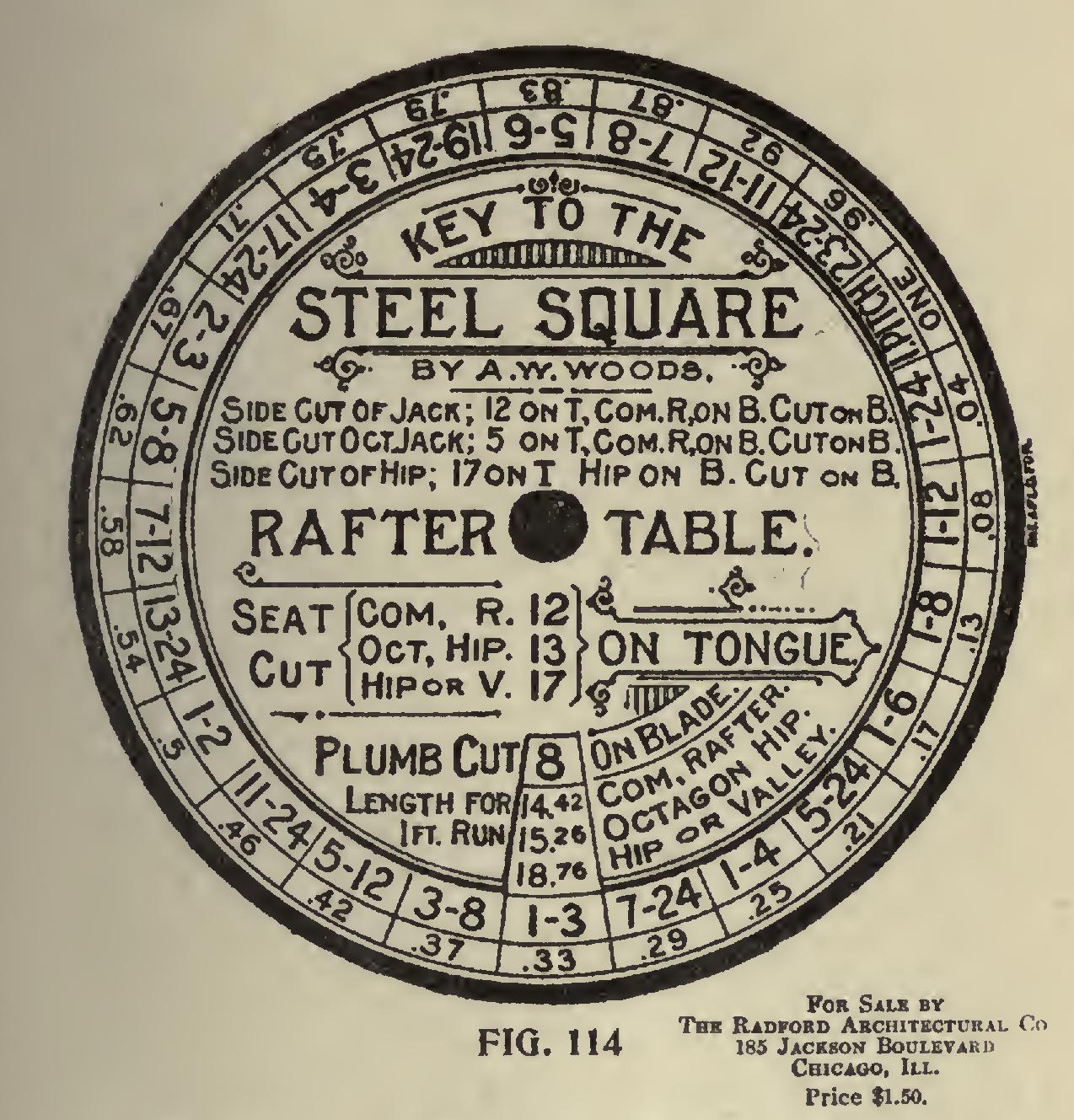
Example: To Find the Lengths and Cuts For the One=Third Pitch.—Operation. Turn the disk until the slot is opposite one-third and you have, as shown in Fig. 114: 12 on the tongue and 8 on the blade. The tongue will give the seat cut and the blade the plumb cut for the common rafter.
For the Corresponding Octagon Hip and the Common Hip or Valley substitute 13 and 17 on the tongue respectively, the tongue always giving the seat cut and the blade the plumb cut. The lengths of the rafters for a one-foot run are found to be 14.42, 15.26, and 18.79 for the common rafter, octagon hip and common hip or valley, respectively. Having the lengths given for one foot in run, it is an easy matter to find the lengths of the rafters for any run in either feet or inches by multiplying the lengths here given by the number of feet or fractions of a foot in the run, and point off as many places in the product as there are decimal figures used in the solution, and reduce to feet and inches. Fraction al figures may be avoided in the run by dropping them and finding the length only for the num ber of feet, and then from the plumb cut measure square out the amount of the fraction, which will give the point for the proper plumb cut.