Hot-Water Heating
system, fig, fitting, drop, supply and radiators
The reason why the connections are made in the manner shown by the various illustrations, is that hot water in circulation has a tendency to flow quickly to the top of the system, and, by taking risers to upper floors from the side of the riser which feeds them, there is a tendency some what to choke or impede the flow to upper floors, this arrangement thereby helping all radiators on the system to circulate evenly throughout.

A special fitting for use on risers, to distrib ute to each floor its proper share of the circula tion, is known as the 0. S. distributing fitting, illustrated in Fig. 47. The curved baffle-plate shown in the center of the fitting effectively divides the flow without friction. The manner of applying this fitting for use on risers is indi cated in Fig. 48, and the neat appearance it affords will readily be noted.
Overhead System. The overhead system of hot-water heating is, in many respects, not un like the overhead system of steam heating. The water is carried to the attic of the building, usually through a single pipe. The top of this main riser is the high point of the system; and from the fitting on this extreme end, the con nection to the expansion tank is made. As the different pipes pitch upward to this point, all air in the system is here collected, whence it passes to the atmosphere through the expansion tank vent. By reason of this action, no air valves are necessary on the radiators or on any other part of the system.
Fig. 49 will give a very clear idea of the adaptation of the system. At or from the top of the main riser, the various attic mains are connected. These pitch down from the main riser, being run in the most convenient manner to supply the various drop pipes, which in turn feed the radiators on the several floors. Refer ence to the illustration will show several meth ods of connecting the radiators to the drop sup ply pipes. The one taken directly from the drop supply to the top of the radiator is the method most fiequently used. By the usage of this top
radiator connection, the cooler water at the bot tom of the radiator is returned into the drop supply pipe.
It is customary to carry the basement return pipes along the ceiling, connecting them together into the main return pipes in much the same manner as the supply branches of a one-pipe steam job are connected, with the exception that the hot-water return branches are connected into the side of the main returns.
If the radiators are required in the basement, it is necessary with this system, that the returns he carried back to the heater along the basement floor.
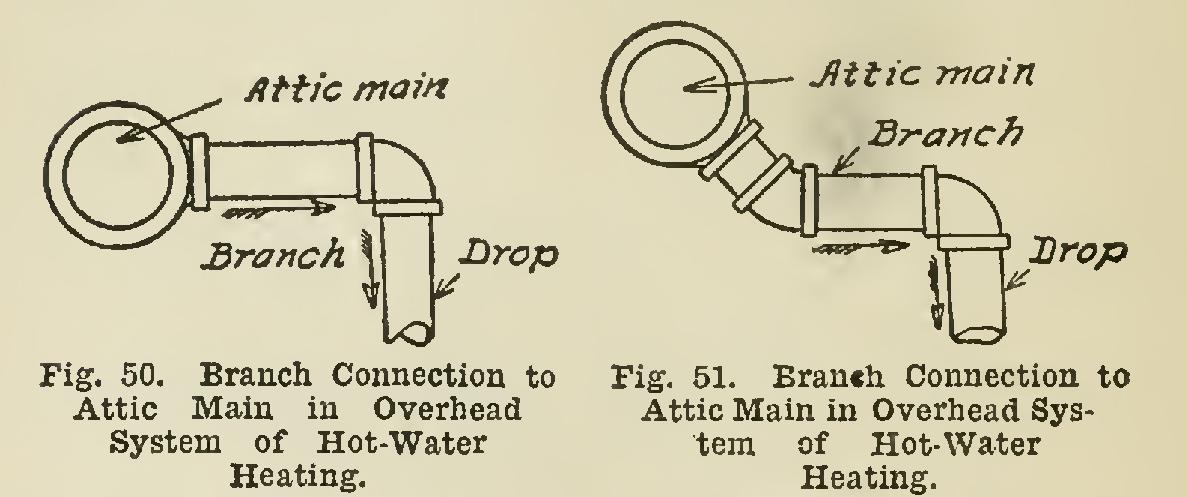
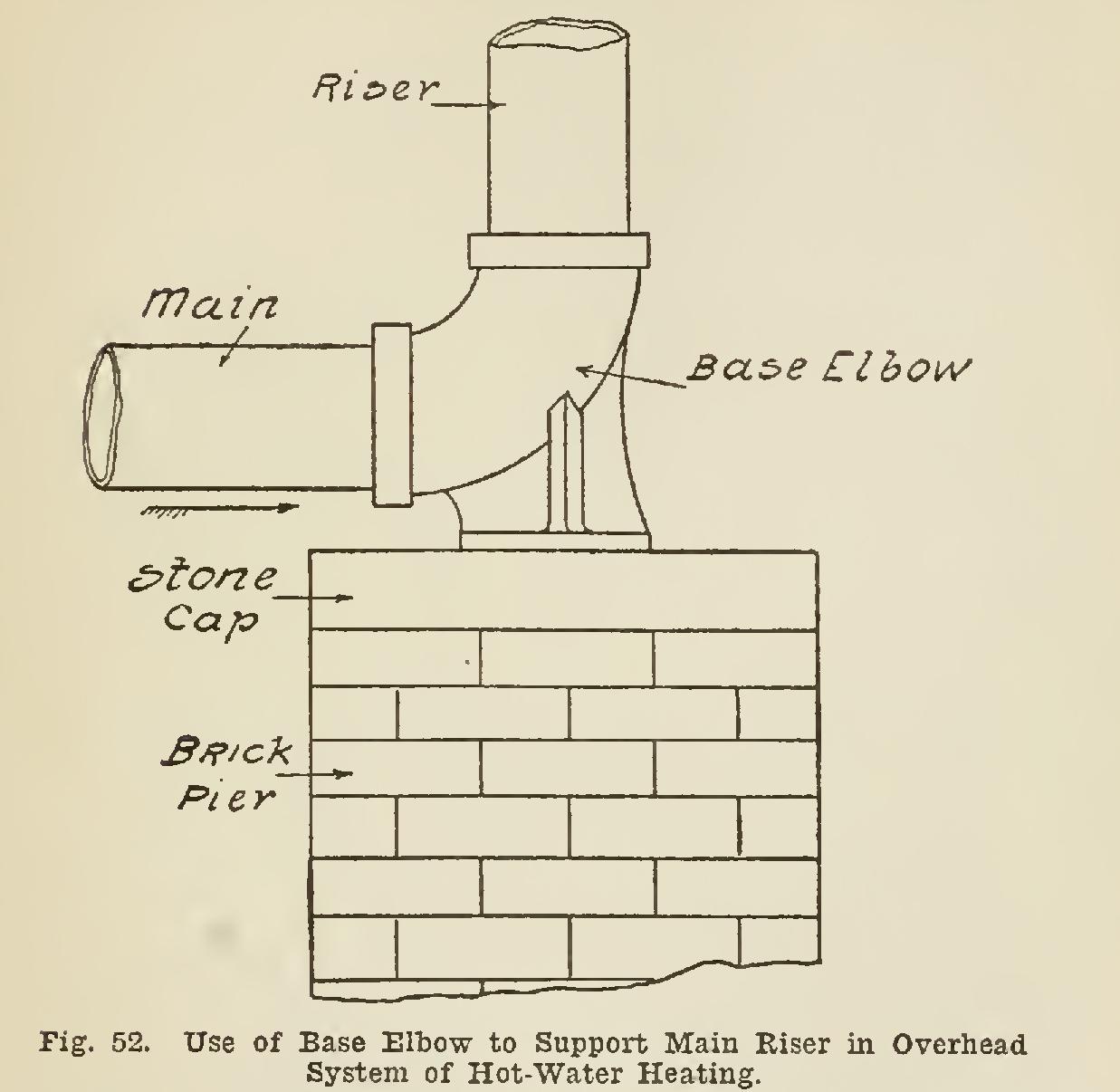
The branches in the attic are taken from the side of the main as indicated in Fig. 50, or from the bottom of the main at an angle of 45 degrees as shown in Fig. 51, inasmuch as connections made in this manner prevent the formation of air pockets in the piping. The main riser should be supported either on a brick or stone pier or on a substantial wall in the basement, in order to prevent the sagging likely to be caused from the excessive weight it carries. A special elbow called a base elbow should be applied at the bot tom in the manner illustrated in Fig. 52.
To insure a neat-appearing job and at the same time afford the desired flexibility to the risers, the radiators should be connected with swing joints. With connections of this nature, the drop supply may be run close to the wall or partition, and nipples of such length used in the tees as will bring the centers of the elbows on a line with the centers of the openings in the radi ators. A plan and elevation of this type of connection are shown respectively in Figs. 53 and 54.

The employment of the "0. S." fittings (de scribed above) on the drop supply, in place of ordinary tees, will materially lessen the friction and divide the circulation to better advantage. The upper fitting in each instance is reversed, as indicated in Fig. 55.