China
people, chinese, country, vast, sometimes and understand
CHINA. "If you could dig a hole deep enough to go right through the earth and come out on the opposite side, you would come out in China." This is what they told us when we were very young, and it's true enough of the physical world. But as we grow older we find that it's true in another way.
For if you could dig deep enough into the mind of man to come out on the other side, if you could think every thought in almost exactly the opposite way from the way you think now, you would probably "come out in China." A book in China begins at the top of the last column on the last page and goes backward till it ends with the first column on the first page. A dinner begins with fruit and sweets and ends with soup and rice. Men in China wear skirts and women wear trousers.
White is the color for mourning, and brides dress in scarlet. And so it goes.
You will never under stand why the Chinese think the way they do, and they will never un derstand why you think as you do. A Chinese and an American can feel the same things; they can both be hungry or happy or ill or in love. But they will never understand each other's thoughts. This is the first thing to remember about China. We can learn certain things about China, but we can never really understand it.
The country itself we can understand of course.
It is a vast country on the east coast of Asia, and it it physically not unlike the United States. In the north the winters are very cold and the summers very hot. The differences are not so marked in the south, where the climate is tropical. A great river, the Yangtze, almost as great as the Mississippi, runs through it, and its fertile basin forms the whole of central China. Western China consists of sparsely populated highlands, and eastern China of lowlands densely populated. Nearly the whole country is sur rounded by mountains.
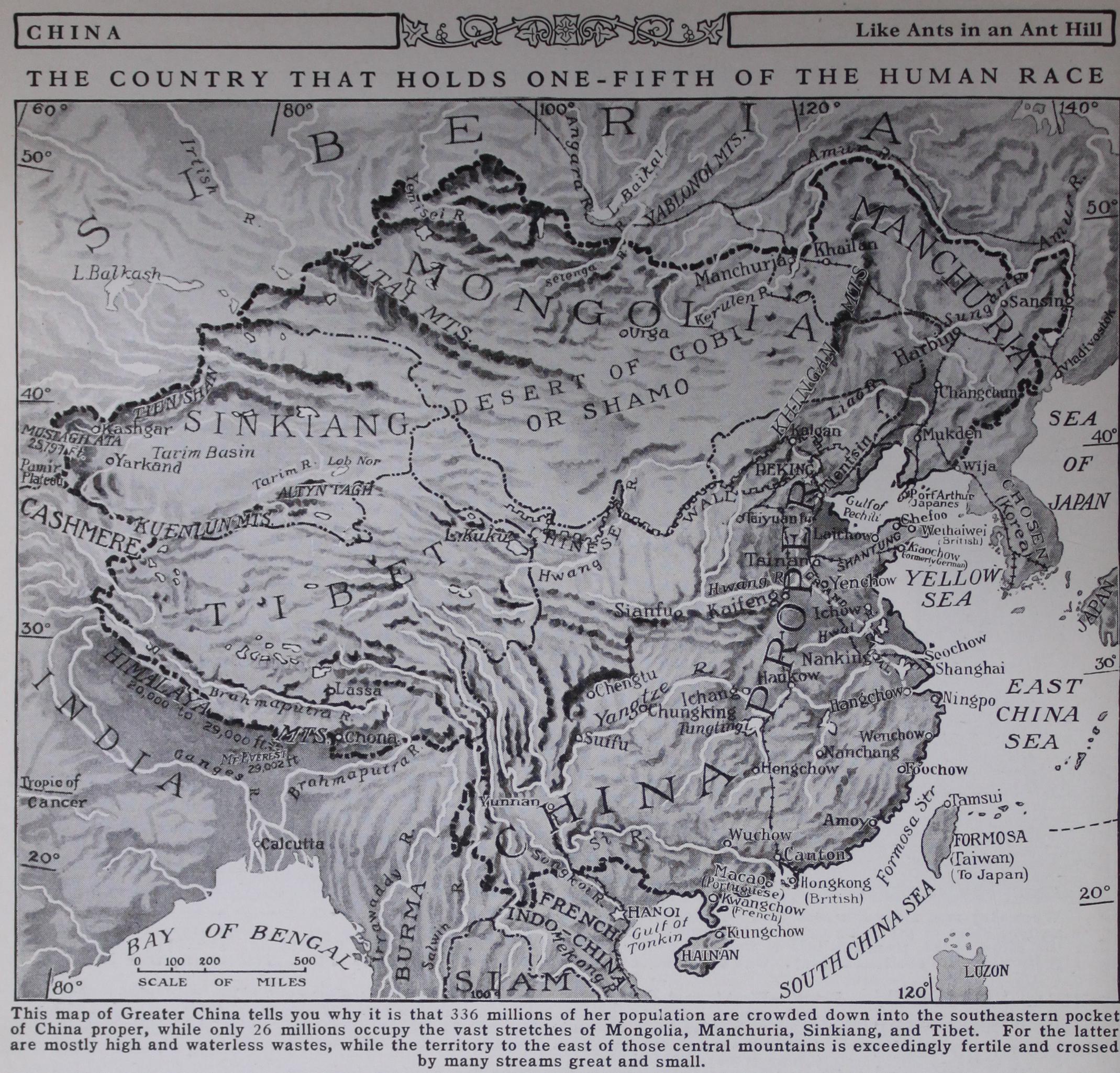
China as a whole in cludes China proper, with its teeming human life and historical importance; Manchuria, which is largely under Japanese control since the Russo-Japanese War of 1904-05; Mongolia and Chinese Turkestan (Sinkiang) in the northwest, with their vast sandy deserts of Gobi and Taklamakan; and the mighty plateau and mountain mass of Tibet, a geographi cal and political borderland between China and British India.
In this vast country, a third again as large as the United States—huddled to gether like ants in an ant hill, live more than one fifth of the human beings in the world—about 362, 000,000 people. It has been estimated that for every square mile of the earth's surface there are about 30 people. But in China prop er, even in the highlands, every square mile has more than 100 people; in the lowlands every mile has 300 to 400, while Shantung has over 500. This means crowded poverty.
Fuel is very scarce, since nearly all the trees in China were cut down centuries ago and the vast coal deposits are almost unworked. As a result the houses are not heated in winter and the people must wear many coats one on top of another. Thus Chinese will speak of a "three-coat cold day." The poor peo ple dress in cotton, usually blue, and the upper classes in silk. The people belong to the Mongolian race. Their skins are of a bronze or yellow color — sometimes almost white, sometimes yellow, and sometimes, especially in the south, al most brown. Their hair is jet black, stiff, and al ways straight. The men have very little hair on their bodies and can sel dom raise a beard, though when they can it is consid ered very honorable. It is also fashionable to let the fingernails grow very long.
Sometimes they protect these nails with a sort of case not unlike a pencil case.
For centuries the upper class Chinese bound the feet of their little girls so tightly, from the time they were five or six years old, that their feet ceased to grow and the toes curled under and the bones were distorted. As a result, many upper-class women walk on mere stumps of feet and are practically helpless. Some of them cannot walk at all. This custom seemed barba rous to Europeans and the more modern Chi nese, and an "Anti-Foot Binding League" was formed which has made progress since 1900 in stopping the practice.