The Spermatozoon
spermatozoa and filament
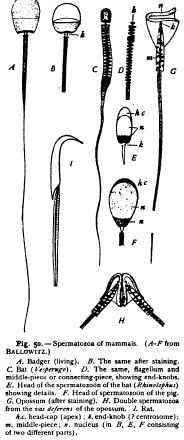
Internally, the middle-piece consists of an axial filament and an envelope, both of which are continuous with those of the flagellum. In some cases the envelope shows a distinctly spiral structure, like that of the tail-envelope ; but this is not always visible. The most interesting part of the middle-piece is the "end-knob" in which the axial filament terminates, at the base of the nucleus. In some cases this appears to be single. More commonly it consists of two minute bodies lying side by side (Fig. 5o, B, D). This body is the only structure in the middle-piece having the appearance of a centrosome; and Hermann conjectures that this is probably its real nature.
The flagellum or tail is merely a locomotor organ which plays no part in fertilization. It is, however, the most complex part of the spermatozoon, and shows a very great diversity in structure. Its most characteristic feature is the axial filament, which, as Ballowitz has shown, is composed of a large number of parallel fibrillae, like a muscle-fibre. This is surrounded by a cytoplasmic envelope, which sometimes shows a striated or spiral structure, and in which, or in connection with which, may be developed secondary or accessory filaments and other structures. At the tip the axial filament may lose its envelope and thus give rise to the so-called " end-piece " (Retzius). In Triton, for example (Fig. 48, F), the envelope of the axial filament (" principal filament ") gives attachment to a remarkable fin-like membrane, having a frilled or undulating free margin along which is developed a " marginal filament." Towards the tip of the tail, the fin, and finally the entire envelope, disappears, leaving only the axial filament to form the end-piece. After maceration the envelope shows a conspicuous cross-striation, which perhaps indicates a spiral structure such as occurs in the mammals. The marginal filament, on the other hand, breaks up into numerous parallel fibrillae, while the axial filament remains unaltered (Ballowitz).
A fin-membrane has also been observed in some insects and fishes, and has been asserted to occur in mammals (man included). Later observers have, however, failed to find the fin in mammals, and their observations indicate that the axial filament is merely surrounded by an envelope which sometimes shows traces of the same spiral arrangement as that which is so conspicuous in the connecting-piece. In the skate the tail has two filaments, both composed of parallel fibrilla, connected by a membrane and spirally twisted about each other ; a somewhat similar structure occurs in the toad. In some beetles there is a fin-membrane attached to a stiff axial "supporting fibre" (Fig. 49,
A). The membrane itself is here composed of four parallel fibres which differ entirely from the supporting fibre in staining capacity and in the fact that each of them may be further resolved into a large number of more elementary fibrillae.
Many interesting details have necessarily been passed over in the foregoing account. One of these is the occurrence, in some birds, amphibia (frog), and mollusks, of two kinds of spermatozoa in the same animal. In the birds and amphibia the spermatozoa are of two sizes, hut of the same form, the larger being known as "giant spermatozoa" (Fig. 49, G, H). In the gasteropod Paludina the two kinds differ entirely in structure, the smaller form being of the usual type and not unlike those of birds, while the larger, or vermiform," spermatozoa have a worm-like shape and hear a tuft of cilia at one end, somewhat like the spermatozoids of plants (Fig. 49, 7. K) In this case only the smaller spermatozoa are functional (von Brunn).
No less remarkable is the conjugation of spermatozoa in pairs (Fig. 5o, H), which takes place in the vas deferens in the opossum (Selenka) and in some insects (Ballowitz, Auerbach). Ballowitz's researches ('95) on the double spermatozoa of beetles (Dytiscida) prove that the union is not primary, but is the result of an actual conjugation of previously separate spermatozoa. Not merely two, but three or more spermatozoa may thus unite to form a " spermatozeugma." which swims like a single spermatozoon. Whether the spermatozoa of such a group separate before fertilization is unknown ; but Ballowitz has found the groups, after copulation, in the female receptaculum, and he believes that they may enter the egg in this form. The physiological meaning of the process is unknown.