Physiological Relations of Nucleus and Cytoplasm
germ-cells and effect
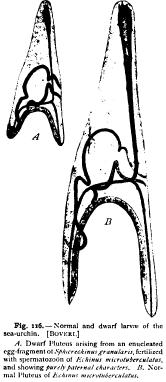
Boveri ('89, 1) has attempted to test this conclusion by a most ingenious and beautiful experiment ; and although his conclusions do not rest on absolutely certain ground, they at least open the way to a decisive test. The Hertwig brothers showed that the eggs of sea-urchins might be enucleated by shaking, and that spermatozoa would enter the enucleated fragments and cause them to segment. Boveri proved that such fragments would even give rise to dwarf larvae, indistinguishable from the normal in general appearance and differing from the latter only in size and in the very significant fact that their nuclei contain only half the normal number of chromosomes. Now, by fertilizing enucleated egg-fragments of one species (Spherechinus gmnularis) with the spermatozoa of another (Echinus microtuherculatus), Boveri obtained in a few instances dwarf Plutei showing purely paternal characteristics (Fig. 116). From this he concluded that the maternal cytoplasm has no determining effect on the offspring, but supplies only the material in which the spermnucleus operates. Inheritance is, therefore, effected by the nucleus Boveri's result is unfortunately not quite conclusive, as has been pointed out by Seeliger and Morgan, yet his extensive experiments establish, I think, a strong presumption in its favour. Should they be positively confirmed, they would furnish a practical demonstration of inheritance through the nucleus.