Wilderness
corps, house, grant, warren and cavalry
The situation about 9 A.M. on the 8th was therefore curious.
'The Union losses in the battle were 18,000, the Confederates at least ii,soo.
consequence of a mistaken order that the trains which he was protecting were to move forward to Piney Branch church.
Warren, facing east, and opposed by part of Anderson's corps, was seeking to fight his way to Spottsylvania Court house by the Brock road. Wilson facing south, was holding the Court house and driving Fitz Lee's cavalry partly westward on to the backs of the infantry opposing Warren, partly towards Block House bridge, whence the rest of Anderson's infantry was approaching. All the troops were weary and hungry, and Sheridan ordered Wilson to evacuate the Court house and to fall back over the Ny. Warren fruitlessly attacked the Confederate infantry at Spindler's, Robin son being severely wounded and his division disorganized. The other divisions came up by degrees, and another attack was made about i i. It was pressed close up to, and in some places over, the Confederate log-works, but it ended in failure like the first. A third attempt in the evening dwindled down to a reconnaissance in force. Anderson was no longer isolated. Early's division observed Hancock's corps at Todd's tavern, but the rest of Ewell's and all Hill's corps went to Spottsylvania and prolonged Anderson's line northward towards the Ny. Thus the re-grouping of the Union army for manoeuvre, and even the running fight or strategic pur suit imagined by Grant when he found Anderson at Spottsylvania, were given up, and on the 9th both armies rested. On this day Sedgwick was killed by a long-range shot from a Confederate rifle. His place was taken by H. G. Wright. On this day also a violent quarrel between Meade and Sheridan led to the departure of the cavalry corps on an independent mission. This was the so-called Richmond raid, in which Sheridan defeated Stuart at Yellow tav ern (where Stuart was killed) and captured the outworks of Rich mond, but, having started with empty forage wagons', had then to make his way down the Chickahominy to the nearest supply depots of the Army of the James, leaving the Confederate cavalry free to rally and rejoin Lee.
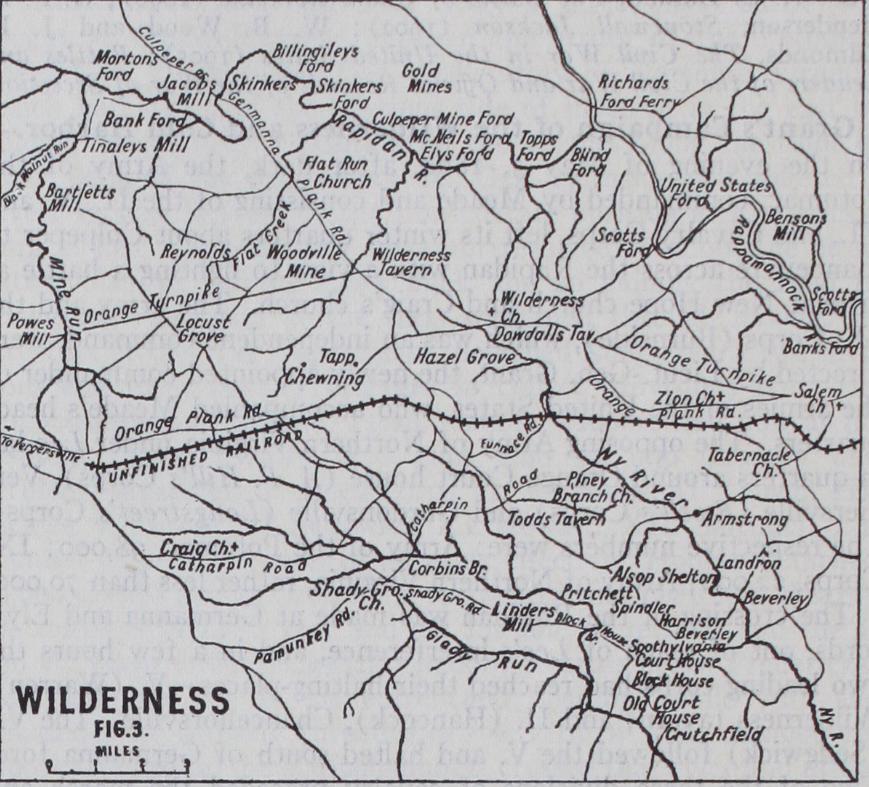
Finding the enemy thus gathered in his front, Grant decided to fight again on the loth. While Hancock opposed Early, and War ren and Wright faced Hill and Anderson, Burnside was ordered by Grant to work his way to the Fredericksburg-Spottsylvania road, thence to attack the enemy's right rear. The first stage of this movement of the IX. Corps was to be made on the 9th, but not the attack itself, and Burnside was consequently ordered not to go beyond a placed called "Gate" on the maps used by the Union staff. This, it turned out, was not the farm of a person called Gate, as headquarters supposed, but a mere gate into a field. Con sequently it was missed, and the IX. Corps went on to Gale's or Gayle's house, where the enemy's skirmishers were driven in'.
to the circumstances of his departure, the angry army staff told him to move out at once with the forage that he had, and Sheridan, though the army reserve supplies were at hand, made no attempt to fill up from them.
further source of confusion, for the historian at least, is that on the survey maps made in 1867 this "Gayle" is called "Beverly." The news of an enemy opposing Burnside at "Gate," which Grant still supposed to be the position of the IX. Corps, at once radically altered the plan of battle. Lee was presumed to be moving north towards Fredericksburg, and Grant saw an opportunity of a great and decisive success. The IX. Corps was ordered to hold its posi tion at all cos..s, and the others were to follow up the enemy as he concentrated upon Burnside. Hancock was called in from Todd's tavern, sent down to force the fords on the Po at and below Tin der's mill, and directed upon Block House bridge by an officer of Grant's own staff, while Warren and Wright were held ready. But once more a handful of cavalry in the woods delayed the effective deployment of the moving wing, and by the time that the II. Corps was collected opposite Block House bridge it was already night. Still there was, apparently, no diminution of force opposite Burn side, and Hancock was ordered to resume his advance at early dawn on the loth.