Kentucky
college, school, schools, public, normal, tax, system, education and university
The municipalities are divided into six classes according to pop ulation, a classification which permits much special local legisla tion in spite of the constitutional inhibition.
Population.
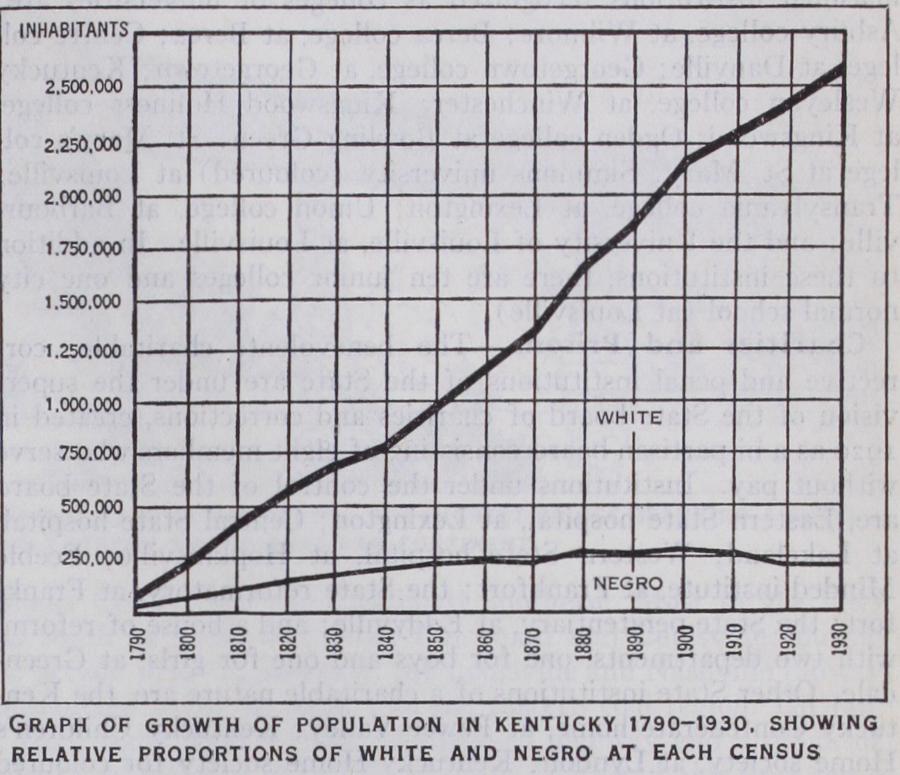
The population of the State in 1930 was 2,614,589. The cities with over io,000 inhabitants were as follows: Finance.—In 1926 the budget system created in 1918 was repealed and a new system created. Under this system the budget commission consists of the governor, the auditor of public ac counts and the State tax commissioners ; the budget officer is the State inspector and examiner. The act also provided for a uniform budget system in each county. The revenue of the State is clas sified under a number of separate funds. The treasurer's report for the fiscal year ending June 30, 1935, showed the receipts of the various funds to amount to $43,421,68o, and the disbursements for the year to be $42,544,606. The three funds showing the great est disbursements were $21,310,122 from the general expendi ture fund; $12,156,244 from the State road fund; $5,095,818 for industrial recovery. The chief sources of revenue were: Real estate, $531,708; gross receipts tax, $9,044,458; tax on whiskey $2,103,096; and a license tax on foreign and local corporations, $884,214. On June 30, 1935, the end of the tax year, there were of outstanding treasury warrants, and the cash on hand amounted to $4,641,694. Banks chartered by the State are subject to inspection and regulation by the State banking de partment, which consists of a commissioner, an assistant com missioner and six examiners.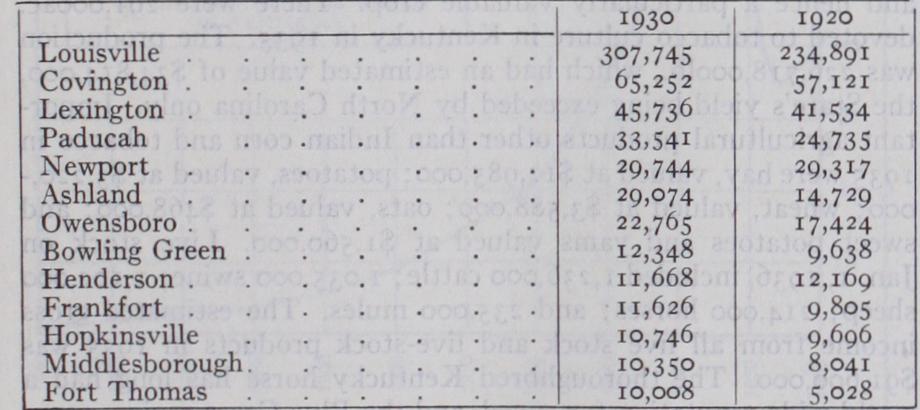
Education.
Public education in Kentucky is under the gen eral supervision of the State board of education, which is com posed of the superintendent of public instruction, the secretary of State and the attorney-general. Until within the present century, public education was supported almost wholly from the State school fund, which was distributed on a per capita basis, and as a result the terms were short and the teachers underpaid. This situ ation was changed in part by an act of the general assembly in 1908 which provided that each county of the State be a unit for taxation, that the county tax be mandatory and that there be a local sub-district tax. According to the report of the State super intendent of public instruction for the year ending June 30, 1935, the total revenue from all sources accruing to the State school system was $23,931,053. Of this sum came from county sources, and $11,783,515 came from other sources. The total disbursements for the year 1934-35 amounted to $23,085,053, representing an outlay of $27.94 per capita of enrolment and $6.07 per capita of total population. The U.S. bureau of education re ported the population between the ages of five and 17 years, inclu sive, in as 763,90o. Of this number 609,684, or 79.8%,were enrolled in the public schools ; of these 518,793 were in the kindergarten and elementary schools. In 1934, 90,891 were in the secondary schools. In 1934 there were 39,903 children attending private and parochial schools. Foi the school year 1934-35 there were reported 759 accredited public high schools and 89 private high schools and academies. Some idea of Kentucky's educa tional progress can be gained from a comparison of figures for 1920 with those for 1930. In this period, illiteracy decreased from 8.4% to 6.6%; the average days attended per year per pupil en rolled increased from 78.7 in 1920 to 121.4 in 1930; the per capita expenditure, based on total public school enrolment increased from $11.56 in 1920 to $38.98 in 1930. School attendance is com pulsory. Separate schools are maintained for white and coloured throughout the educational system. A text-book commission, cre ated by an act of the general assembly in 1926, selects and adopts schoolbooks for the entire State and fixes a maximum retail price.
What was formerly the State Agricultural and Mechanical col lege at Lexington became the State university by legislative enact ment (1908) and University of Kentucky (1917) ; there is no tuition fee except in the college of law. The University has also colleges of liberal arts, education and commerce. The agricultural experiment station and the agricultural extension work are asso ciated with the university. The training of white teachers is pro vided for in four normal schools and teachers' colleges, eastern Kentucky State Normal school and Teachers college, at Rich mond; western Kentucky State Normal school and Teachers col lege, at Bowling Green ; Murray State Normal school, at Murray; and Morehead State Normal school, at Morehead. The State provides advanced education for the coloured at the Kentucky Normal and Industrial institute, at Frankfort, and the Western Kentucky Industrial college, at Paducah. The private and denom inational institutions recognized as colleges or universities are : Asbury college, at Wilmore ; Berea college, at Berea ; Centre col lege, at Danville ; Georgetown college, at Georgetown ; Kentucky Wesleyan college, at Winchester; Kingswood Holiness college, at Kingswood; Ogden college at Bowling Green ; St. Mary's col lege at St. Mary; Simmons university (coloured) at Louisville; Transylvania college, at Lexington ; Union college, at Barbour ville; and the University of Louisville, at Louisville. In addition to these institutions, there are ten junior colleges and one city normal school (at Louisville).