Kentucky
ohio, louisville, river, coal, region, products, value, country, french and principal
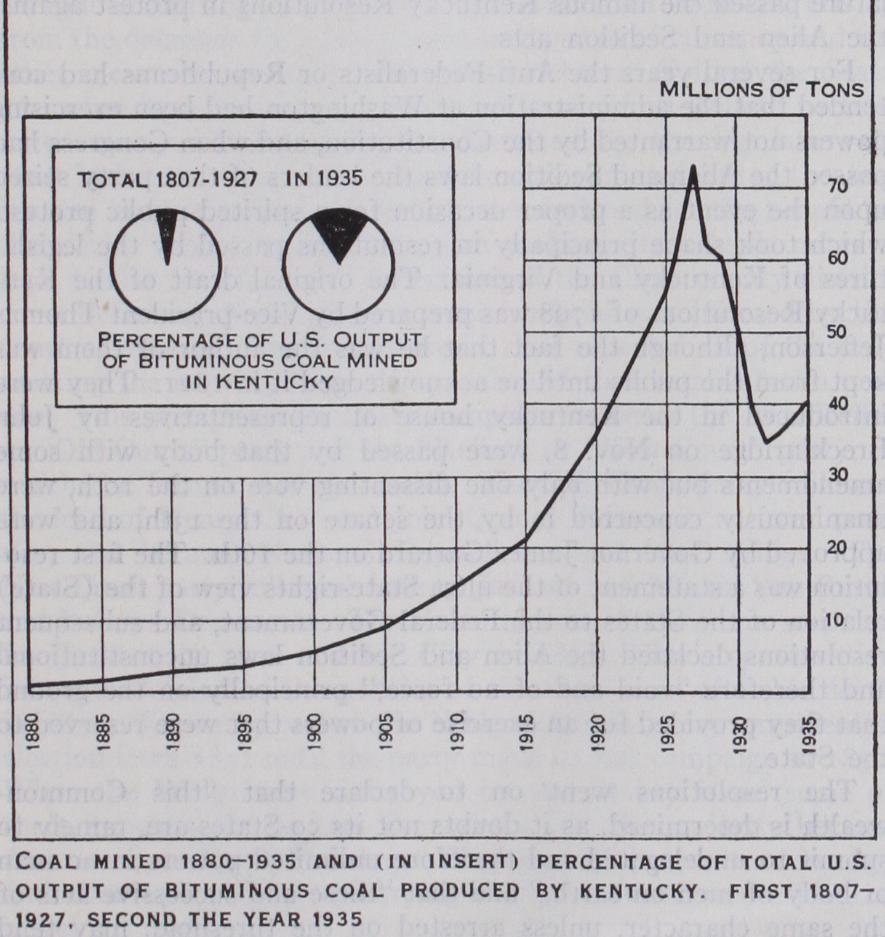
Kentucky ranked eighth among the States of the Union in the value of mineral products in 1934, producing 2.92% of the total value for the United States. The State in 1934 ranked first in the production of fluor-spar, fourth in native asphalt, and fourth in coal. The principal products in the order of their value were coal, natural gas, petroleum, and clay products. The total mineral pro duction in 1934 was valued at $89,042,117; in 1929 the value was $132,650,000. Coal mining was the principal industry, giving employment to about 90% of the persons engaged in mineral pro duction. Bituminous coal output in 1934 was 38,525,235 short tons. The coal producing areas include about 8,000 sq.m. in 22 eastern and south-eastern counties, which are part of the Middle Appalachian coal-field, and approximately 5,000 sq.m. in 10 counties in the western part of the State. Approximately 75% of the production was from the eastern district. The industry second in importance was the production of petroleum and natural gas. The most productive pool, Big Sinking, was opened in Lee county ; another field appeared in the south-western counties, centring about Allen and Warren ; and in 1926 still another in Daviess county. In many locations the drillers opened gas wells which have reduced the State's dependence on West Virginia's supply ; and Mt. Sterling, Winchester, Paris, Lexington, Frankfort and Louisville obtained natural gas. The principal oil refinery is at Louisville. From 1909 to 1919 the value of the products of mines, quarries and wells rose from $12,000,000 to $75,000,000 or 625%; by 1929 the value of the products had risen to $102, 500,000, or 137% over that of 1919.
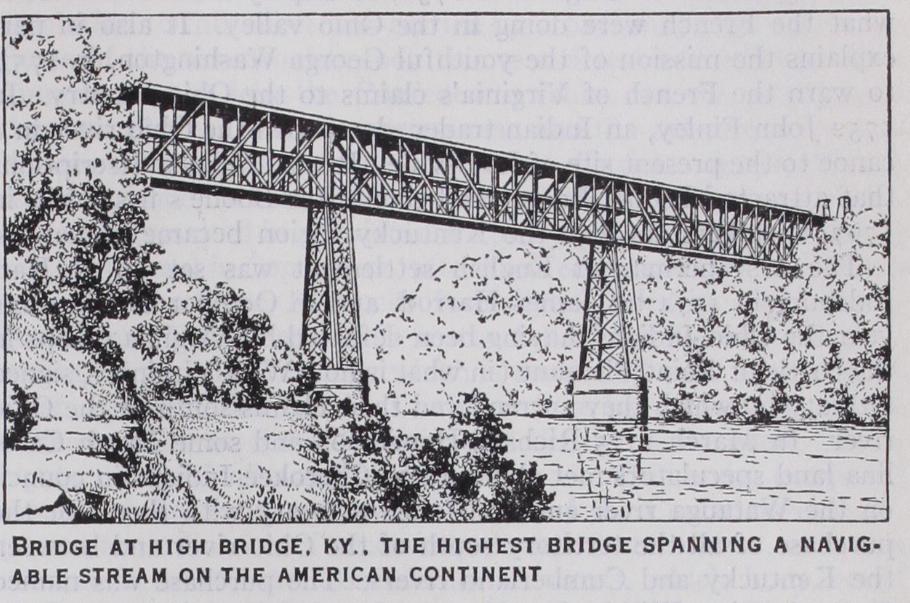
The transportation system of Kentucky may be said to date from the marking of a trail through the Cumberland Gap by Dan iel Boone in 1775. This trail, later widened and called the Wilder ness road, and the Ohio river served as the chief highways of the early settlers. In the early part of the i 9th century, the streams and turnpikes were relied upon, and then came the first railway, begun in 1830 and put in operation in 1835. Up to 188o the rail way mileage had increased to only 1,530, but after this date it increased rapidly. In 1936 there were 3,743m. of steam railway in operation, a slight decrease from the 192os. The principal lines are the Louisville and Nashville, the Chesapeake and Ohio, the Illinois Central and the Cincinnati Southern. Most of the lines run south or south-west from Cincinnati and Louisville ; during the decade 1910-20, however, the Louisville and Nashville railway constructed 332m. of track into the eastern coal region. On Jan. I, 1935, there were 6,77om. of surfaced highway and 7,538m. of unsurfaced highway in the State. River boats and pipe lines serve as the chief transport for petroleum products. Hydro-electric plants distribute electricity from Dix river and the falls of the Ohio (Louisville).
Early Days.
The history of Kentucky has features not shared with other States west of the Allegheny mountains. To the Indians it was known as the "Dark and Bloody ground" because of the incessant wars between the Iroquois and the Cherokees for its possession. Each of these savage nations laid claim to thisfamous hunting territory, and each used every known art of savage warfare to make good its claim. So deadly were these struggles that the first explorers spoke of Kentucky as a beautiful country devoid of inhabitants, with the exception of some Shawnees dwell ing along the Ohio and a few Chicksaws living along the Missis sippi. Kentucky early attracted the attention of both the French and the English ; it was the first region settled in the westward movement and the first State west of the Allegheny mountains admitted into the Union. The first white men to sight the terri tory were in search of a water passage to the western waters, or the Pacific ocean. It was while on such a quest that La Salle (q.v.), in 1669, passed down the Ohio until he came to the falls where the city of Louisville now stands. The next white men to come into the region were Thomas Batts with a party in 1671, acting under the authority of the Tory governor of Virginia, Sir William Berke ley. They too were in search of the river that would lead to the Pacific. For more than half a century after these first adventurers, nothing is heard of Kentucky. It is possible, however, that casual French explorers or English settlers carried away by the Indians traversed the region in the meanwhile. It is almost certain that a Frenchman named Longueril discovered Big Bone Lick in 1739. The next evidence of French interest came in 1749, when Celoron de Bienville, with a following of soldiers and Indians, was sent into the Ohio valley to take formal possession of the country ; as evi dence that he had done this, he buried lead plates. At this time Virginians were showing renewed interest in the country beyond the mountains, and as a result two land companies were organized and bought up vast tracts of western land. Dr. Thomas Walker (1715-94), as an agent and surveyor of the Loyal Land company, passed through the Cumberland gap in March 1750 and followed down the Cumberland river in search of a suitable place for settle ment, buN, he did not get beyond the mountain region. In Oct. i75o Christopher Gist, on a similar mission for the Ohio company, set out from the banks of the Potomac and followed an Indian trail which led from Wills creek to the Ohio. In the following spring he explored the country westward from the mouth of the Scioto river. This interest in Kentucky land caused Robert Dinwiddie, one of the stockholders of the Ohio company, when made lieu tenant-governor of Virginia in 1752, to display a keen interest in what the French were doing in the Ohio valley. It also in part explains the mission of the youthful George Washington, in 1753, to warn the French of Virginia's claims to the Ohio country. In 1752 John Finley, an Indian trader, descended the Ohio river in a canoe to the present site of Louisville. It was Finley's descriptions that attracted Daniel Boone, and soon after Boone's first visit, in 1767, travellers through the Kentucky region became numerous.