Kentucky
products, value, valued, decreased, tobacco, region, hospital, estimated and industry
Charities and Prisons.
The benevolent, charitable, cor rective and penal institutions of the State are under the super vision of the State board of charities and corrections, created in 1920 as a bi-partisan board consisting of eight members who serve without pay. Institutions under the control of the State board are, Eastern State hospital, at Lexington ; Central State hospital, at Lakeland; Western State hospital, at Hopkinsville; Feeble Minded institute, at Frankfort ; the State reformatory, at Frank fort ; the State penitentiary, at Eddyville; and a house of reform, with two departments, one for boys and one for girls, at Green dale. Other State institutions of a charitable nature are, the Ken tucky Confederate home, at Pewee Valley ; Kentucky Children's Home society, at Lyndon ; Kentucky Home society for coloured children, at Louisville ; a school for the deaf, at Danville ; and a school for the blind, at Louisville.
Industry, Trade and Transportation.
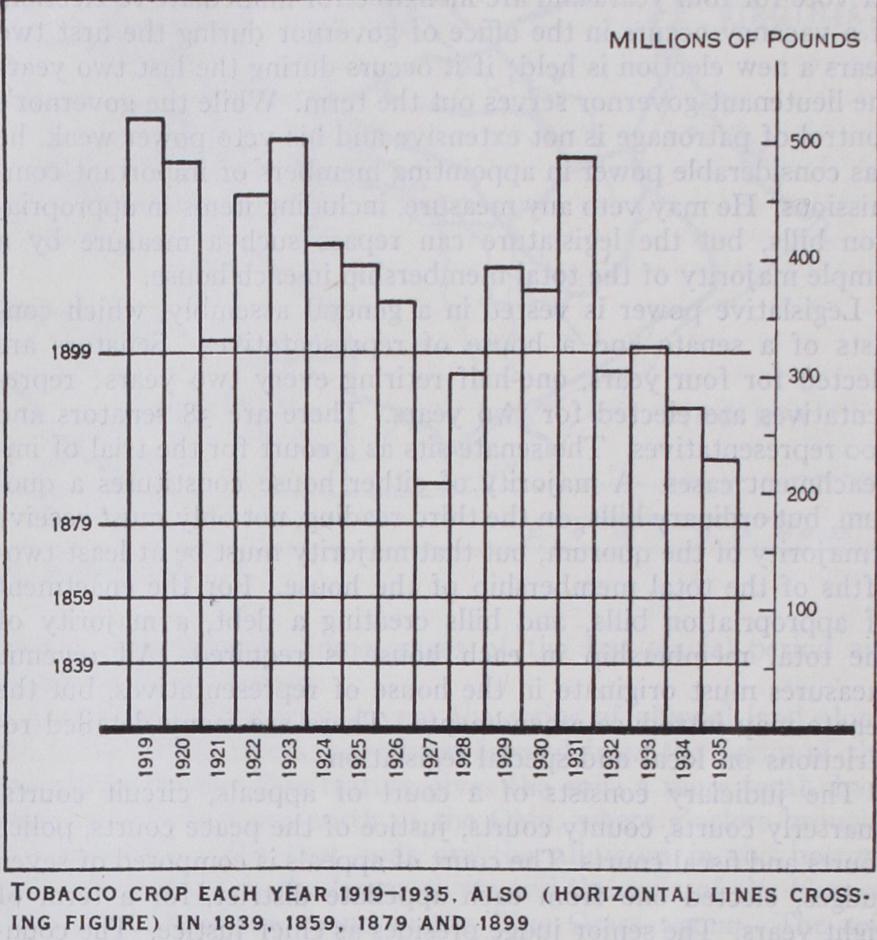
Kentucky is still a rural State, having 69.4% of the population rural in 193o. Agri culture, however, no longer compares favourably with manufac tures as a source of wealth. The farm population in 1920, accord ing to the U.S. census bureau, was 1,304,862, but by 1930 it had decreased to 1,176,524. The number of farms decreased from 270,626 in 1920 to 246,499 in 1930, but increased to 278,298 in 1935. Improved land has decreased steadily since 1910, despite the efforts of the reclamation service which has expended large sums in the counties bordering on the great rivers and in the western coal area. The number of farm owners decreased from 179,327 in 1920 to 157,403 in 1930, but by 1935 had increased to 174,661. Tenantry shows a corresponding fluctuation, as the number of tenants decreased from 90,33o in 1920 to 88,421 in 1930, but in creased to 102,215 in 1935. Field crops in 1930 were valued at $86,700,000; and in 1935 they were estimated to be worth $67, 600,000, giving the State the rank of twenty-second among the States of the Union. Indian corn (maize) is the leading agricul tural product in acreage, yield and value. In 1935, the 2,829, 000ac. devoted to its culture produced 62,238,0oobu. worth $47, 301,000. The crop second in value is tobacco. Tobacco was intro duced into the northern part of the State as early as 1780, and thence it spread to the west. Toward the close of the 19th cen tury it was introduced in the rich Blue Grass region, where it soon supplanted hemp. The two most important tobacco-growing districts are the Black Patch, in the extreme south-west corner of the State, which, with the adjacent counties in Tennessee, grows a black, heavy leaf, bought extensively by foreign agents, and the Blue Grass region, as far east as Maysville, and the hill country south and east, whose product, the red and white burley, is a fine-fibred light leaf, peculiarly absorbent of liquorice and other ingredients used in the manufacture of sweet chewing tobacco, and hence a particularly valuable crop. There were 291,00oac.devoted to tobacco culture in Kentucky in 1935. The production was 226,718,000lb., which had an estimated value of $34,814,000, the State's yield being exceeded by North Carolina only. Impor tant agricultural products other than Indian corn and tobacco in 1935 were hay, valued at $12,985,000; potatoes, valued at $3,220, 000; wheat, valued at $3,588,000; oats, valued at $468,000; and sweet potatoes and yams valued at $1,560,000. Live stock on Jan. 1, 1936, included 1,236,000 cattle; 1,035,000 swine; 1,102,000 sheep; 214,000 horses ; and 235,000 mules. The estimated gross income from all live stock and live-stock products in 1935 was $91,600,000. The thoroughbred Kentucky horse has long had a world-wide reputation for speed, and the Blue Grass region, espe cially Fayette, Bourbon and Woodford counties, is probably the finest horse-breeding region in America and has large breeding farms.
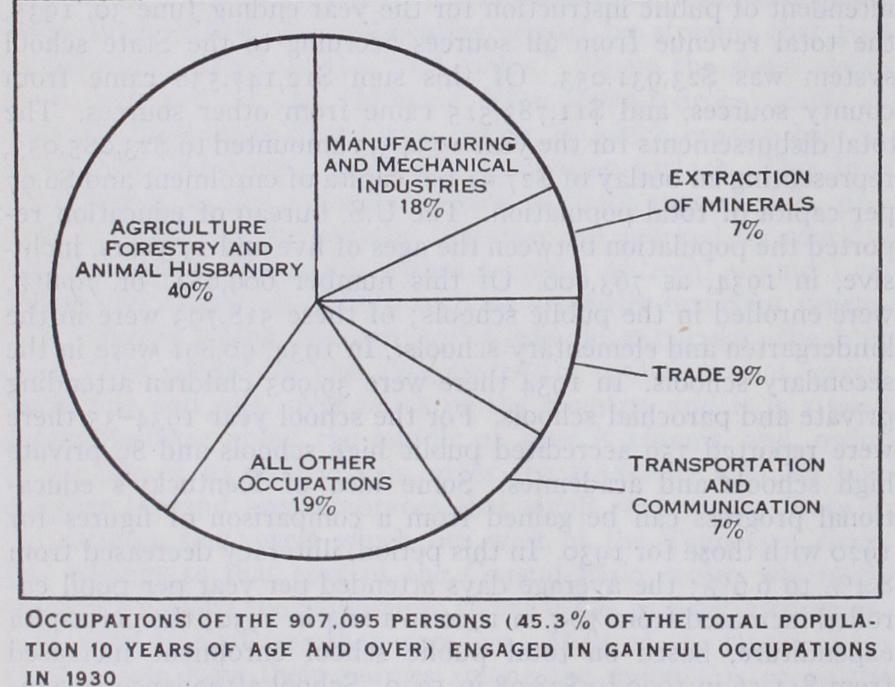
Kentucky's oldest industry of importance was the manufacture of distilled liquors, and the business again became one of leading rank after the repeal of the National Prohibition Amendment in 1934. Products of her farms and forests continue to be the chief sources of raw materials for the State's manufactures; the iron and steel works have developed in late years, but industry suf fered following the depression of 1930. The total value of manu factured products of the State decreased from $499,747,000 in 1929 to $297,808,000 in 1933, or over 40%. In 1933 the State's 1,274 industrial establishments gave employment to 56,085 wage earners, and added $123,240,000 to value of products. Measured by the value of the products, the industries ranked as follows in 1933 according to the United States census of manufactures : General construction and repair in steam railway repair shops, $14,700,000; petroleum refining, $11,928,000; flour and other grain-mill products, $11,795,000; slaughtering and meat-packing, $10,332,000; bread and bakery products, $6,891,000; printing and publishing, $6,519,000; foundry and machine shop products, $5,083,000; butter, cheese, and condensed milk, $4;710,000 ; men's clothing, $4,444,000 ; furniture, $3,533,000 ; lumber and other tim ber products, $3,009,000 ; and planing-mill products, $2,557,000. The value of all manufactures in 1933 was $297,808,329. Louis ville was the chief manufacturing centre in 1933. Other important industrial centres were Newport, Covington, Paducah and Ashland.