Lamp
lamps, design, shade, oil, art, modern, time, base, light and terra-cotta
This lamp was refilled on ex actly the same day each year, so that there seems to have been an idea of measuring time by it, such as may also have been the case in regard to the lamp stand capable of holding as many lamps as there were days of the year, which Dionysius the Sicilian tyrant placed in the Prytaneum of Tarentum. At Pharae in Achaia there was in the market-place an oracular statue of Hermes with a marble altar before it to which bronze lamps were attached by means of lead. Whoever desired to consult the statue went there in the evening and first filled the lamps and lit them, placing also a bronze coin on the altar. A sim ilar custom prevailed at the oracle of Apis in Egypt (Pausanias, vii. 22. 2). At Argos he speaks of a chasm into which it was a cus tom continued to his time to let down burning lamps, with some reference to the goddess of the lower world, Persephone (ii. 22. 4). At Cnidus a large number of terra-cotta lamps were found crowded in one place a little distance below the surface, and it was conjectured that there must have been there some statue or altar at which it had been a custom to leave lamps burning at night (Newton, Discoveries at Halicarnassus, etc., ii. 394). These lamps are of terra-cotta, but with little ornamentation and so like each other in workmanship that they must all have come from one pottery, and may have been brought on one occasion to the spot where they were found, probably the funeral of a person with many friends, or the celebration of a festival in his honour, such as the parentalia among the Romans, to maintain which it was a common custom to bequeath property. For example, a mar ble slab in the British Museum has a Latin inscription describing the property which had been left to provide among other things that a lighted lamp with incense on it should be placed at the tomb of the deceased on the kal ends, nones and ides of each month (illus. Marbles, v. pl. 8, fig. 2). For birthday presents terra-cotta lamps appear to have been frequently employed, the device generally being that of two figures of Victory holding be tween them a disc inscribed with a good wish for the new year : ANNV Nov FAVSTV FELIX. This is the inscription on a lamp in the British Museum, which be sides the Victories has among other symbols a disc with the head of Janus. As the torch gave way to the lamp in fact, so also it gave way in mythology. In the earlier myths, as in that of Demeter, it is a torch with which she goes forth to search for her daughter, but in the late myth of Cupid and Psyche it is an oil lamp which Psyche carries, and from which, to her grief, a drop of hot oil falls on Cupid and awakes him. Terra-cotta lamps have very frequently the name of the maker stamped on the foot. Clay moulds from which the lamps were made have been discovered in considerable numbers.
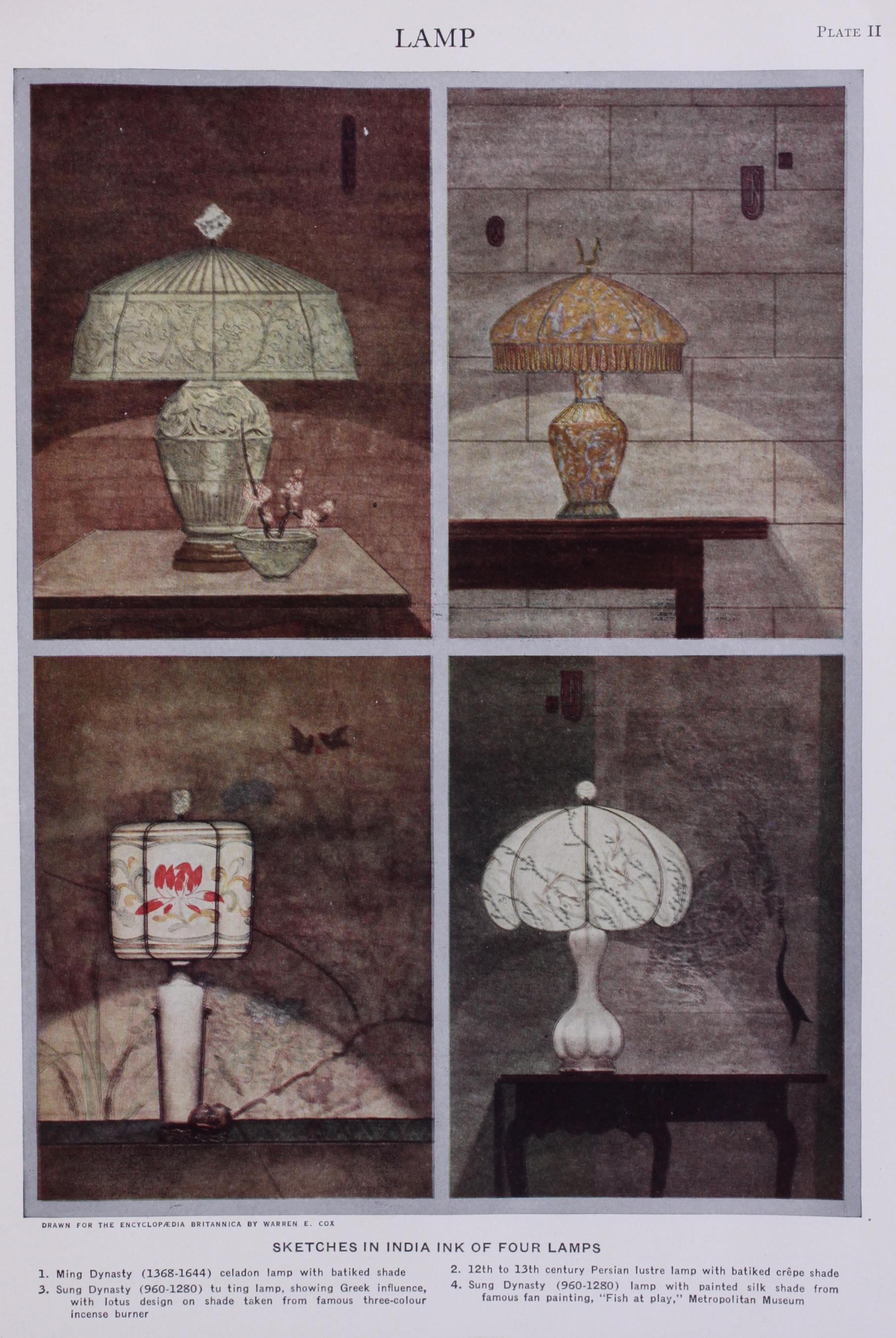
A
new element has been introduced within the last fifty years into the decoration of the interior. For centuries men beautified their homes by the use of rugs, furniture, tapestries and other wall hangings, and during all this time the lamp consisted of a torch, a small cup of oil in which floated a wick, a candle in an ornamental candlestick or a kerosene lamp. Only since the discovery of electric light which did away with the necessity of considering ventilation and fire risk, and which at the same time made pos sible great candle-power in small space, has the art of the de signing of lamps and shades come into being, if we except the beautiful mosque lamps and Chinese and Japanese lanterns.
There is a distinct trend in modern decoration toward the elimi nation of unnecessary art objects, a reaction against the crowding of the 19th century. Yet lamps are necessarily art objects which demand prominent settings in order to fulfill properly their func tion of distributing light. Therefore, in order not to run counter to the tendencies of the day it is necessary in the designing of lamps to merge them into their backgrounds as much as possible.
A work of art should have unity of line, structure and colour, and the trend in modern lamp design is to make the texture of the shade harmonize with the texture of the base. Thus velvets may be employed in conjunction with bronze and pottery vases. Thin silks, satins and taffetas may be used with porcelain vases, the sheen of the material matching the glaze of the vase.
It is interesting to note that because we have used oil lamps for centuries the eye, accustomed to an oil container, demands something of the sort even when it is entirely unnecessary in the electric lamp. We may break away from tradition, but should not do so too abruptly and without reason, and therefore lamps which are constructed with the slender stems adequate to carry an electric wire are often less satisfactory to the eye than those con structed with a larger and more substantial base. Moreover, through the use of high candlepower demanded in the modern home, the lamp-shade must be large enough to eliminate glare (see LIGHTING) and should therefore have a large and massive base to support it.
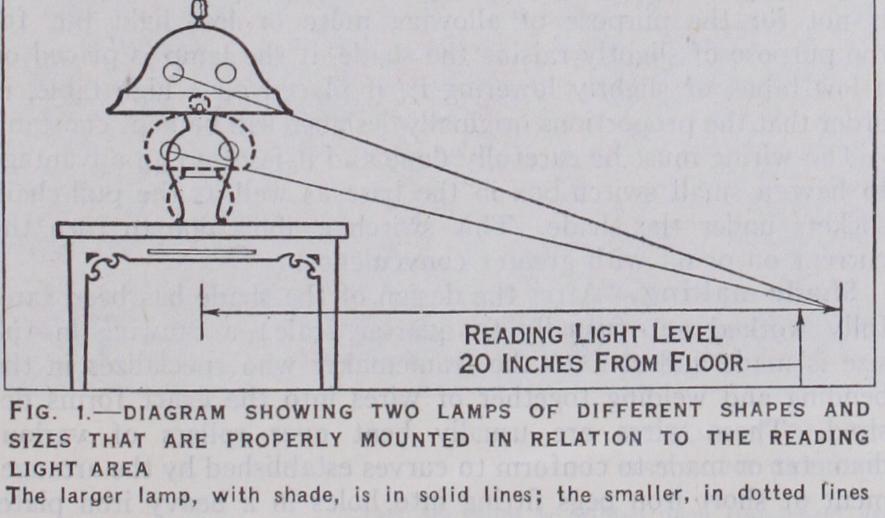
In order that lamp bases may harmonize with the furnishings of the home, they must be chosen from potteries, porcelains and bronzes of appropriate periods, conforming in colour and design with the rugs, wall hangings, furniture and general architectural treatment. Reading-light areas should be laid out in planning the arrangement of the lamp units in a room. When the radius of one of these reading-light areas has been established and the base selected for the lamp, the shade can be designed without regard to the light area and only when the mountings are planned should the light area be brought into consideration. The diagram in fig. I shows a table on which stands a large lamp with a shade of one shape in solid lines and a small lamp with a shade of another shape in dotted lines, and it will be seen that when a line is drawn from the circumference of the reading-light area this establishes the location of the electric bulbs on the mountings. The problem of lighting (q.v.) is considered sepa rately; this article is therefore concerned solely with the design and construction of a new type of art object which is to be moulded into the interior and made harmonious with it, giving it a proper accent in the form of a high-light when the lamp is in use, and casting over it a tint or wash that will establish the mood of the interior at night.
When the other furnishings of the room are antique the lamp should be antique. When they are modern it should be modern, but of whatever style or period, there are certain fundamental rules of design which will help to make the unit beautiful. There should not be a too abrupt change from the design and colouration of the vase to the design and colouration of the shade. The elements to be considered in knitting them are: (I) propor tion, (2) the quality of the curve, (3) texture and (4) colour.