House Decoration - Difference Between Color and Paints
red, light, tint, green, blue, white and cornice
Another example (Fig. 5) shows a room cor nice which provides for a neutral, or warm green, flatted wall-color. Next to this is a soft terra cotta, or reddish-brown, a few shades darker than the wall; above this a band of wall-color, and this framed by the previous terra-cotta at A below, and a lighter shade at B above. The cove is painted in a lighter and more yellow tint of the walls, bounded also on top by the lighter terra-cotta tint. A deep-cream flat comes next; then the ogee in a light tint of greeny-blue, which is separated from a faint and soft salmon-tint on the ceiling by a small cream flat.
Fig. 6 represents color applied to a cornice in a room over a rich and glowing wall-paper of semi-natural floral design, the colors being warm greens and browns, with flowers in mixtures of soft rich red, old gold, and a little "gobelin" or greenish-blue. The ceiling is coated with a soft but decided pink tint, made with Venetian red and ocher; and next to the cornice there is a mar gin 8 inches wide in a deeper shade of the same color. The base of the cornice is a medium bronze green, the cove Indian red and a little white— deeper than the base in tone. The margin color is put on the flat above a medium tint of soft gobelin blue at the flat and hollow next to the cove, and the remaining members warm buff and a greenish-yellow or light mossy green. The lines and ornament may be in terra-cotta, moss green, and light gob elin blue upon the light pinky-buff of ceiling. In this illustration the place for a little gilding is indicated.
What should be the color expression of the present-day drawing-room? White ought to pre dominate, either in mass or in combination, as tints, with other colors. These colors should be yellow to add richness and brilliancy, blue to re lieve and enhance it—just as the "field" of blue sky contrasts with the sun. It may be asked, But why not pink or green sentiments'? For these general reasons—that light, not heat, should predominate; that light and heat together are inconsistent with the sentiment of such a room; and, further, that true green is not only bilious of temper but almost fatal to mixed combinations.
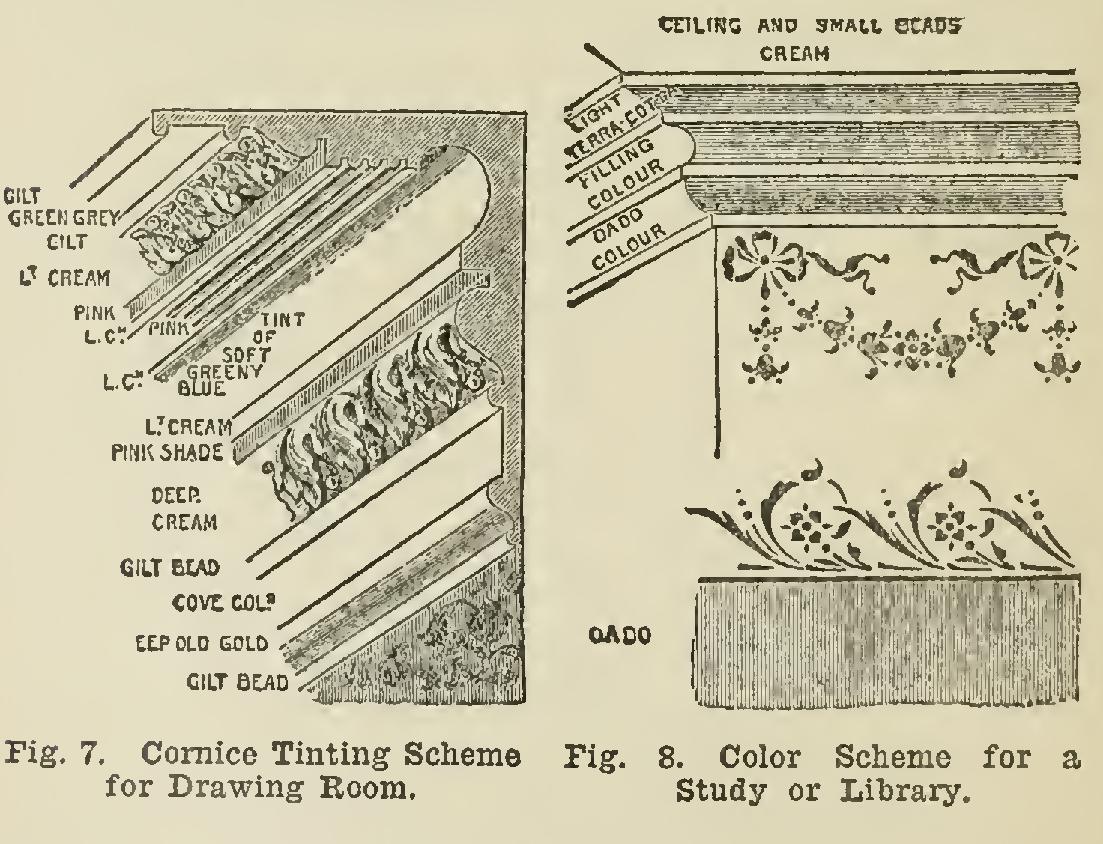
Fig. 7 is a treatment for the cornice of a room having a straw-colored ceiling and old gold walls; the cornice is colored in self-tones, or monotones of the same colors. The blue cove tint, though appearing blue against a faint yel low and cream, is, when viewed alone, quite a green tint. The very faint pink-red color is a
tint of Indian red. The creams are made with chromes and umber, and must be clearly com pounded to be pleasing.
Next consider the dining-room. Its modern purposes are chiefly displayed by artificial in terior light; hence white plays but an humble part in its treatment. Red tones for comfort and warmth are most natural. Red also, although classed as a stationary color, is safer in practice when toned down with black, or in positions naturally shaded. Try a mass of fiery red, then add an equal proportion of black, and note the resulting sentiment: "prudent heat"—red, shaded with black. Again, add white to red: result—heat still powerfully dominant. A dining-room may be colored red, of any intensity, with the hall, or room approach, colored intense green-blue. The result will then be that the red appears more intense and brilliant after looking at the hall color. Harsh or strong contrast is a matter irrespective of harmony. In an age of temperance and moderation, let color contrasts be consistent, simple, temperate, and expressive —not overbearing in sentiment, like the ancient Egyptian and Chinese colorings, nor sensuous, like the Pompeian.
Halls and staircases are not presented to the eye for long periods, hence their color expres sion may not be so arbitrarily stated. If well lighted, we must restrain our hand in the posi tive sentiments generally; but if badly lighted, then aim to give expression to brilliancy and cheerfulness. When dull and cheerless weather predominates, the warm and cheerful tones are most successful.
The study and library are open to much di vergence of color treatment. Any one of the positive color sensations is in keeping with the use of these rooms; but expediency must be studied; and white and yellow are "bad," unless the natural light is very poor.
A pleasing color and treatment for painting walls is a light green-grey "filling" or upper por tion, and a terra-cotta or Indian red color for the dado or lower portion. This will harmonize ad mirably with light oak woodwork. "Cream" for the filling would not wear so well, showing dis coloration sooner than the above. "Light sal mon" would be better, but not so cheerful and harmonious in effect.