A Writing Desk
inch, inches, top, edge, pieces, length and fig
The lines on the outside corresponding to the knife lines on the inside should be put on lightly with a sharp pencil.
For the mortises which receive the tenons on the board which serves as base of the compart ments, one is laid off from the joint-edge, just as was the one for the stretcher, the dimensions being the same. The measurements for the other mortise should also be made from the joint edge, the first being eight and one-fourth inches, and the next ten and one-fourth inches.
Gauge on the joint-edge three-sixteenths of an inch, and on the inside surface three-eighths of an inch for a rabbet, the rabbet extending from the top of the piece to a point three-six teenths of an inch below the upper line marking the gain for the compartment base.
The manner of cutting mortises, gains, and rabbets has previously been described, and need not be repeated.
The board for the compartment base should be squared up to twelve inches by thirty-four inches.
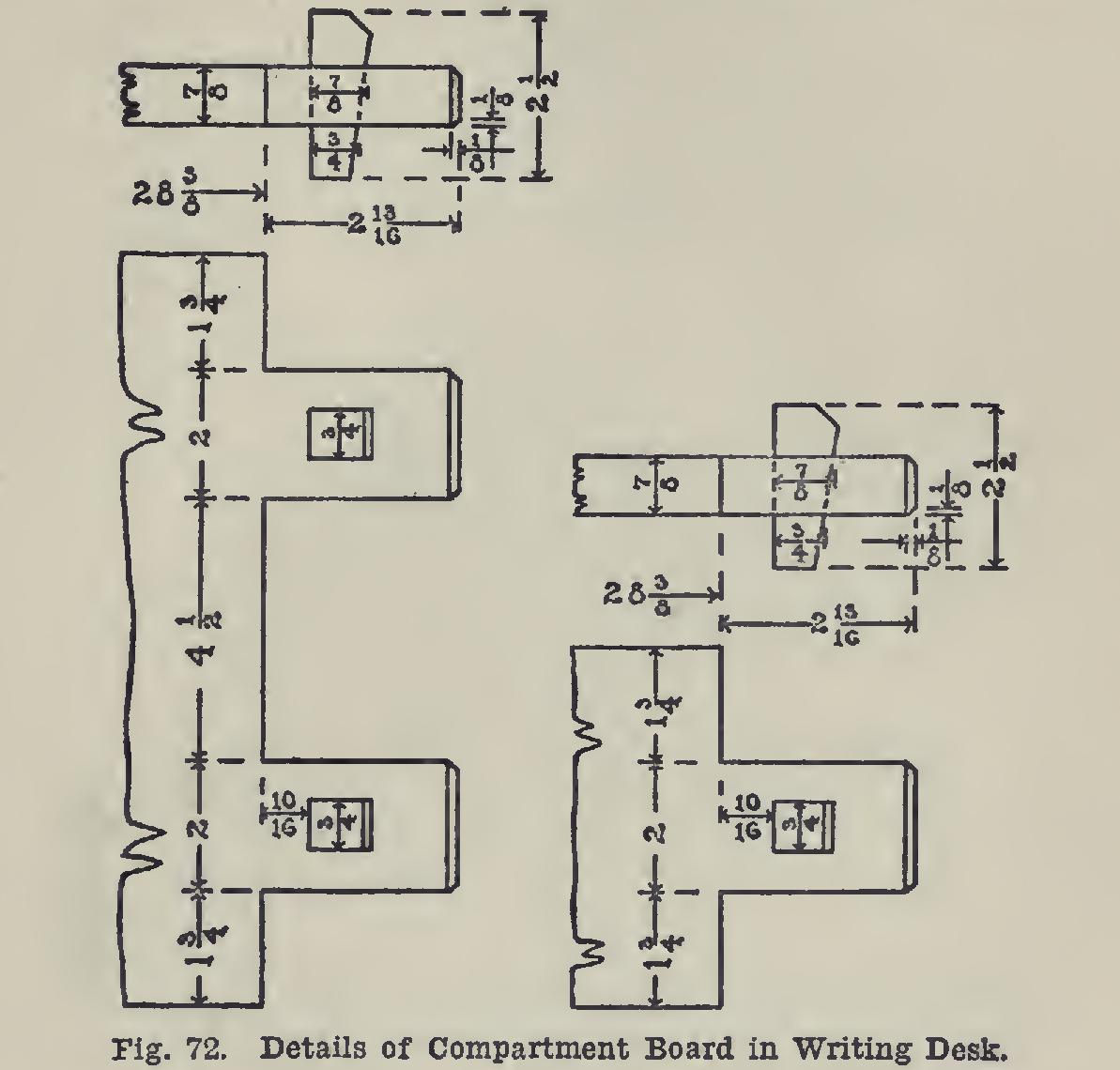
On the ends of this, lay out and cut the tenons as shown in Fig. 72, at the left. Remember to do all measuring from the joint-edge, which should, in this case, become the back edge; other wise the tenons may not fit the mortises.
It should be noted that the distance from shoulder to shoulder of the tenons is twenty eight and three-eighths inches (Fig. 72), although the distance between the sides of the desk is but twenty-eight inches (Fig. 71). This added length is due to the "letting in" of the ends three-sixteenths of an inch at each end.
The distance from the shoulder of the tenon to the first line of the mortise for the key, or wedge, is ten-sixteenths, the depth of gain allow ing three-sixteenths of an inch, and one-six teenth more being allowed in order to insure a wedging action on the part of the key.
Gauge on the top surface, from the back edge of this board, three-eighths of an inch; and on the back edge, from the top surface, gauge three sixteenths of an inch. This rabbet is cut for the back of the compartment to rest in.
The stretcher, from shoulder to shoulder, is of the same length as the piece just described and for the same reason. Its tenons are laid out and cut similarly (see Fig. 72, at the right).
Plane a joint-edge for the top of the com partment, and square the ends so that the top shall have a length of twenty-eight and three eighths inches. Next, set the gauge to seven
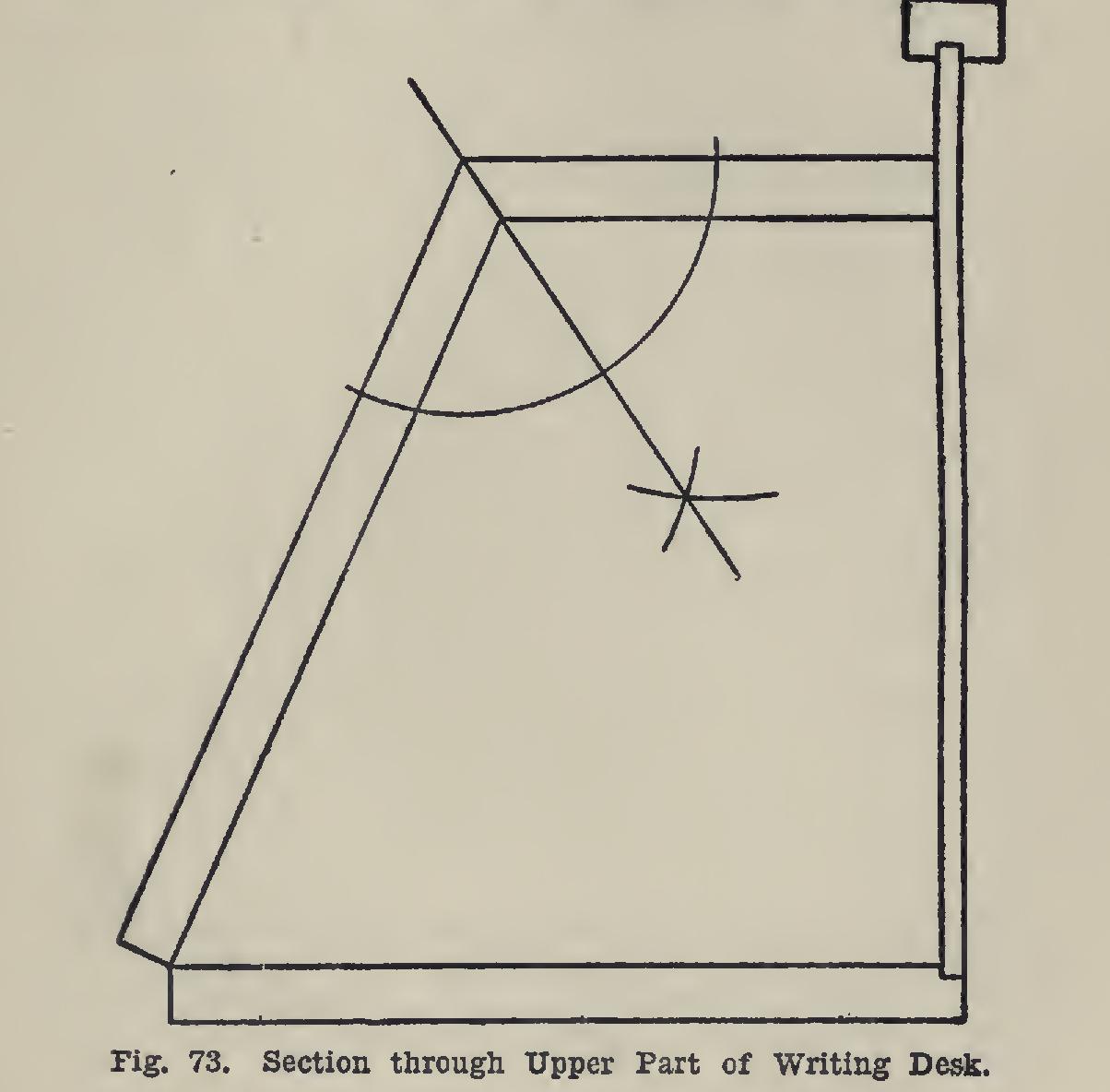
and one-eighth inches, and gauge for the width of the top side. It remains to set the bevel square to the proper angle, and plane the re maining edge to this angle. To get this angle, draw on one of the side pieces of the desk with a sharp pencil, lightly, so that they can be easily erased, lines to indicate the locations of the lid and top piece. A line drawn from the vertex of the outer angle to that of the inner angle, will give the slope (Fig. 71). If these angles are bisected, the result is likely to be more accurate (Fig. 73).
For the back, three-eighths of an inch tongued-and-grooved whitewood ceiling may be used, being nailed in place after the parts of the desk are assembled. These pieces of ceiling should be cut to a length of fourteen inches, and should be put on vertically, the nailing being done from the back side into the top and bottom parts of the compartment. This back should not be put on until the rest of the desk has been stained and filled, as it should be finished in the white with shellac.
The pieces which support the drawer should be squared to one-half an inch each way, with a length of eleven and one-half inches each. They may, be made of hard or soft wood, and are to be fastened with screws so that one end of each shall be flush with the back edge of the side pieces to which it is fastened.
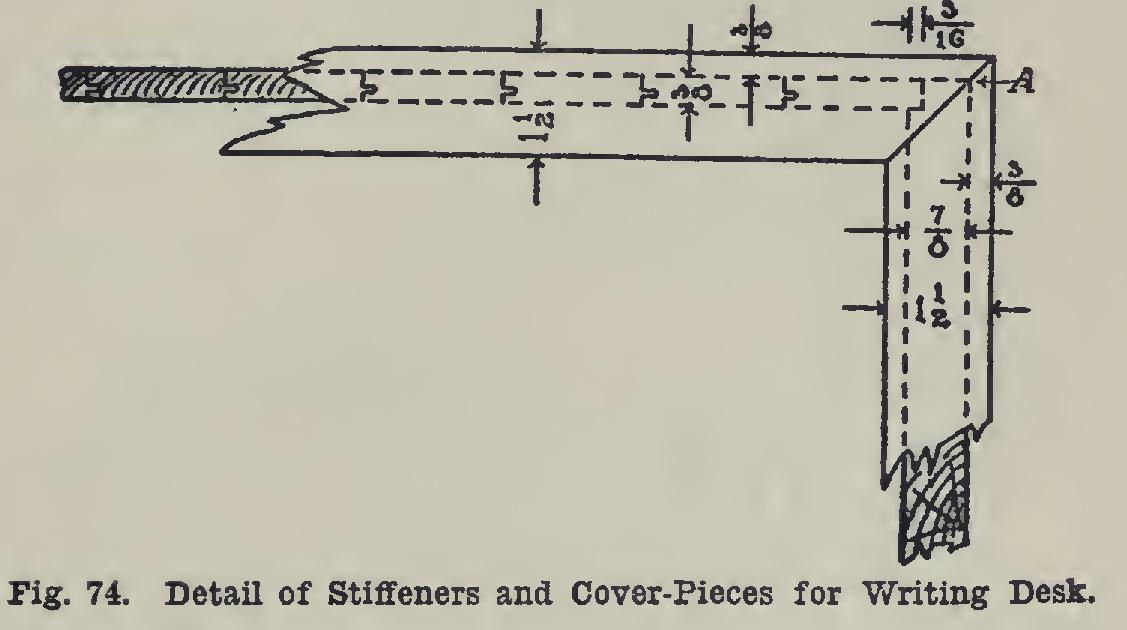
The parts having been assembled, the pieces which are to go around the top to stiffen the broad sides and to cover the ends of the ceiling or back may be placed.
The under sides of the pieces which cover the seven-eighths-inch stock should be rabbeted to a depth of three-sixteenths of an inch, with a width of seven-eighths of an inch. The gauging should be done from the outer edge, being set first to three-eighths, then to one and one-fourth inches. The rabbet should extend to within one-half an inch of one end, while at the other it should be cut entirely out. The length of these pieces can best be determined by placing them in position, and marking. They join the corresponding piece on the back with miter joints.