Suggestions for Handicraft Fur Niture Work
top, table, legs, wood, inches, piece, height and shown
This kitchen table may be made of soft or hard wood. It will be found advisable, in either case, to use a close-grained soft wood, such as white pine, for the top. Pine is less likely to warp, and is more readily cleaned than most other woods. This top should be of good, clear lumber, free of any "shakes" or other imperfec tions, and should be especially well seasoned. The leaf at the back of the table is to be hinged to the top proper. When raised, it is supported by means of a fifth leg, which swings around from under the table. The size of the table, the length and width, and the height of the top from the floor, should be determined by local condi tions. A small space will demand a small table, and vice versa, while different women have different likes as to the height of the top.
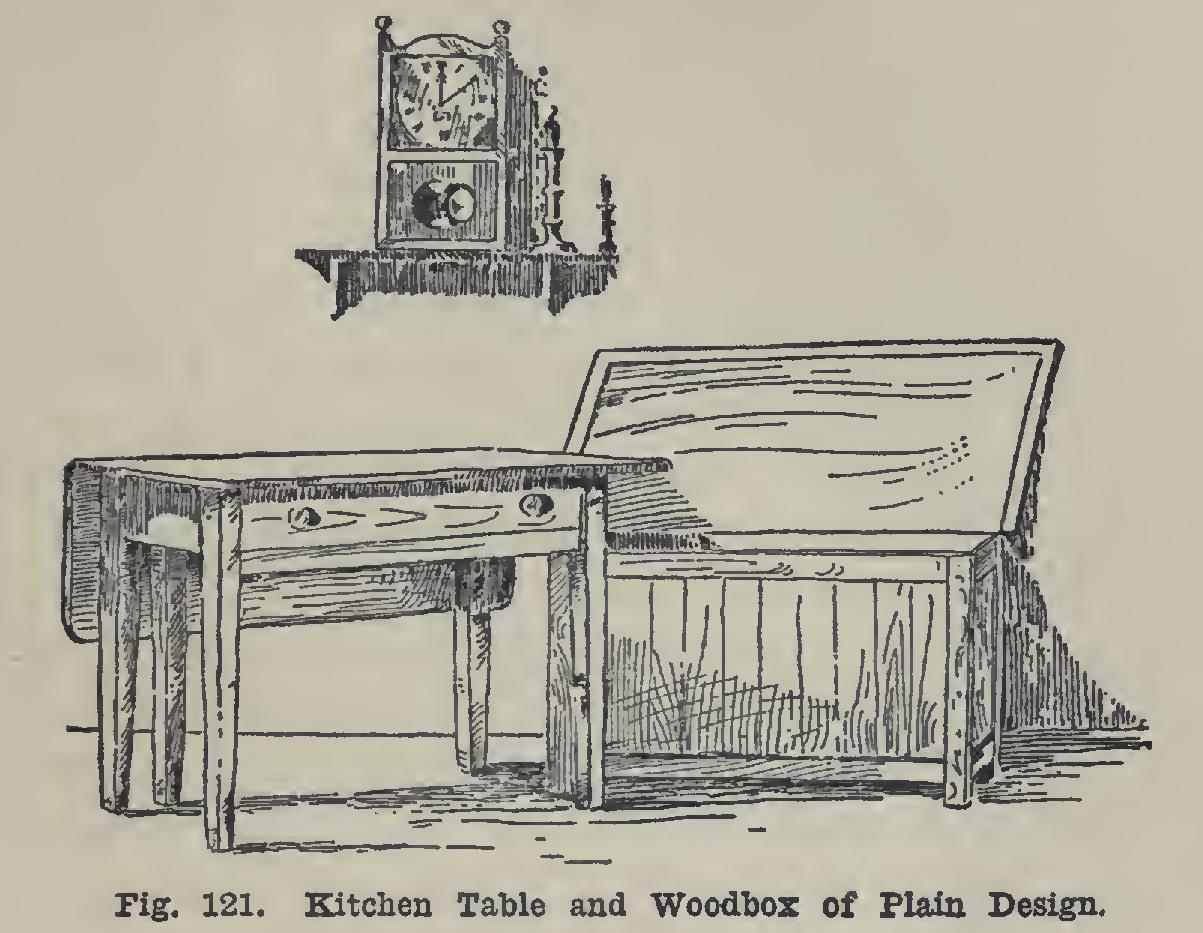
The top and rails may be appropriately made of seven-eighth-inch stock, while two-inch will be about right for the legs. The legs are to be slightly tapered; the drawer sides, back, and bottom may be made of three-eighth-inch white wood or pine; and the whole should be plowed and fitted together in a thorough and workman like manner. The knobs for the drawer are suitably turned out of wood, though metal ones might be used if more easily procured.
Housewives like light finishes in the kitchen; so the table frame would better be finished light. The top, however, ought to have no finish except a thorough sanding. The housewife will tell you the reason, if you cannot surmise it.
Another piece for the kitchen is the wood box, Fig. 121. A woodbox, usually, is con structed out of a drygoods or soap box. We could have described a way to make one of these which would have answered the purpose and would have been much cheaper than the one shown in the sketch. The struggle against dirt and unloveliness is hard enough for the kitchen dweller, however, without the addition of such a burden.
The woodbox shown in the sketch is to be thoroughly constructed by tenoning the rails into the posts. These rails should be at least one and one-eighth inches thick, and should be rab beted to receive the paneling. The paneling should be tongued-and-grooved to prevent the dust from sifting through. The bottom, like wise, should be made dust-proof, and should be solidly fitted. The lid shown in the sketch is cleated around the outer edge so as to fit over the outside of the box. The joint between the top and cleat is covered with a thin piece of stock fastened to the two parts by means of round-head screws. The paneling for the sides should have the joints relieved by beading. An
other way would be to groove both edges of each piece, beveling the outer edges almost to the grooves, a spline being used to joint the parts together.
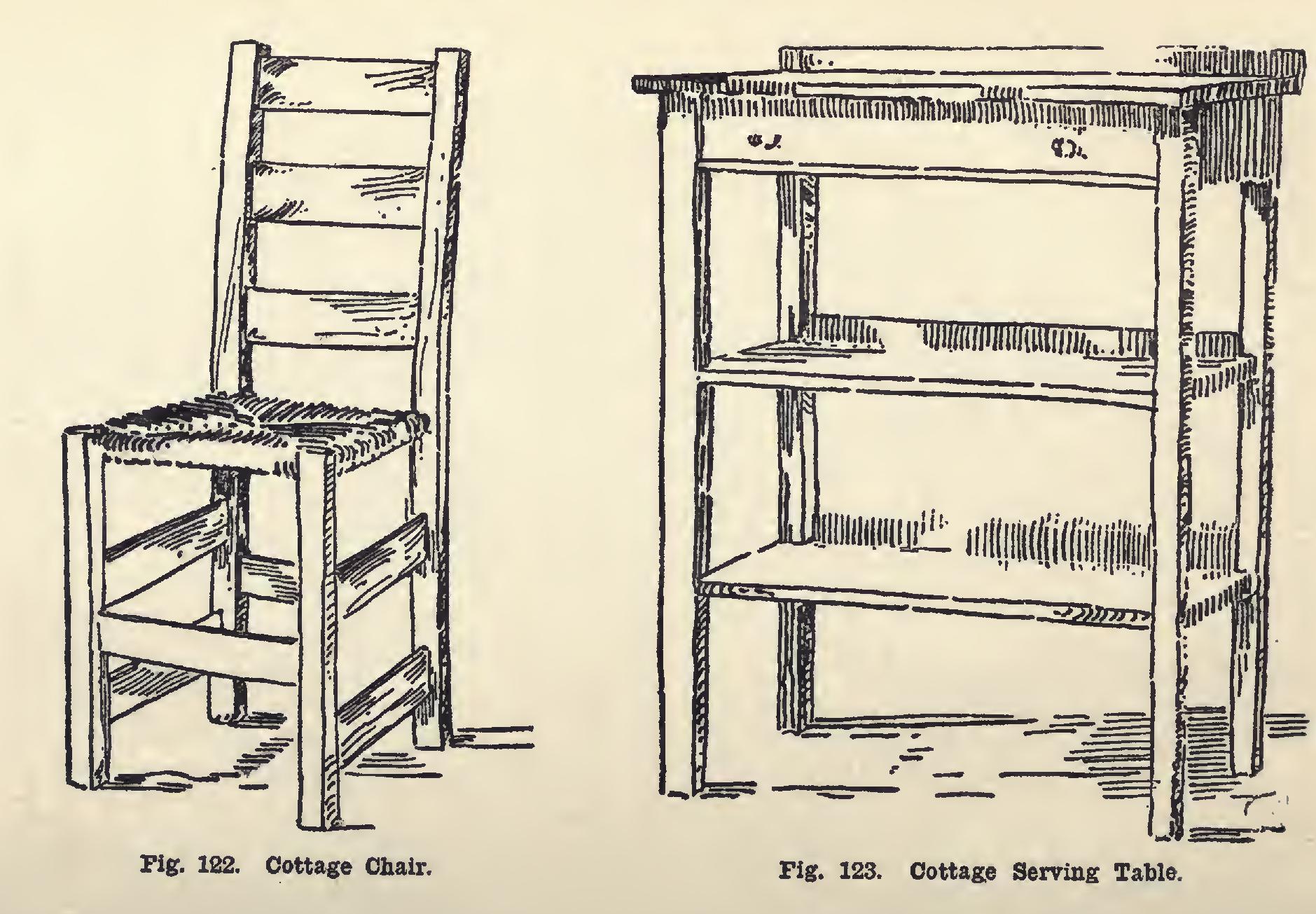
In Fig. 122 is shown a cottage chair. The size of the legs and the other proportions are to be determined by the craftsman himself. If a chair of light weight is wanted, legs one and one-eighth inch square will not be too light. The height of the chair from the floor, the height of the back, the width and depth of the seat, the width between the front and between the back legs, should not be fixed without first measuring chairs that are at hand. Unless one is ex perienced, his estimate of such proportions is likely to be far from correct. If you are an ama teur and are inclined to doubt this, suppose you make an estimate of the height of an ordinary chair seat, then put the rule on, and verify your estimate. The flag seating should not be put on until after the woodwork has been finished.
In Fig. 123 is a cottage serving table. Noth ing could be more appropriate for the dining room of a cottage than this simple piece of furniture. It should be made of oak, and fin ished to correspond with the other furnishings of the room. The top and shelves may be of seven-eighths or three-quarters-inch stock, the top being eighteen inches wide by thirty inches long. The legs should be thirty-eight inches long, with a width and thickness of one and three-quarters or two inches. The legs should be tapered towards the bottom; and the shelves should be "let into" them, and should be dow eled and thoroughly glued.
The china cabinet and extension table (Fig. 124) are of the same simple design as the serv ing table. It will be observed that the ends of the china cabinet are made up of panels. These, like the doors, are glazed with double-strength glass. Good proportions for this piece would be 38 by 68 by 15 inches.
The dining table is of Dutch design, and can readily be made into an extension table. Quar tered white oak should be used. The top should be made thicker than the ordinary table top, so as to match the legs.
A suitable finish for the oak pieces is ob tained as follows: Place the furniture in an air-tight chamber in which are vessels of am monia. In twelve hours the fumes of the am monia will have penetrated the wood, causing a chemical change of color. Linseed oil should then be rubbed well into the wood, after which several coats of wax should be applied.