Suggestions for Handicraft Fur Niture Work
furniture, inches, pieces, wood, fig, honesty and presence
In many homes, however, especially in the cottage, the lack of room in which to place sepa rate single beds, and the added expense of keep ing up separate bedding, render it advisable for the householder to make use of the old-style double bed. By many such people, the desir ability of single beds is still recognized. They may find a compromise in which the head and foot parts of the two single beds are combined in one piece, the middle post suggesting what they recognize as desirable, while the construc tion admits of the advantages pertaining to the old style.
The parts of foot and head pieces ought to be mortised and tenoned and pinned. There is no occasion for trying to conceal the dowels which serve as pins, since honesty is one of the fundamental things to be sought in craftsman furniture, the presence of the pin-head is an in dication of honest effort toward strength. There is no necessity for going to the extreme that one prominent and reputable furniture house goes— the pinning of all tenons. There is no occasion for pinning small tenons where great strength is not a necessity. To do so, and to emphasize the presence of the pins on such occasions, is not ex cusable from any point of view. Honesty in furniture, like honesty in anything else, is de sirable and essential; but to "go out of your way" to call attention to your efforts to pro duce honest furniture is as reprehensible as for the man of business to proclaim "out of season" and without excuse that he is honest.
The side rails are to be made with fasteners at the ends such that they can be easily detached from the foot and head. Tradition tells of an amateur who once made a bed, mortised and framed all its parts together in his shop, and otherwise completed it, only to find he could not get it out of the shop door.
The necessity for the mirror (Fig. 128) will undoubtedly appeal to the ladies rather than to the men. As in the dresser, plain plate or bev eled plate may be used for the glass. Eighteen by forty or fifty inches is a good size for the glass.
The supporting frame must be firmly fast ened together. The curves of the feet may be cut with the turning saw, and firmly fastened to the uprights. The weight of mirror will demand that metal fastenings be used as swing-pivots.
These can be procured with ornamental heads. They must be placed somewhat above the center of weight.
The builder of these pieces of furniture must decide what wood. he wants to use in making them. Probably no wood is more easily ob tained, or gives more pleasing results when fash ioned into furniture, than oak. It is a low-priced wood, too, when compared with mahogany and other similar woods. Quarter-sawed white oak is preferable for furniture, though plain-sawed also is very appropriate for this style of furni ture.
All the pieces which are built for the same room should be made from the same kind of wood.
At the present time when the luxuries of yesterday are the necessities of to-day, the ac companying sketches of library or den furniture will be taken as a matter of course. His majesty, The American Citizen, likes nothing better than to sink far into the soft cushions of a comfort ably inclined chair, to get his feet above their usual level, a good book or his paper in his hands, and—sometimes—a good cigar in his mouth. At such times the magnanimous spirit pervades his presence, and he is ready to bestow favors.
The home craftsman in his workshop may provide for such as he—and, in fact, for the gentler sex, too, should they be willing to over look the matchbox on the light-stand.
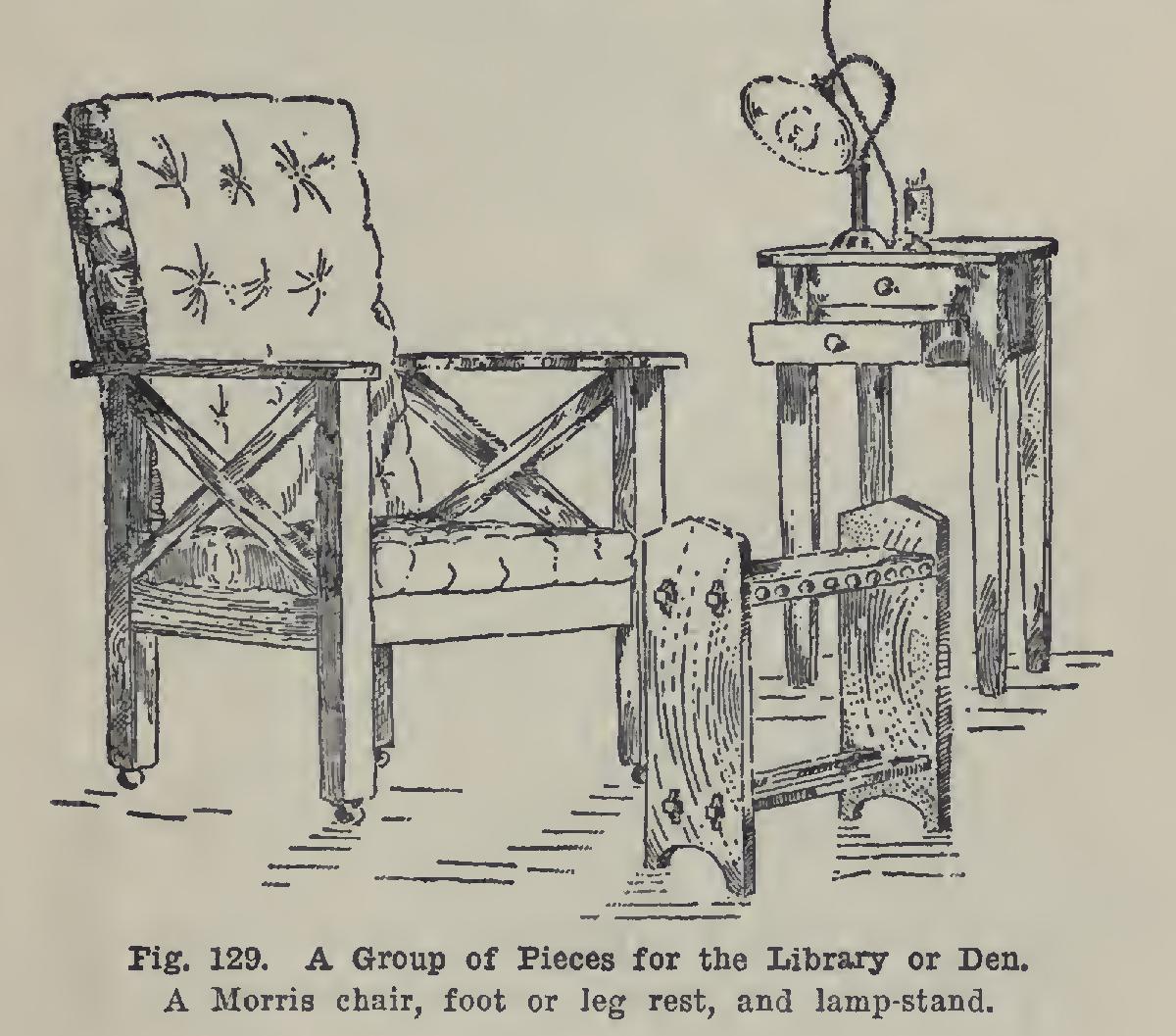
In Fig. 129 is shown a group of pieces that will make home attractive for any man who is so fortunate as to possess one. Nor need the home be unattractive because of the absence of such pieces, for they are not difficult to make.
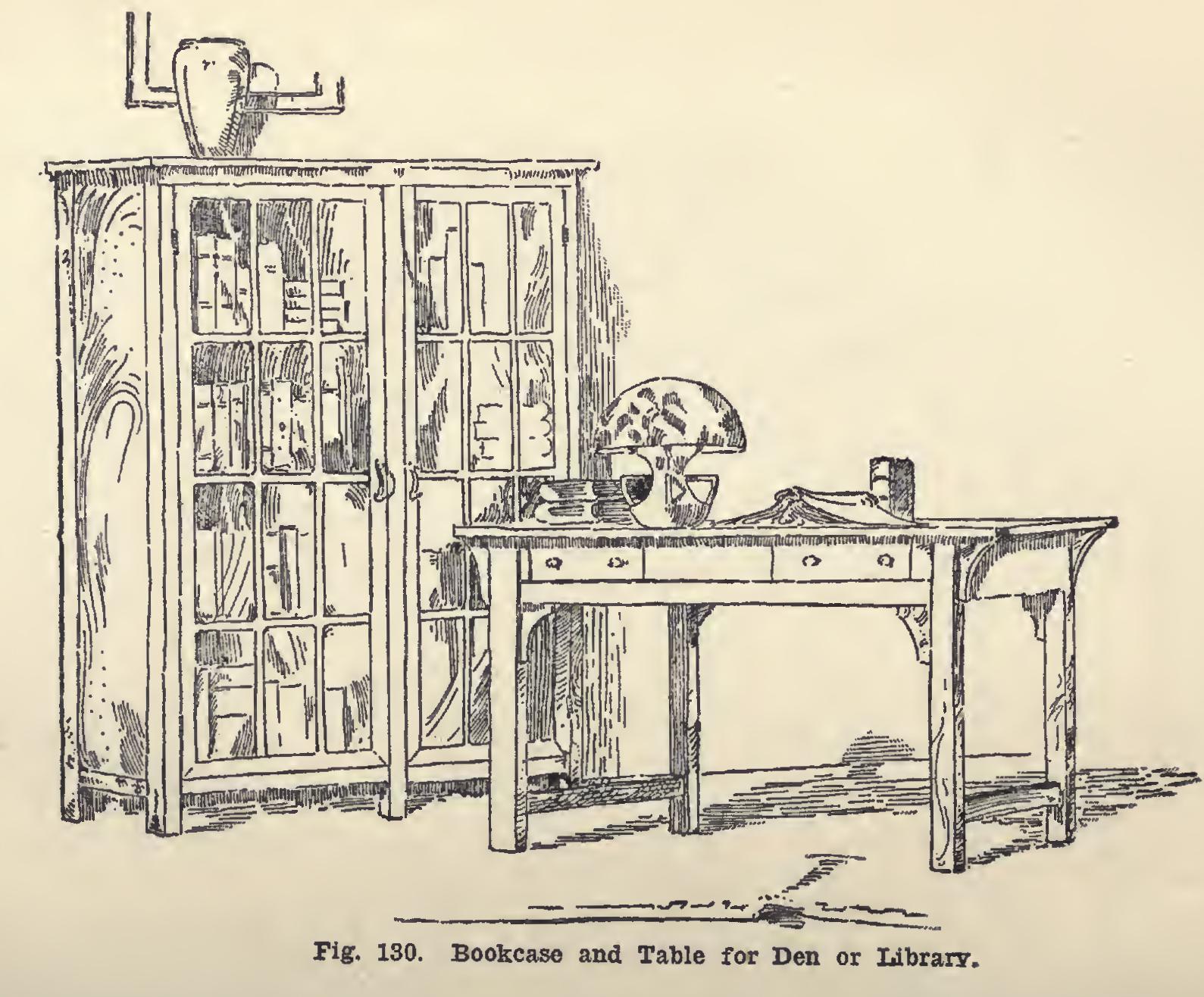
In this day of large living rooms and no sit ting rooms or parlors, when there is no place for privacy where the man of the house can throw aside his coat and vest and indulge in his petty sin of smoking, the den offers a fine re treat. It may be called a "den;" it may be a "library," too, by the addition of a table and a case for books (Fig. 130).
The Morris chair (Fig. 129) is of very simple design. Proportions for it are as follows: Legs, two and one-quarter inches square, and twenty four inches long; seat, twenty-one inches square from post to post; back, twenty-eight inches high. The arms are of one and one-eighth-inch stock, and project back beyond the rear leg about ten inches.