Roofs and Roof Construction
feet, span, inches, thickness, weight, suitable and divide
Queen=Post Roofs. —Queen-post trusses are used for spans over thirty feet, and contain two perpendiculars to brace up the tie beam spanning the walls.

Fig. 143 is a queen-post truss for a thirty-two feet span. The same form is suitable up to about forty-two feet span, and beyond that size prin cesses or intermediate posts and struts have to be inserted between the queens and the heels of the roof, as shown by the dotted lines; and it is sometimes necessary to frame a small king-post truss (also shown on the figure by dotted lines) above the straining beam SB, to support the ridge. SS is the straining sill and Q the queens. The other members are known by the same names as in other trusses.
A good rule to ascertain the thickness of queen post trusses is as follows : Divide the span by 8, and the quotient will be the required thickness (in inches), making up for odd parts by adding an other inch for heavy-tiled roofs and omitting such fractions for slates.
Taking the tie-beam for thirty-two feet span at 11 inches deep, and principal rafters at 6 inches, by adding one inch for every five feet additional span we can arrive at their depth for the different roofs.
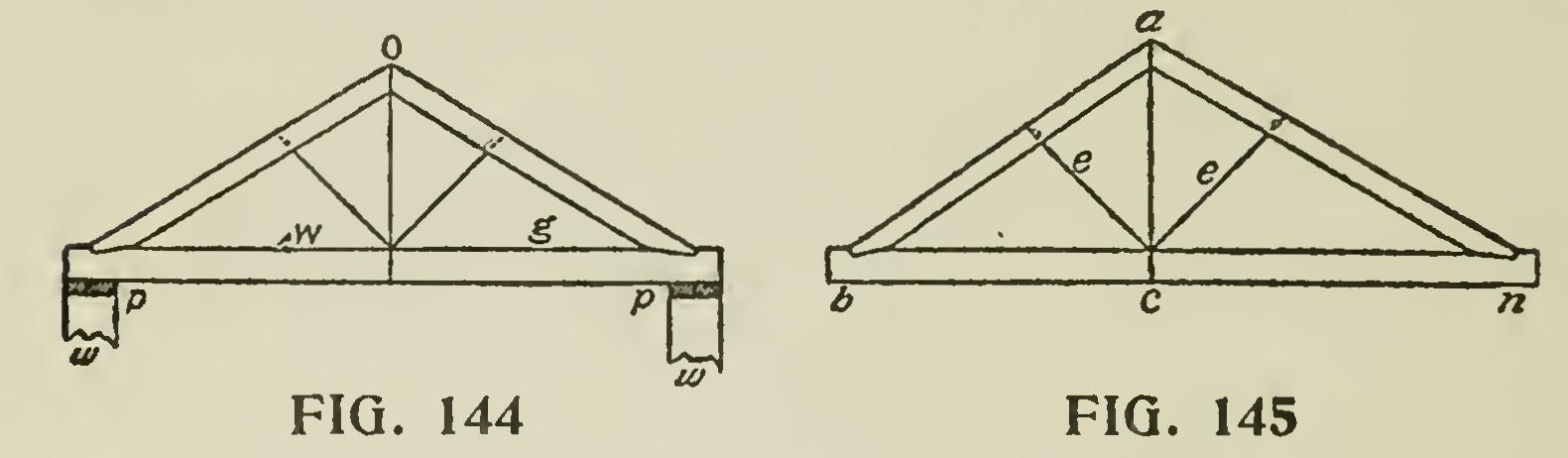
In Fig. 144 we show a roof that is at once strong and cheap for spans from twenty to thirty feet. pp shows the wall plates, w the wall, o the ridge and head of suspending rod; W and g show where the suspending rods may be placed if the span exceeds twenty-five feet.
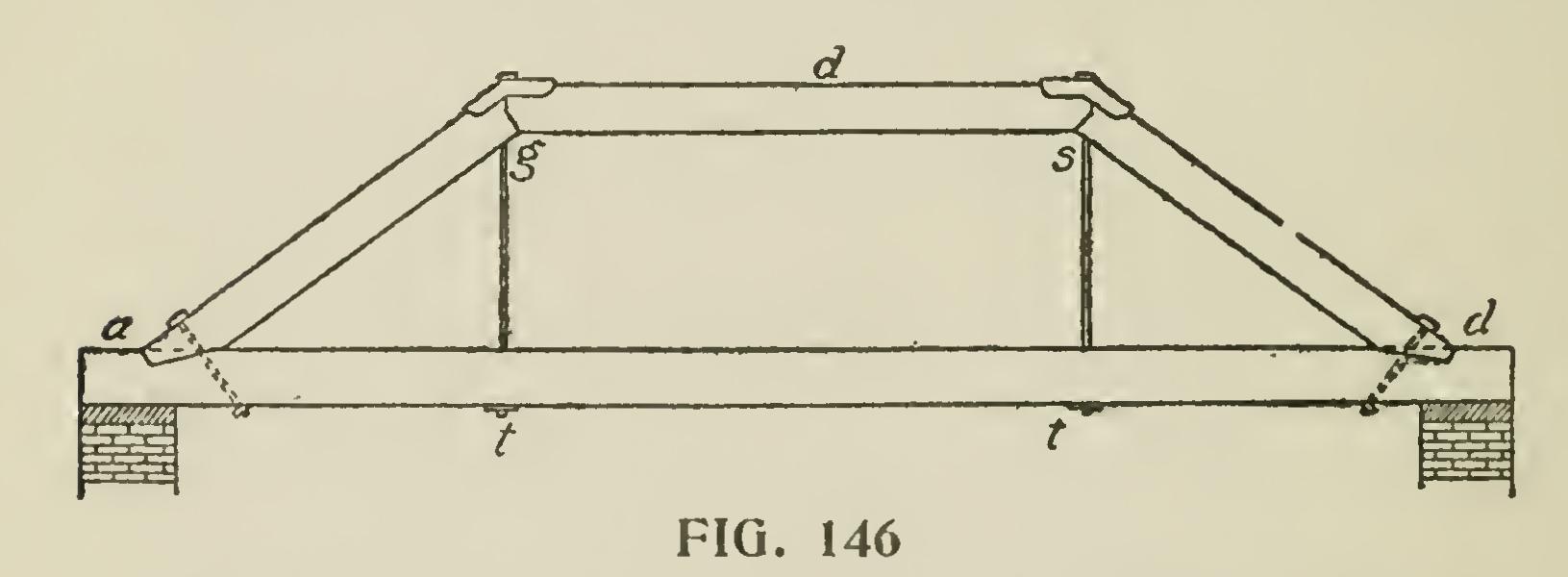
Fig. 145 shows a roof with unequal sides; ac shows the suspending rod; ee may be braces of wood or rods of iron; b and n are resting points. This is suitable for a span from twenty to thirty feet.
Fig. 146 is suitable for a roof with a deck and where the span is not more than twenty-five feet. It is also suitable for a small bridge crossing a creek where the span is not more than sixteen to twenty-two feet. The deck is shown at d; gt, st show the suspending rods; ab show projections for gutters and ease-offs.
In estimating the pressure on the roof, for the purpose of apportioning the proper sizes of tim ber to be used, not only the weight of the timber and the slate or other covering must be taken, but also the weight of snow which, in severe cli mates, may be on its surface, and also the force of the wind, which we may calculate at forty pounds per superficial foot.
The weight of the covering materials and the slope of the roof, which is usually given, are con tained in the following table: With the aid of this table, and taking into ac count the pressure of the wind and the weight of snow, the strength of the different parts may be calculated from the following rules, which were deduced by Mr. Treadgold, from experience; they are easy of application and useful for simple cases. Mr. Treadgold assumes lbs. as the weight on each square foot. It is cus tomary to make the rafters, tie-beams, posts and struts all the same thickness.
To find the dimensions of the principal raf= tors in a king=post roof of pine timber: Rule :—Multiply the square of the length in feet by the span in feet, and divide the product by the cube of the thickness in inches; then multiply the quotient by .96 to obtain the depth in inches.
Mr. Treadgold gives also the following rule for the rafters as more general and reliable: Multiply the square of the span in feet by the distance between the principals in feet, and di vide the product by 60 times the rise in feet; the quotient will be the area of the section of the rafter in inches.
If the rise is one-fourth of the span, multiply the span by the distance between the principals, and divide by 15 for the area of section.
When the distance between the principals is 10 feet, the area of section is two-thirds of the span.
To find the dimensions of the tie=beam, when it has to support a ceiling only.
Rule.—Divide the length of the longest un supported part by the cube root of the breadth, and the quotient multiplied by 1.47 will give the depth in inches.
To find the dimensions of the king=post: Rule.—Multiply the length of the post in feet by the span in feet; multiply the product by .12. which will give the area of the section of the post in inches. Divide this by the breadth for the thickness, or by the thickness for the breadth.