Classes of Structural Members
beams, beam, supports, simple, stresses and fig
CLASSES OF STRUCTURAL MEMBERS Beams and Structural Girders 30. The simplest member is the beam or girder. The terms "beam" and "girder" prac tically signify the same, and are so used by many persons. It is better, however, to make a distinction, and to designate a member which is not built up, and which is the same size through out, by the term beam. Those members which are composed of one or more beams, or of various combinations of plates and shapes, and which may or may not be of same size through out, should be called girders.
The same formulas for stress apply to both beams and girders, but the method of design is different.
A beam or girder may be defined as a mem ber which is supported on one or more supports, and which is stressed by being bent.
31. Classes of Beams.
Beams or girders are divided into several classes, according to the manner in which their ends rest or are fixed on the supports. These classes are: 1. Simple boars, or beams which have the ends resting freely on two supports (Fig. 24).
2. Cantilever beams, or beams which rest on one sup port only. Ofttimes cantilever beams have the second half built in a wall, one half only being used (Fig. 25).
3. Overhanging beams, which are a combination of classes 1 and 2 (Fig. 26).
4. Continuous beams, or beams which rest on more than two supports (Fig. 27).
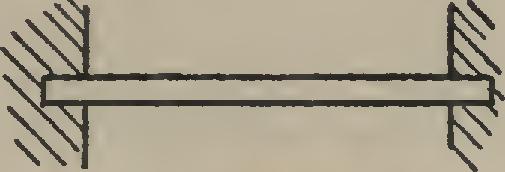
Fig. 28. Restrained Beam.
5. Restrained beams, which rest on two supports, but have their ends fixed so that they are immovable (Fig. 28).
6. Hybrid
beams, which are beams combining the characteristics of two or more of the above classes of beams.
Simple beams are used to a far greater ex tent than all other classes put together. In their case, it is comparatively easy to analyze and calculate stresses; and it requires no heavy con struction to hold the ends of such beams, since they are perfectly free to move on their sup ports.
Overhanging beams
are seldom used. They are, as will readily be seen, a combination of sim ple beams with cantilevers at the ends. The method of determining the stresses in them is more complicated than in the case of simple beams; but the design of overhanging beams— and, in fact, of all the other types of beams—is as simple as the design of the simple beam it self, once the stresses are obtained.
Continuous beams
are seldom used. The computation of the stresses in them is quite complex. Also, the supports must always re main at the same elevation as when first built; for, if these should happen to rise or sink, ex tra stresses would occur in the beam, and, should the difference in elevation be considerable, the stresses might become so great as to cause fail ure or rupture of the beam.
On account of the fact that it is practically impossible to make foundations which will not settle to at least some small extent, beams of this class should never be used where they will rest on any artificial foundation. Theoretically, continuous beams are more economical than simple beams; but the fact that the foundations settle causes such uncertainty, and also such excessive stresses, that their use has been almost discontinued, except in cases where foundations are on the natural solid rock.
Restrained Beams.
This class is open to the same objection as continuous beams, for, if the supports should settle, the stresses would be in creased above those computed. restrained beams require less material to sup port a given load than do simple beams, but the uncertainty of the stresses resulting from the un known amount of settling of supports, which is bound to occur unless the foundation is on solid rock, has either limited their use to such cases or they are made the same size as would be re quired for simple beams of the same span.
It is customary when a beam is partially or restrained at the ends, to consider it as a sim ple beam, and design it as such. Then it is cer tain that it will be safe, since, for a given span— that is, the distance between any two supports— and a given load, the simple beam requires more material than any other class.