Miscellaneous Uses of Reinforced Concrete
feet, inches, steel, placed, walls, pocket, column and buttresses
Seven hundred and fifty piles, varying in length from 20 feet to 40 feet, were driven by the use of two 50-foot drivers. These piles are of a uniform diameter of 16 inches and are composed of a mixture of 1 part Portland cement, parts sand, and 5 parts one-inch trap rock. In placing these piles, the driver is brought to the proper position over the pile location, and a hollow steel form, 16 inches in diameter, fitted at the bottom with a blunt, detachable cast-iron point, is driven until the required penetration is obtained. Sufficient plastic concrete for the length of the pile is then poured into the form, and the form withdrawn, allowing the concrete to settle down into the hole, coming into intimate contact with the sur rounding ground, cementing itself thereto and forming a rugged, monolithic column 16 inches in diameter from top to bottom.
The heads of these piles protruded 6 inches into the reinforced concrete footings, which were 2 feet 6 inches thick, and on which were constructed concrete column bases 4 feet by 4 feet by 10 inches.
A hoist and tower was erected over the mixer ; and an incline, equipped with industrial railway and car operated by cable, was constructed from the storage piles of sand and stone to mixer. The concrete was raised to the desired height in the tower, and discharged into a chute fitted with a gate. The concrete was drawn from the chute into industrial cars of about 18 cubic feet capacity each, pushed by hand on tracks to the point of pouring.
The concrete for the structure was mixed in a large mixer and in the proportions of 1 part Portland cement, 2 parts clean, coarse sand, and 4 parts l/5-inch to 11/2-inch crushed trap rock. All concrete was mixed to a jelly-like consistency, and when placed was thoroughly worked with spades and other tools to increase the density of the concrete and to work the mortar to the forms so that when they were removed the surface of the con crete was smooth and free from voids.
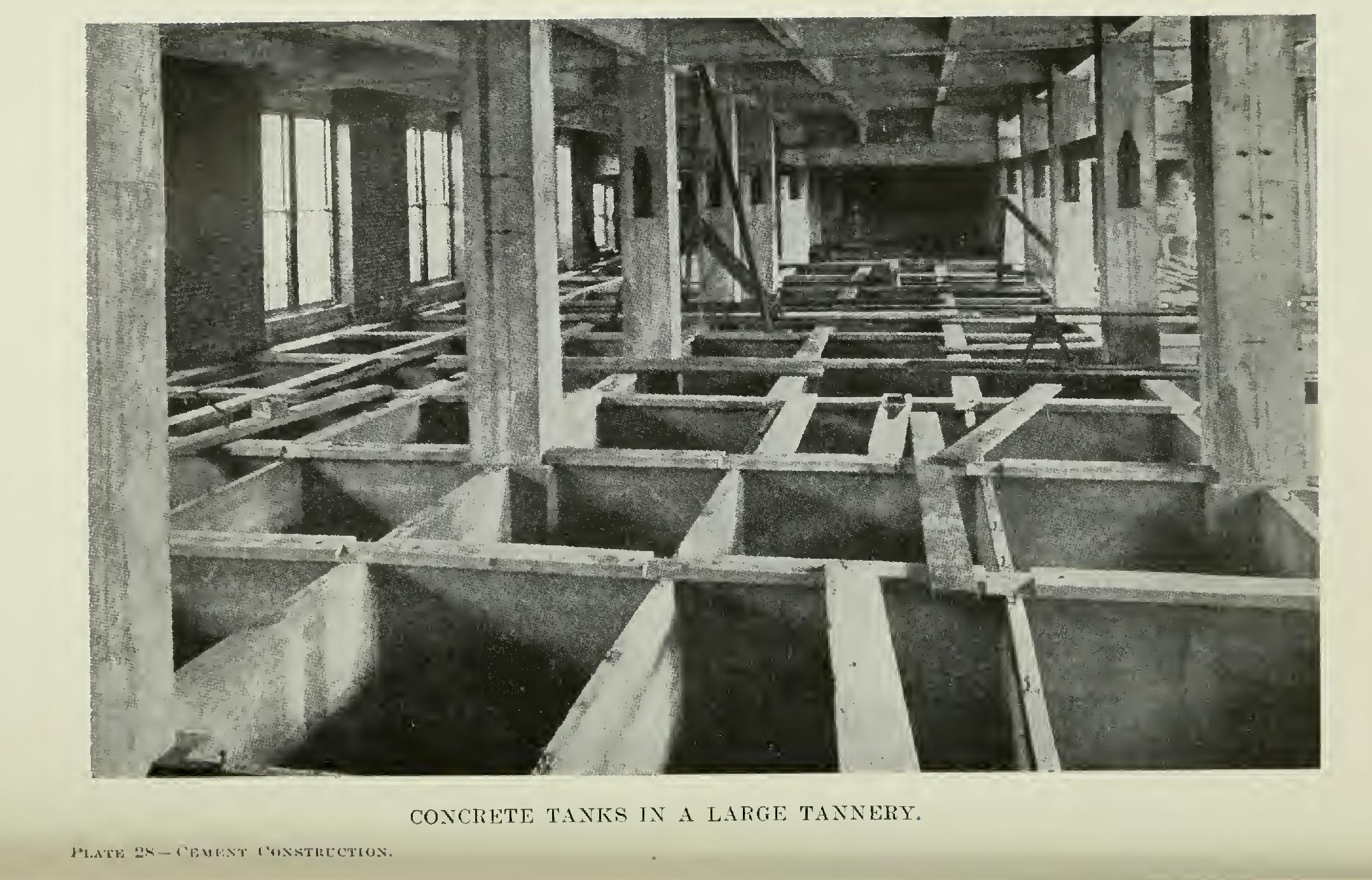
The forms for this work were made of spruce, and were built in units at the mill and shipped to the site of the work, where it was only necessary to assemble the various units and support same. This proved to be a very satisfactory and economical method.
The reinforcing steel was delivered on the site of the work and consisted of straight cup bars. Bending of the bars was done by hand, cold, at a very small cost. In placing and assembling, the steel was thor oughly wired together to prevent displacement during the placing of concrete.
On the column bases, the column reinforcement was erected and enclosed in a column form, and the forms for the slabs, girders, and beams were then erected, supported and braced. The columns were then poured with concrete to the under side of the girders and allowed to harden and set for at least twenty-four hours. During this period the steel reinforcement for the girders and beams was placed, and eventually these members were poured, and also the floor-slabs, the rein forcement for which was placed during pouring. The surface of the slab or floor was troweled to a smooth wearing surface while the concrete was soft. Previous to pouring the slabs, boxes at the location of the open ings in the floor for the chutes were set and secured, into which openings cast-iron hoppers were finally placed.
There were left reinforcing rods protruding, to which other rods were spliced as reinforcement for the walls. The forms for the walls were set up in sections to a height of about 6 feet, the reinforcement placed and secured, and forms well braced and the work then poured.
The pocket is divided into twelve separate compart ments, one division wall running the entire length through the center of the pocket, and partition walls every 30 feet apart transversely across the pocket, mak ing pockets 30 feet by 45 feet in dimension. These divi sion walls are 2 feet in width at the bottom and 1 foot in width at the top, and are designed as cantilevers, the steel being placed vertically and anchored in the girders. Sufficient horizontal steel was used so that cracks would not develop. The outer walls are 12 inches thick at the bottom and 8 inches thick at the top, and are 24 feet high. They are stiffened with buttresses every 10 feet. These buttresses extend into the pocket 7 feet at the floor level, and run to within 8 inches of the line of the wall. They are 10 inches wide and reinforced with nine steel rods on the outer face, running down into a beam for anchorage. The walls between the buttresses were designed as beams and the steel was bent in at the buttresses and held by rods anchored into the buttresses.
A wooden roof with a tar and slag covering encloses the top of the pocket, protecting the coal from rain and snow.
A new trestle 50 feet in height has been erected, and from this lead four automatic railways, no other power than gravity and a weighted triangle being necessary for their operation.