Miscellaneous Uses of Reinforced Concrete
feet, dam, water, cubic, blocks, yards and supply
"With this type of wall it is necessary to prevent the development of a hydraulic head under the base. Ade quate provision should also be made against failure by sliding on the foundation, and a projection extending into the soil should be provided in all cases.
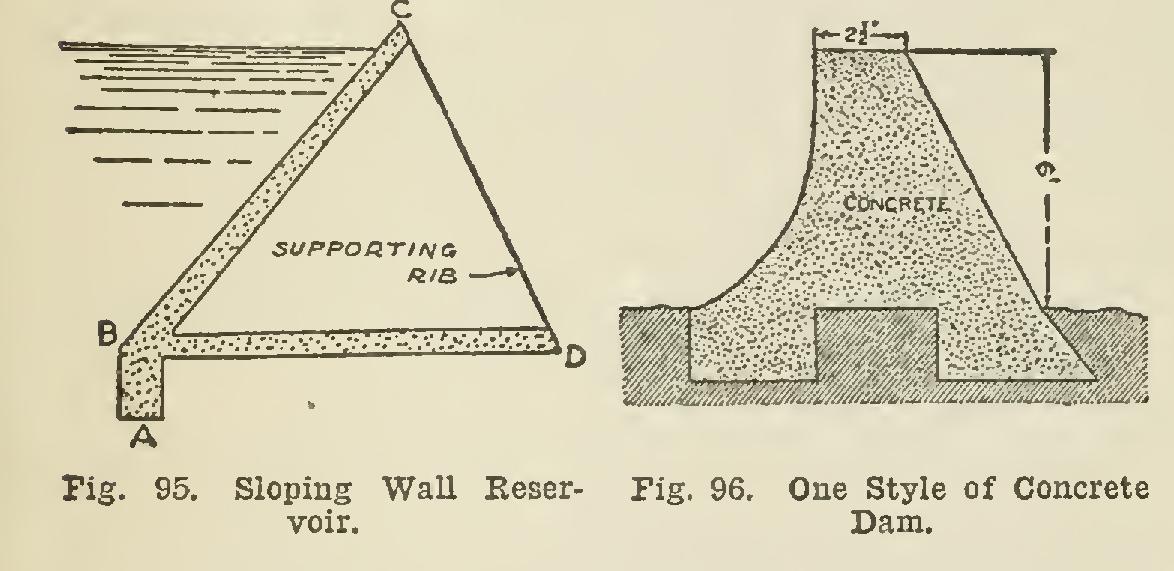
"Type 2—Sloping Walls. This type of wall, which is illustrated in Fig. 95, is desirable and economical under some conditions. The deck B-0 is carried on the but tresses or walls B-C-D, which in turn may be carried on a continuous footing or rest on isolated footings. When a rock foundation is available, the buttresses are built directly upon the same, and the apron A-B let into the rock a suitable depth. With independent footings, a small leakage would not endanger the stability of the wall, and could easily be taken care of. This type of structure has been extensively used for dams, and has proven entirely successful." A Great Concrete Dam. The city of Sydney, N. S. W., Australia, is at last assured against a water famine, now having a water supply for its growing population, which at the present time is close up to 600,000. The great Cataract Dam is completed, and the supply is derived from the Nepean and Cataract rivers.
The catchment area of 354 square miles, with the good rainfall which is characteristic of the coastal districts of New South Wales, is ample for the requirements of the city, even supposing enormous expansion, but the existing storage at Prospect (only 5,446,000,000 gallons by gravita tion) is quite inadequate; and further, as the water from the rivers mentioned is conveyed to Prospect by a system of canals and tunnels, hav ing a daily capacity of only 150,000,000 gallons, the storm flow of the rivers cannot be fully availed of, and must be increased shortly by additional works.
Occasionally, for some years back, and espe cially in 1902, severe droughts occurred, and the Prospect reservoir was drawn on to such an ex tent as to cause anxiety as to the supply. Owing to this, and to the concurrent steady increase in the population of the city and suburbs, serious shortage of water was feared; and though the citizens of Sydney were never placed on a limited supply, except occasionally in the matter of water for ornamental gardens, it was felt that, in view of the future, more of the water available during rainy years must be impounded for the city supply. For that reason, therefore, the ma
sonry and concrete dam has been erected on the Cataract river, with a storage capacity of 21,411, 500,000 gallons.
The body of the Cataract dam (Plate 29) is com posed of Cyclopean rubble masonry, consisting of blocks of sandstone weighing from two to four and one-half tons, built to break joint both vertically and horizontally, and to have a maximum of bond. The stones are bedded in cement mortar, and the vertical joints are made with concrete. The proportion of blocks to concrete and mortar is approximately as 65 to 35. The up-stream face consists of concrete blocks 5 feet by 2 feet 6 inches by 2 feet, set upon and jointed with special cement mortar and backed by an average of 3 feet of basaltic concrete. The down-stream face is of concrete 6 feet thick ; the foundations of the dam have been carried to a depth of 35 feet below the bed of the river in solid sandstone rock. Reinforced concrete is used in the construction of the valve chambers at the base of the dam. The fol lowing figures give the main dimensions: Length of dam, feet 811 Height above river bed, feet 157 Depth below river bed, feet 35 Total height from base to top, maxi mum, feet 192 Top width, feet 16% Bottom width, feet 158 Maximum depth of the water, feet 150 Total storage capacity, gallons 21,411,500,000 Area covered by water, acres, approx 2,400 Material in dam as completed: Hearting masonry, cubic yards 111,455 Rubble masonry, cubic yards 1,975 Concrete, cubic yards 23,846 Facing blocks, cubic yards 8,966 Total, 146,242 Total cement used, tons 19,000 Quantity of excavation in connection with works, foundations, by-wash, etc., cubic yards 215,000 Ironwork in pipes, valves, etc., tons 319 Three classes of concrete were used in the dam, of which the following is the specification: "No. 1 Concrete. For use in the up-stream face blocks, the lining of off-take vertical shafts, and all sur faces exposed to the water, was composed of the follow ing proportions: Cement, 375 pounds; sand, cubic feet; bluestone and shivers, 15 cubic feet; the bluestone and shivers was in proportion of 3 parts of stone to 2 parts of shivers.