Hip Roof Framing
cut, rafter, blade, tongue, common and length
HIP ROOF FRAMING We have already referred to the great variety of problems—many of them of considerable com plexity, depending on the greater or less com plexity of the kind of roof selected for the struc ture—that arise when the carpenter is con fronted with the problem of putting on the roof. These problems will vary with the number of hips and valleys, the pitch, length of run, etc., but the fundamental principles involved in their solution are not many; and a familiarity on the part of the carpenter with the steel square will enable him to solve them all.
A Formula in Figures.
We first lay off com mon rafter, which has been previously explained; but deeming it necessary to give a formula in figures to avoid making a plan, we take one third pitch. This pitch is one-third the width of building, to point of rafter from wall plate or base. For example, always use 8, which is one third of 24, on tongues for altitude; 12, one-half the width of 24, on blade for base. This cuts common rafter. Next is the hip-rafter. It must be understood that the diagonal of 12 and 12 is 17 in framing, and the hip is the diagonal of a square added to the rise of roof; therefore we take 8 on tongue and 17 on blade; run the same number of times as common rafter, these figures also give the seat and plumb cut of the hip. To cut jack rafters, divide the number of openings, for common rafter. Suppose we have five jacks, with six openings, our common rafter is 12 feet long, each jack would be two feet shorter. First 10 feet, second 8 feet, third 6 feet, and so on. The plumb cut is the same as for the cut of com mon rafter; seat cut also the same as for the com mon rafter. To cut miter to fit hip. Take half the width of building on tongue and length of common rafter on blade; blade gives cut, or the same result may be found by taking the diagonal of 12 and 8, which is 14 7-16, then take 12 on tongue, 14 7-16 on blade; blade gives cut.
Side Cut of the Hip.—In connection with the hip there must be another cut considered, called the side cut of the hip, though the angle to obtain this cut is across the top or back of the rafter. Were there no slope to the roof, this
angle where it meets the ridge pole would be an angle of 45 degrees, but when a slope is given this angle becomes more acute. The rule is, take the length of the hip on the blade and its run on the tongue, the blade gives the cut or take 17 on the tongue and 18i on the blade, blade gives the cut as shown in Fig. 41.

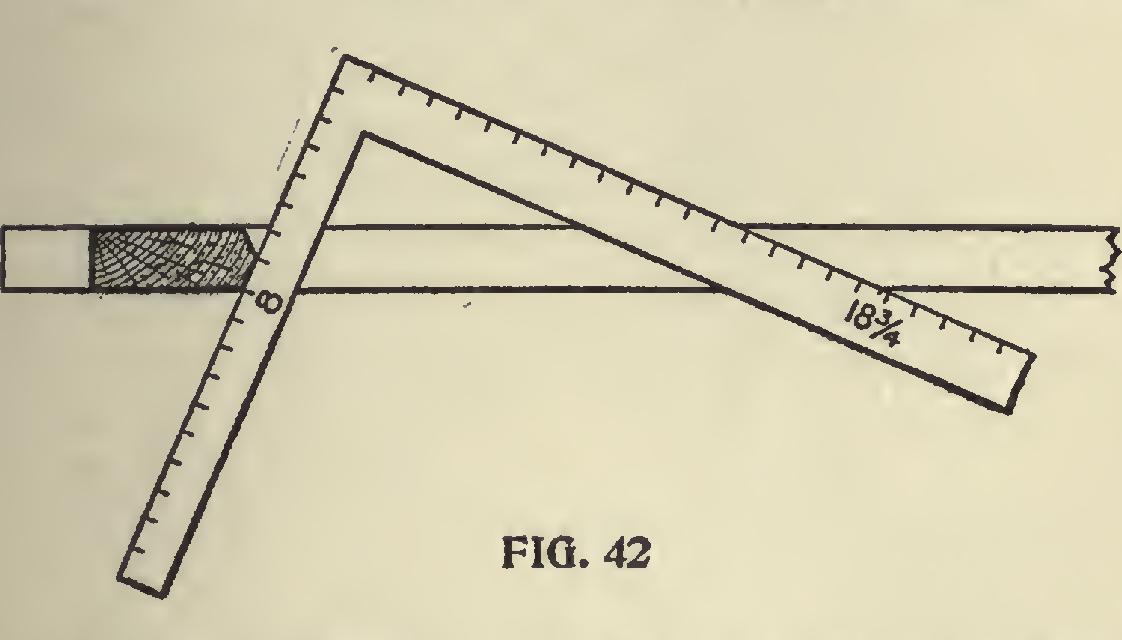
Beveling of Hip Rafter.—The hip-rafter should be beveled so as to be in plane of the common rafter; height of hip on tongue, length of hip on blade; tongue gives bevel, or we take 8 on tongue, 18-1 on blade; tongue gives bevel, as shown in Fig. 42. These figures will cover all cuts in putting on cornice and sheathing.
To Cut Bed Moulds For Gable to
fit under cornice; take half the width of the building on tongue, length of common rafter on blade; blade gives cut; machine mouldings will not member, but this gives a solid joint; and to member prop erly it is necessary to make the mouldings by hand, the diagonal plumb cut differences.
To Cut Planceer, to Run Up Valley: Take height of the common rafter on tongue, length of rafter on blade; tongue gives the miter cut. The side cut takes the length of common rafter on blade, and run on tongue; tongue gives cut.
These figures give the cuts regardless of width of building.
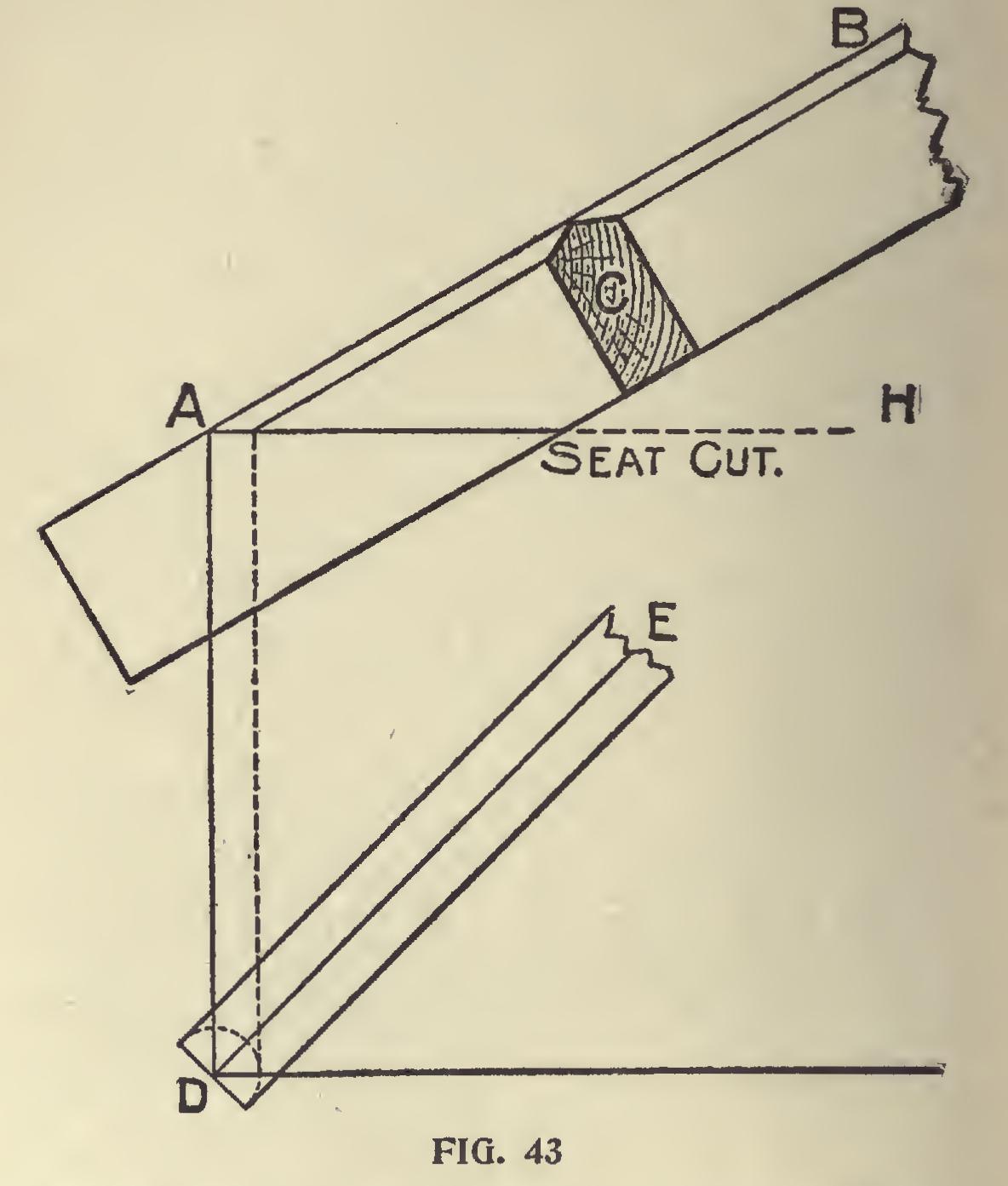
Fig. 43 applies to backing of hips where the corner is at right angles and the pitches are the same. At the angle D will be seen the inter section of the sides of the angle rafter with the sides of the plan.
With one point of the compasses at D, de scribe the curve from the line as shown. Tan gential to the curve draw the dotted line, cutting All, then draw a line parallel to A B, the pitch of the hip. The bevel will be found at C, which is a section of the hip-rafter.
The Principles to Be Determined in a Hip Roof are eight, namely: 1st. Span or width of building to be roofed. 2d. Run of the building, which is / the span. 3d. The rise given the common rafter.