Hip Roof Framing
cut, line, jack, length, jacks, valley and square
Therefore, reductions should be made from the lengths here calculated by squaring back from the plumb cut one-half the thickness of the ridge board, which will give the point for the proper cut for the common rafters and jacks that fit against same. For the jacks that fit against a hip or valley for a square cornered building, deduct one-half the diagonal thickness of the hip it rests against, by measuring square back from the plumb cut. Rafters are usually about 1i inches thick, and the proper reduction in that case would be practically 11 inches. However, the jacks will fit just as well though they will be one-half of their thickness out of their regular spacing, or if the measurement line is taken on the long side of the jack, then they will be of the proper length without any reduction.
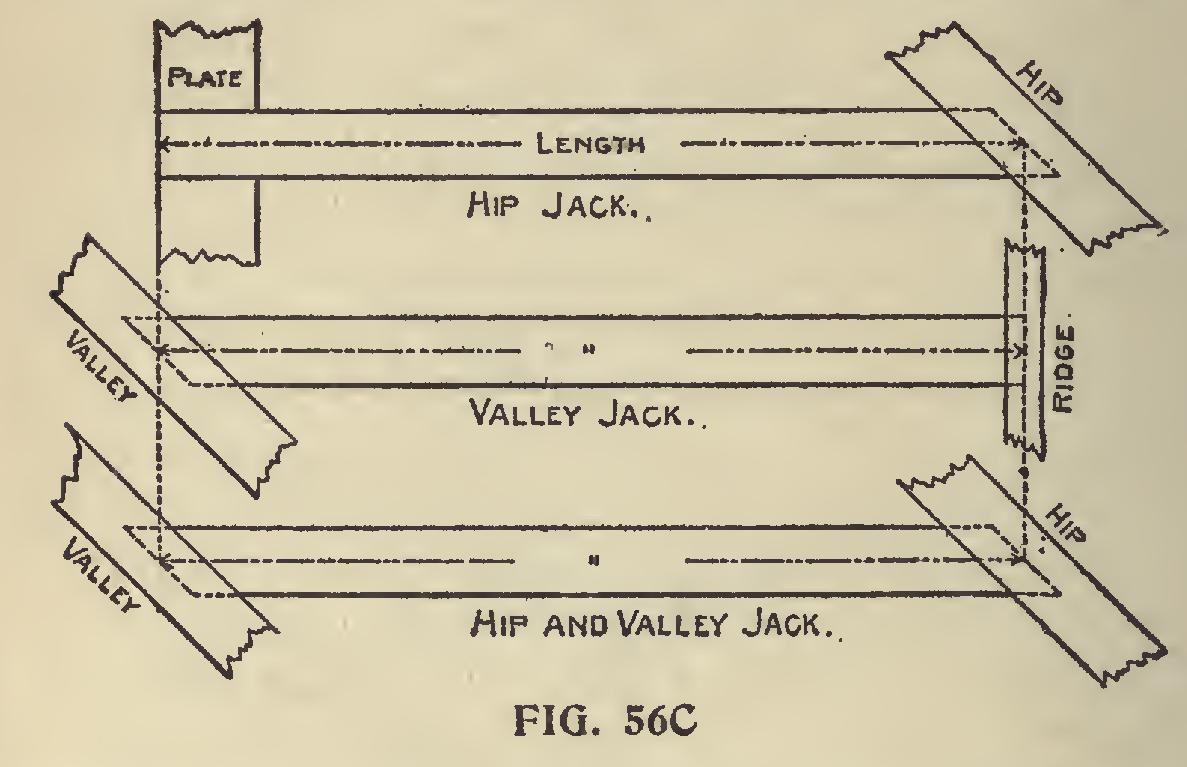
Different Kinds of Jacks Described.—There are several kinds of jacks and while we are at this point it might be well to describe them. They are known by the position they occupy as follows: A jack with the upper end resting against a hip is called a hip jack. A jack with the upper end against the ridge board and the lower end against the valley is called a valley jack.
A jack cut in between a hip and a valley is called a hip and valley jack, or more 'generally known as a cripple jack. The latter in many cases is a very appropriate name, however, we prefer to call them by the former name.
In Fig. 56c is shown a plan of these jacks.
The measurement line is at the center of the back in each case and shows all of them to be for the same length of run, the dotted lines showing the amount of the reduction to be made to fit to their proper place. In this, it will be seen that the cut across the back of the jacks(com monly called side cut) is at an angle of 45 degrees and this remains so regardless of the pitch given the roof. Therefore, the side cut of a jack, in one sense of the word, is a miter just the same as for a square-cornered frame. To prove this, after the side cut has been made for any pitch, cut off the peak end of the rafter on a line parallel with the seat cut and it will be seen that the angle is at 45 degrees, just the same as shown in the plan.
Hexagonal Roofs.—Take 6 and fifteen-six teenths on the tongue and 12 inches on the blade, and apply as shown in Fig. 57, and it will give the miter.
The side of a hexagon equals the radius of the circumscribing circle. The square width is determined from two parallel sides; a diagonal of the figure, is a line from opposite angles. The first pair of hips are set up as in an octagonal roof. The second and third pairs have a side bevel. To find this, take half the side of the hexagon on the tongue and half the square width added to the gain of the hip-rafter in running that dis tance, on the blade. The tongue gives the cut. Strike the bevel across the rafter. Now, the second and third pairs are to be measured back shorter than the first pair, on their middle lines, just half the length of this bevel. The third pair has the bevel cut on both sides from the center. The backing of the hips is found by taking 7-12 the rise of roof on tongue and the length of hip on blade; the latter gives the cut. The side of the hexagon is 7-12 its square width, or apothegm. The lengths and bevels of the jack-rafters are found as in octagonal roofs.

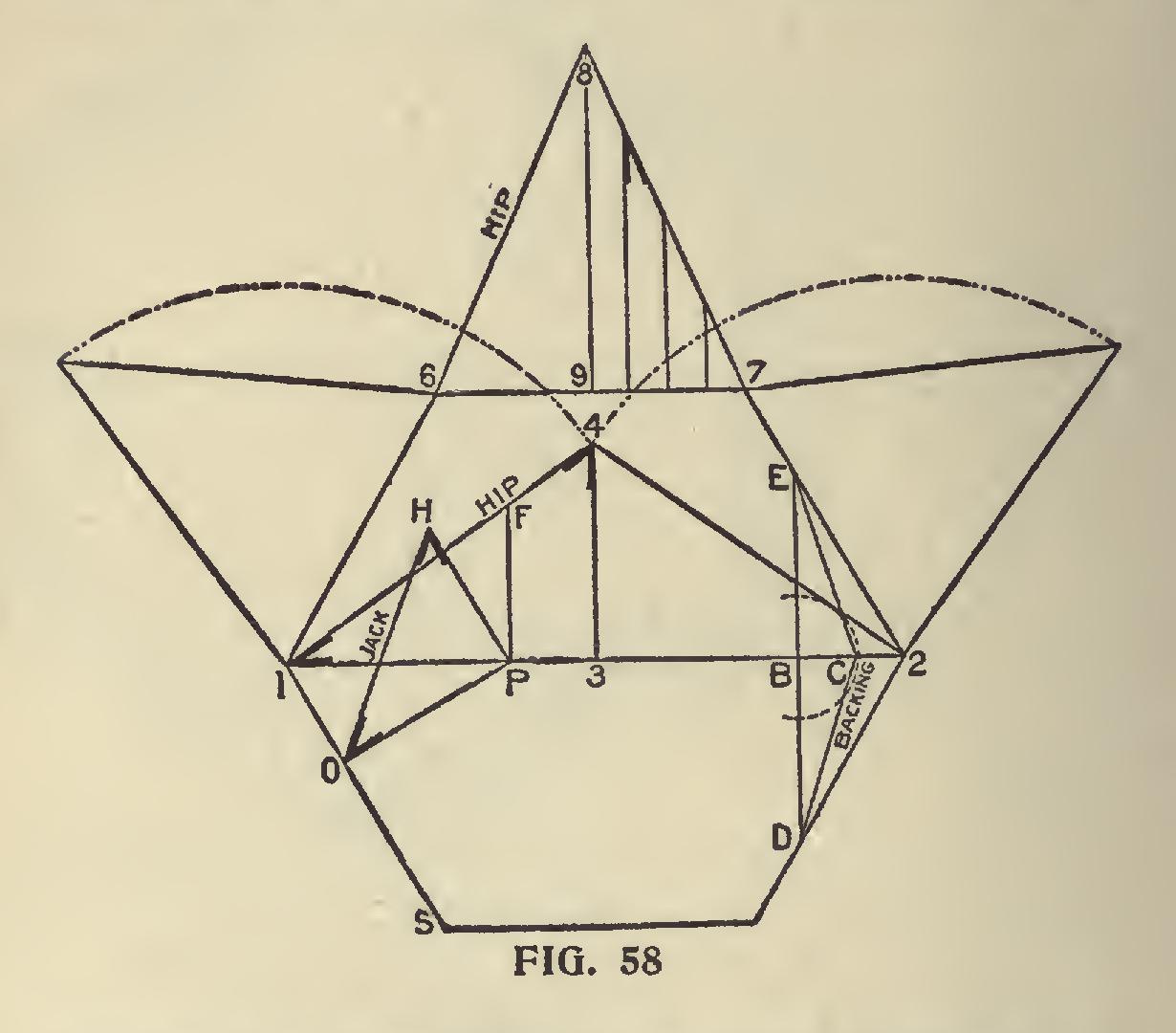
To Timber a Hexagon Roof.—On the line 1-2, Fig. 58, is the seat of the hips, 3-4 will be the rise. On the line 1-S say at 0, draw a line at right angles touching the line 1-2 at P which is the seat of a jack rafter. From 0-P at right angles draw P-H equal to P-F, and connect OH: this gives the length, seat and plumb. cut of jack rafter. From 6-7 draw the line 8-9 indefinitely; set the compasses to 1-4, which is the length of the hip, and this length at 6 intersect 9-8 at 8, repeat from 7, which is the covering for one side of the roof, the intermediate lines being the lengths of jack rafters and bevels for side cut. On the line 1-2, say at B, take B for a center, touching the line 4-2, for radius, describe the arc BC; through B, at right angles to 1-2, draw the line DE, and from C to E and C to D will be found the bevels for backing the hips.