Hip Roof Framing
length, cut, run, square, blade, jack and octagon
Octagonal Roofs.—Fig. 52 represents an octag onal roof. In its construction the suggestions following, on octagons, must be referred to.
To find the side of an octagon when the side of the square is given. Multiply the side of the square by 4.97 and divide by 12. The quotient is the side of the inscribed octagon.
To continue with an octagon roof ; the length of hips is found as usual from rise and run, the run being half the diagonal of the octagon. Cut the first pair full length to butt against each other; the next pair are to be set up at right angles to these, and each is to be cut shorter than the first pair by half the thickness of first pair, measured square back from the down bevel. The third and fourth pairs are to be cut shorter than the first by half the diagonal of a square whose side is the thickness of the first rafters. If the thickness of the first pair is 2 inches, then the third and fourth pairs are shortened by 1 and 5-12, as 2 and 10-12 is the diagonal of a square whose side is 2.

The first and second pairs have no side bevels; the side bevels of the third and fourth run back on both sides from the middle of the rafter. Find this bevel by taking the original length of rafter on blade and its run on the tongue, when the blade shows the cut. The backing of the hips obtain by taking 5-12 of the rise on the tongue and the length of hip on blade, the latter giving the bevel; for the side of an octagon is 5-12 its square width.
Half the square width is the run of the middle jack rafter, from which and its rise we get its length. From the length deduct the same amount as from the third and fourth pairs of hips. If there are to be two jacks between the middle one and the corner, we divide the length of side into three parts, also the rise, whence are ob tained as before the distance of rafters apart, and the rise of the shortest jack. Divide half the square width of octagon by three to find the run of shortest jack. Just as the square is laid on to find the length of a jack, it gives the down and lower end bevels; while the side bevel is obtained by taking length of middle jack on blade and half one side of the octagon on the tongue; the blade giving the cut.
Lengths and Bevels of Hips and Jacks.— The following illustra tions and reading mat ter are from Mr.Woods'
pen and are largely self-explanatory. They show the lengths and bevels of hips and jacks for an octagonal tower roof. The seat and plumb cuts are found in the usual way of taking the pro portion of the run and rise on the tongue and blade but there must be an addition al or diagonal cut across the back of the jack to fit against the hip, as shown in Fig. 53 by the dotted lines at A-B. These lines are always ver tical and the same distance apart re gardless of the pitch given. A diagonal line from A to B across the back of the jack determines the angle.
Fig. 54 illustrates this point. If there were no pitch at all then 5 and 12 would give the cut. These figures also give the starting lines A and B, which, since the rafters are of the same thick ness, will remain at right angles the same distance apart. Thus, if the rafter be 2 inches thick, the lines A and B will be 4 inches apart.
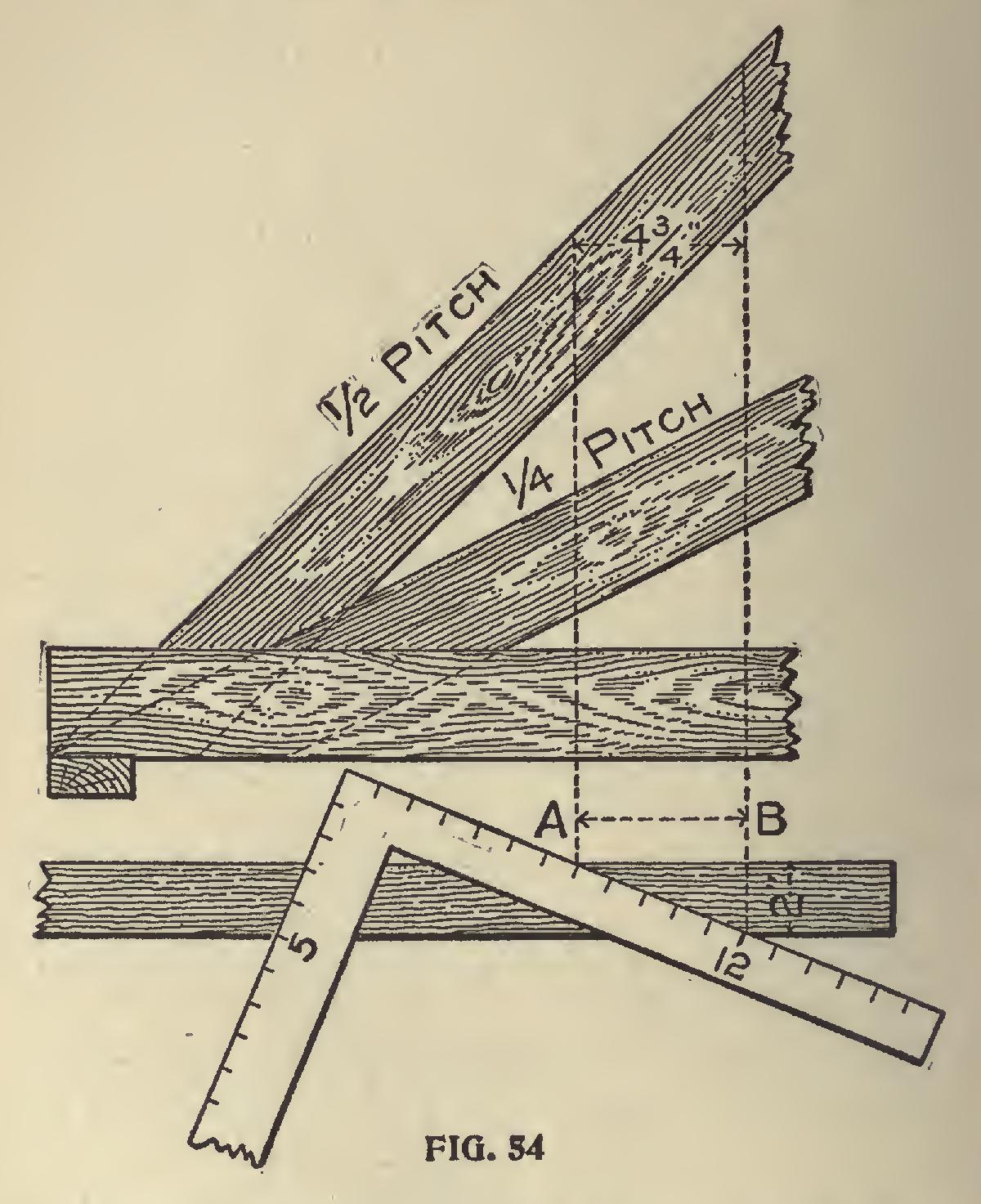
The jack cut may also be found as follows : Take 5 on the tongue and the length of the com mon rafter for one foot run on the blade, the blade giving the cut. Thus it will be seen that when the principles of roof framing are under stood it is not neces sary to lay out an elaborate diagram. A simple line drawing like that shown in Fig. 55 illustrates all that is contained in Fig. 53.
In the plan shown in Fig. 53 it will be seen that the hips do not come to a common center within themselves, but instead are resting against a center piece which may be a finial or flag pole, and in that case furnishes an excellent bracing for same, but when this is used the lengths of the hip must be shorter. The best way to obtain this is to find the full length of the hip and lay off the plumb cut and from this at right angles measure off one half the thickness of the pole, which will give the proper point of the plumb cut. When this pole is omitted the common way is to let one pair of the hips butt against each other as shown in Fig. 56. The runs are reckoned from the outer edge of the plates to the center, as GO for the common rafter and OF for the hip, but since all of the rafters do not run to the center there must neces sarily be a deduction from the runs, as given above.