80 Heating and Ventilation
tank, pipe, mercury, pressure, system and chamber
The mains should have an area of approxi mately 100 square inches for each 100 square feet in direct radiators supplied, and all branches should be of the same size pipe as the risers which they feed, with the exception that when a branch of extended length is taken from near the end of an extremely long main, the branch should be one size larger than the riser. Table VII gives the sizes of mains required to supply varying amounts of radiating surface under the accelerated system.
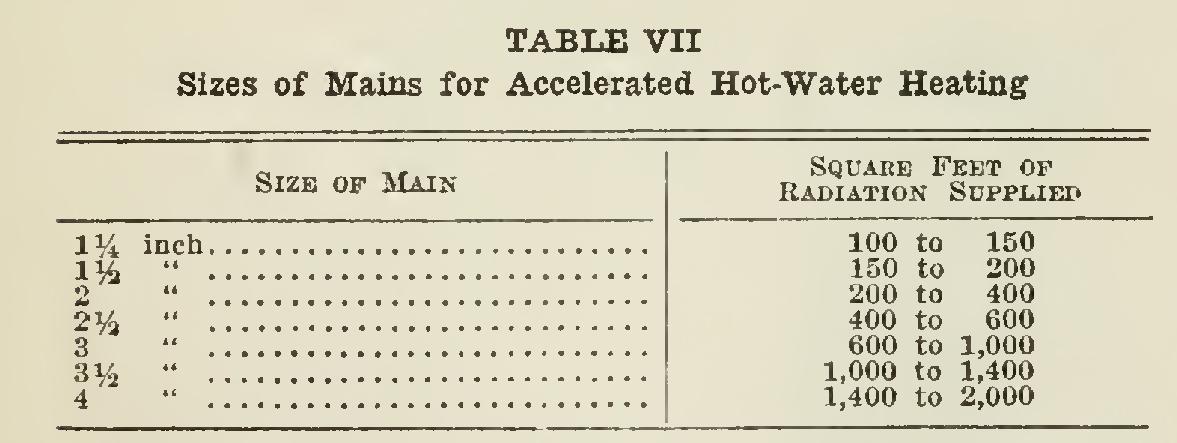
Fig. 70 shows a plan of a small accelerated job of thirteen radiators, with the sizes of flow and return mains, branches, radiators, and valves marked. For convenience in illustrating, the piping is shown on the first-floor plan.
The oblique lines denote risers to second-floor radiators.
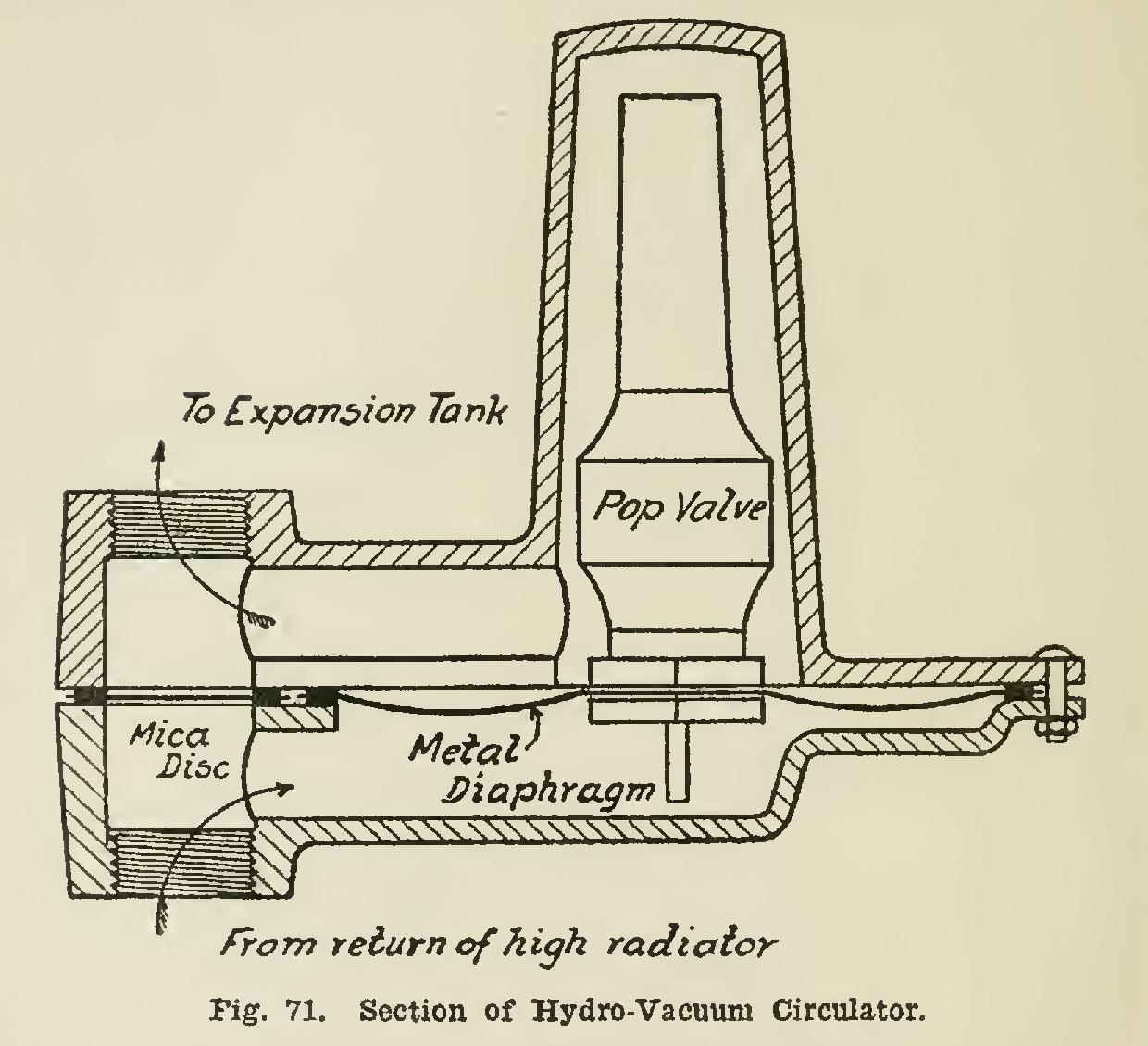
The success attained by the use of these sev eral original methods of accelerated hot-water heating has led to the placing upon the market of several new appliances, all aiming to "assist" the circulation in the apparatus. One such de vice called the Hydro-vacuum Circulator con sists of a pop safety-valve enclosed within a housing, the attachment being placed upon the expansion pipe. Fig. 71 is a sectional view of the appliance, showing the pop valve referred to, the seat of which is held in position by a metal diaphragm, very thin and as resilient as a rubber cushion. The contraction of the water in cooling produces a pull (created by vacuum) on the under side of the diaphragm, which force, together with the weight of water in the expan sion tank and in the pipe above, opens the valve by depressing the seat, thereby allowing the water in the tank to enter the heating system. As a safeguard against a possible sticking of the valve, the straightway passage through the cir culator is closed, as shown in the illustration, by a disc of amber mica which will break under a pressure of about twenty pounds. This pro vision thereby makes it impossible to accumu late a dangerous pressure on the system.
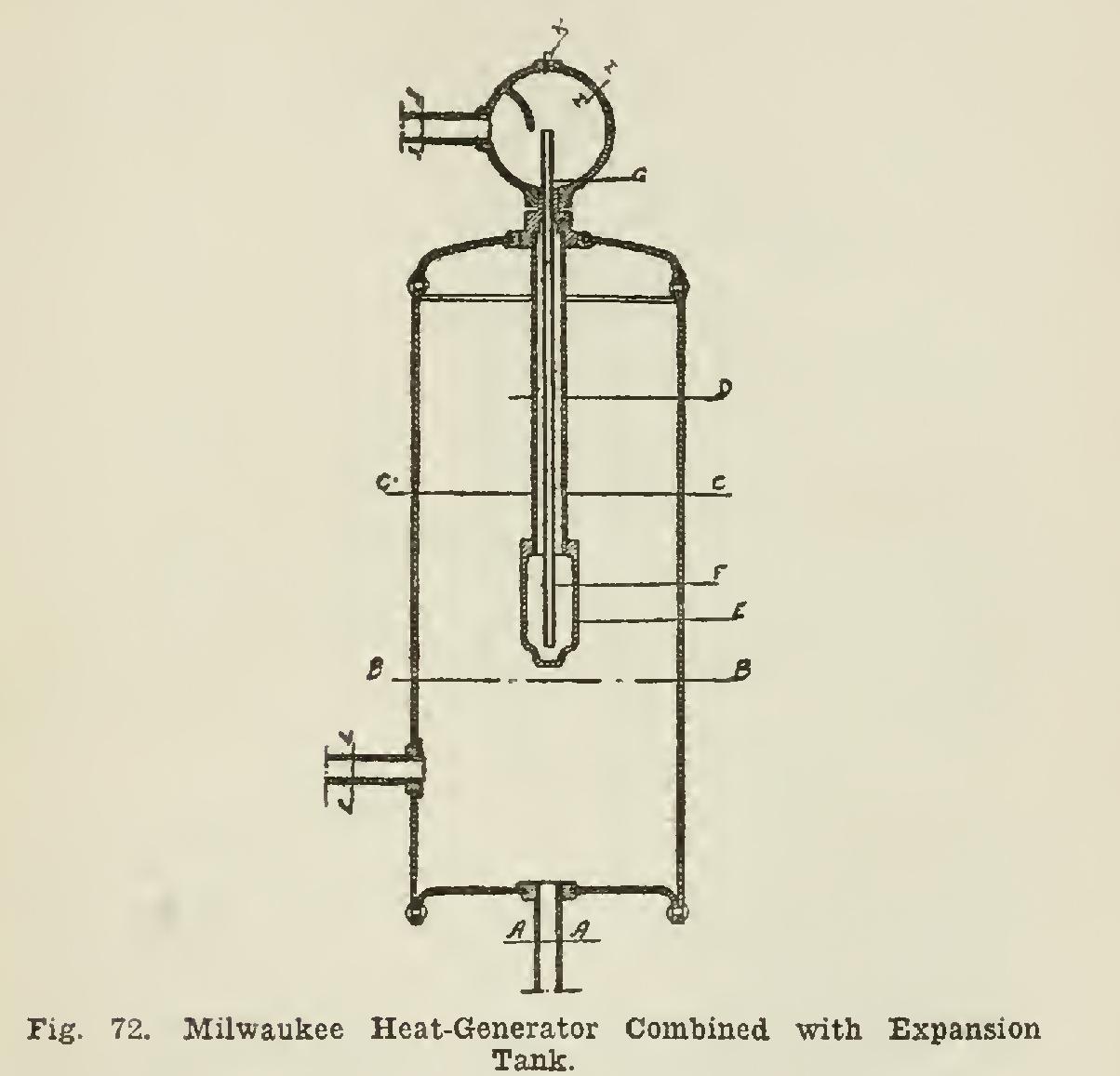
Another device for accelerating circulation by pressure is the Milwaukee Heat-Generator, a mercury appliance contained within the expan sion tank, as illustrated in Fig. 72. A mercury
pot is held suspended within the center of the tank, by a pipe which screws into an opening at the top end of the tank; and a round separating chamber is screwed on the top end of this tank. A small circulating pipe is contained within the larger one, the lower end being submerged in the mercury, from which it extends upward through the top opening of the tank into the separating chamber. The outer casing of pipe is provided with two holes at C C.
The tank is filled to about one-quarter its capacity; and the water, expanding when heated, forms an air cushion at the top of the tank. The' pressure entering the outer casing or pipe through the openings C C presses down upon the mercury, forcing it up to the circulating tube. When the mercury reaches the point marked G at the bottom of the separating cham ber, there should be about ten pounds pressure on the system; and a further increase in tem perature will cause the mercury to spill over or discharge at the top of the circulating pipe into the separating chamber, this action relieving the pressure on the system. The mercury which in this manner finds its way into the separating chamber, then re-enters the circulating tube through the small opening provided at G, and drops to the mercury-pot.
In Fig. 72, A A is the expansion pipe; B, the normal height of water in the tank; C C, the openings in the outer tube or casing marked D; E, the mercury pot; F, the circulating tube; G, the opening in tube F at the bottom of the sepa rating chamber H; J J, the overflow and vent pipe; K, a plugged opening for admitting the mercury to the device.
There are other devices of a similar nature for accelerating hot-water circulation; but the descriptions of those already mentioned will give the reader an idea of the general construction and operation of practically all other types.