80 Heating and Ventilation
system, water, size, circuit, radiation and fig
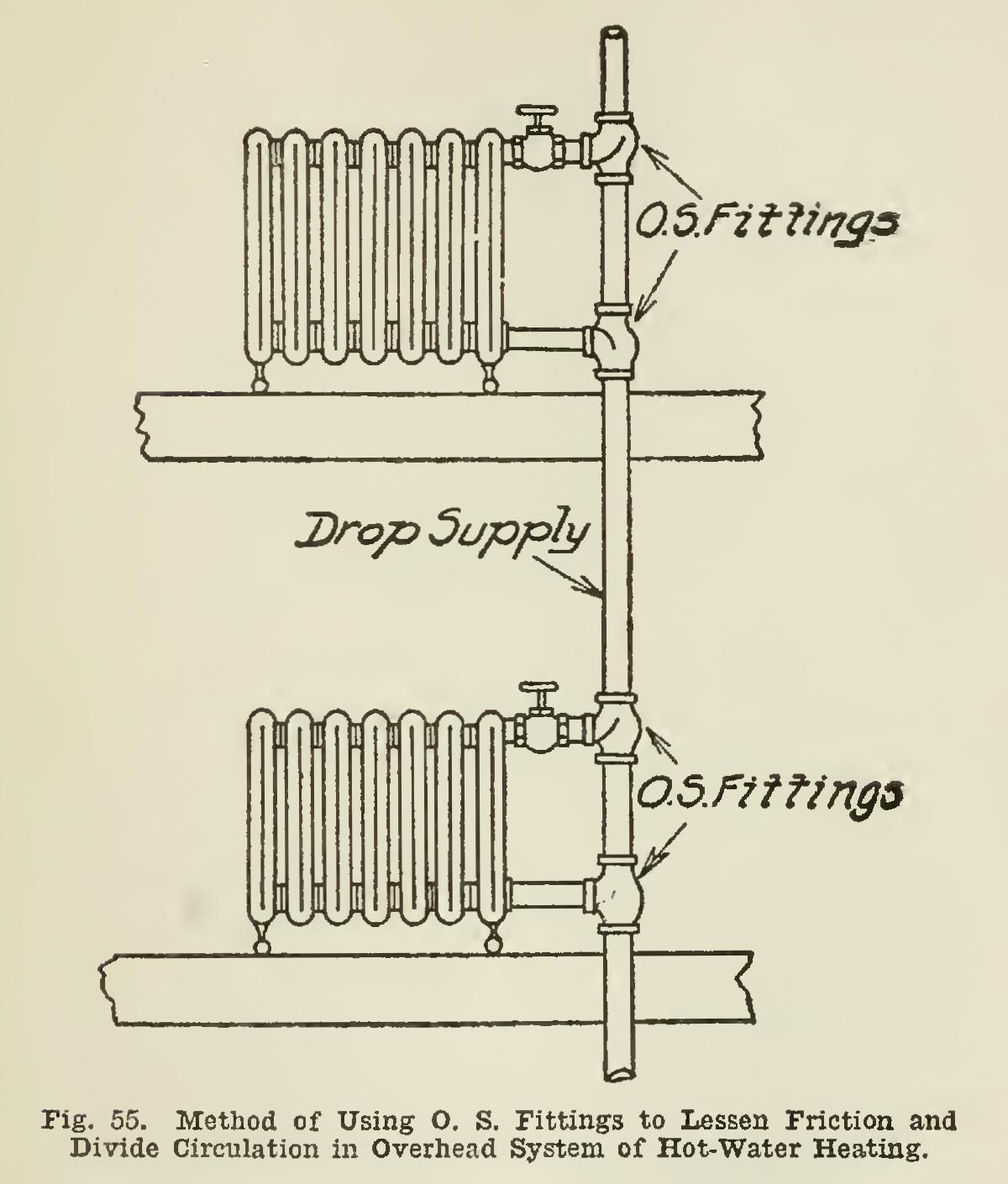
80 HEATING AND VENTILATION Like the overhead steam system, the over head hot-water system is especially adapted to large buildings where each drop may supply a line of radiators on the various floors below. It is particularly positive in circulation, owing to the pressure developed by the weight of the water.
Circuit or Single-Main System.
The one pipe circuit system of hot-water heating has been widely used in America, particularly throughout the Western and Middle Western States, having found favor among many heating contractors and engineers; and while there is much that can be said in approval of this sys tem, the elimination of some of its present fea tures would add greatly to the advantages derived.
In this system a single pipe does the double duty of a flow and return main, in quite the same manner as a one-pipe steam main. Starting from the heater, this pipe rises to as high a point as the height of the cellar will permit, whence it has a gradual fall or pitch from the heater approximately one inch in each ten feet of length. The expansion tank is connected from the high point of the main above the heater. The flow branches are taken from the top of the main, the returns from the radiators entering the main at the bottom and traveling in the same direction as the flow of hot water. The return or cooler water, however, does not mix with the hot water, owing to the fact that as the latter is lighter it hugs the top of the main.
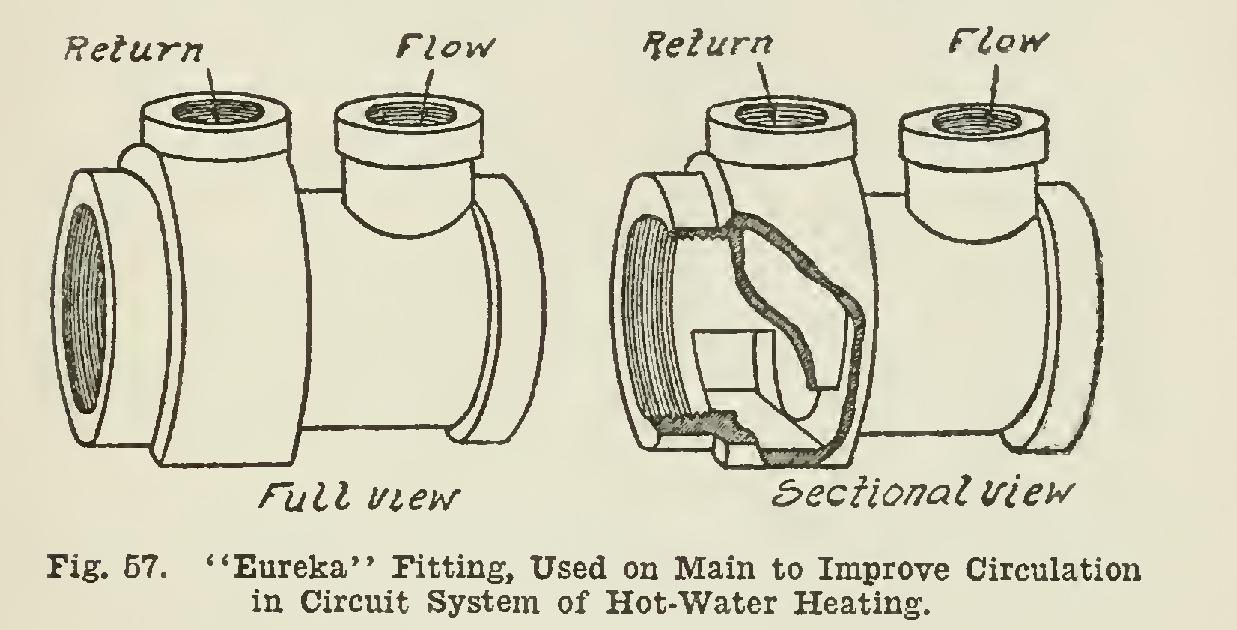
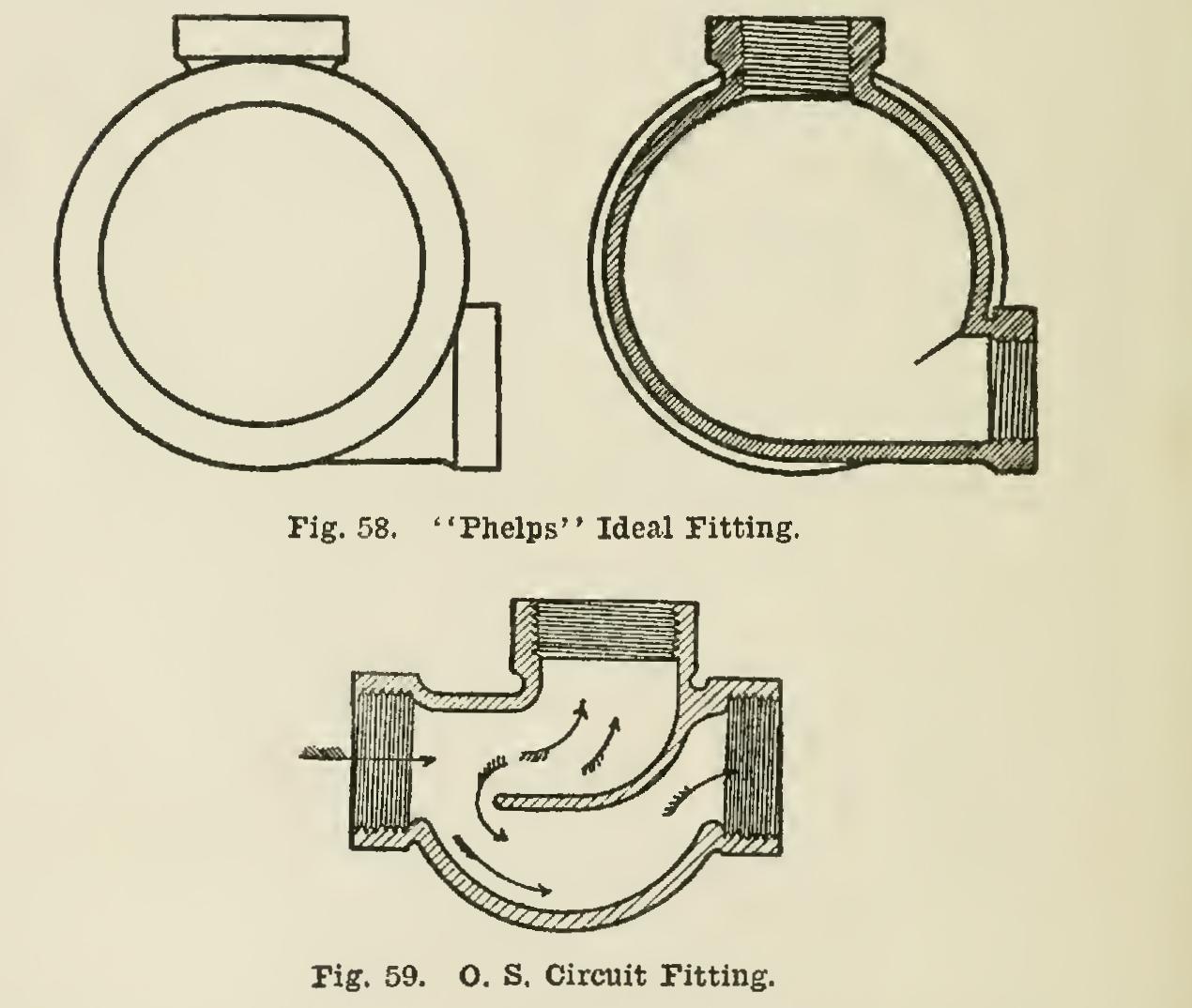
Fig. 56 gives a general idea of the construc tion of this system and the manner of making connections to the radiators. There are several special fittings which may be used on the main to improve the circulation, one of which—the "Eureka"—is illustrated in Fig. 57. The broken view shows the interior arrangement providing for the return of the circulation into the main on its under side, through the bottom of the fit ting. Fig. 58 shows a special style of tee having top and side on a line, with outlets at the top and bottom; this device is known as the Phelps Ideal Fitting. The 0. S. Circuit Fitting is shown in Fig. 59.
In Fig. 56, each of these special fittings is noted on the main; and we might say that one advantage gained by their use is that a single fitting, as in the case of the Eureka or Phelps type, takes care of both flow and return branches, thus overcoming additional pipe cut ting and the threading of the large pipe.
As the hottest water is that part of the sup ply nearest the heater, it is well, if possible, to feed first those radiators which are located on the cold or exposed side of the building; other wise, should the main be of any considerable length, it will be necessary to increase the radi ation connected from the last leg of the circuit, in order to obtain desired results in that portion of the building.
When heating a church or similar structure, the usage of a large proportion of the piping and fittings which would necessarily be required on an ordinary installation may be avoided by adopting this system. Inasmuch, however, as residences are as a rule compactly built, the warming of homes can in general be better served with the two-pipe system.
Sizes of Mains for Hot-Water Work. The size of main necessary for an ordinary system of hot-water heating depends upon the size of all the different branches and the ampl. of radiation fed by each. Table V gives the mini mum and maximum amounts of radiating sur face which should be served by different sizes of mains.
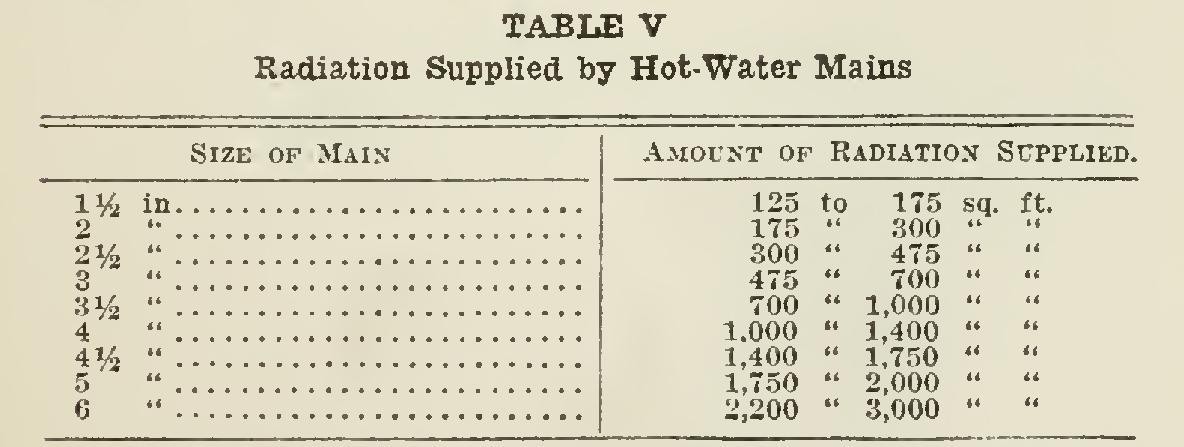
Where the quantity of radiation is scattered —that is, composed of a large number of radi ators—the size of main called for by the mini mum amount is the proper one to select. Where the surface is compact, or divided into large units, the size indicated by the maximum amount is the correct main to use. With the gravity system of hot-water piping, open-tank generous sized mains will afford the best service.
For a circuit job of hot water, use the size of main indicated for the minimum amount of radiation in Table V. For example, for 475 square feet of radiation, use a 3-inch main; for 1,000 square feet of radiation, a 4-inch main; and so on.