Hot-Air Heating
furnace, feet, cubic, cent, add and surface
HOT-AIR HEATING The "hit or miss" methods which have been and are still followed to a great extent in the installation of furnaces and. other details of hot air heating apparatus, have brought this type of modern heating system into general disrepute by reason of the poor results necessarily ob tained. In many cases the furnace-man or tinner seems to possess no idea of the proper method to follow in setting the furnace, running the hot-air pipes, or locating the registers; or— if knowing—seems not to care. It is careful attention to these details, however, which will naturally assist in securing a satisfactory job.
Cheap competition work incidental to large building operations where several houses or groups of houses are erected collectively in rows or in pairs and offered for sale by the builders— "operation work," as it is called—has resulted in the placing of thousands of furnaces too small in capacity to operate properly, and of so cheap a construction as to be practically worthless after a few seasons' use.
The proper preparation of a building for the installation of a furnace begins with the foundation, as the chimney for the use of the apparatus should be located in such a position that the furnace may be set well towards the north and west sides of the cellar or basement The furnace should be placed in this position in order to have the shorter warm-air pipes serve the colder part of the house, as it is extremely difficult to force warm air towards the north or west through piping of exceptional length.
Under ordinary conditions the furnace should be set not more than six feet distant from the chimney flue. It is far better, how ever, to double the length of the smoke pipe in order to be able to locate the furnace toward the west or north, than it is to double the length of the hot-air pipes, if either one of these two con tingencies arises.
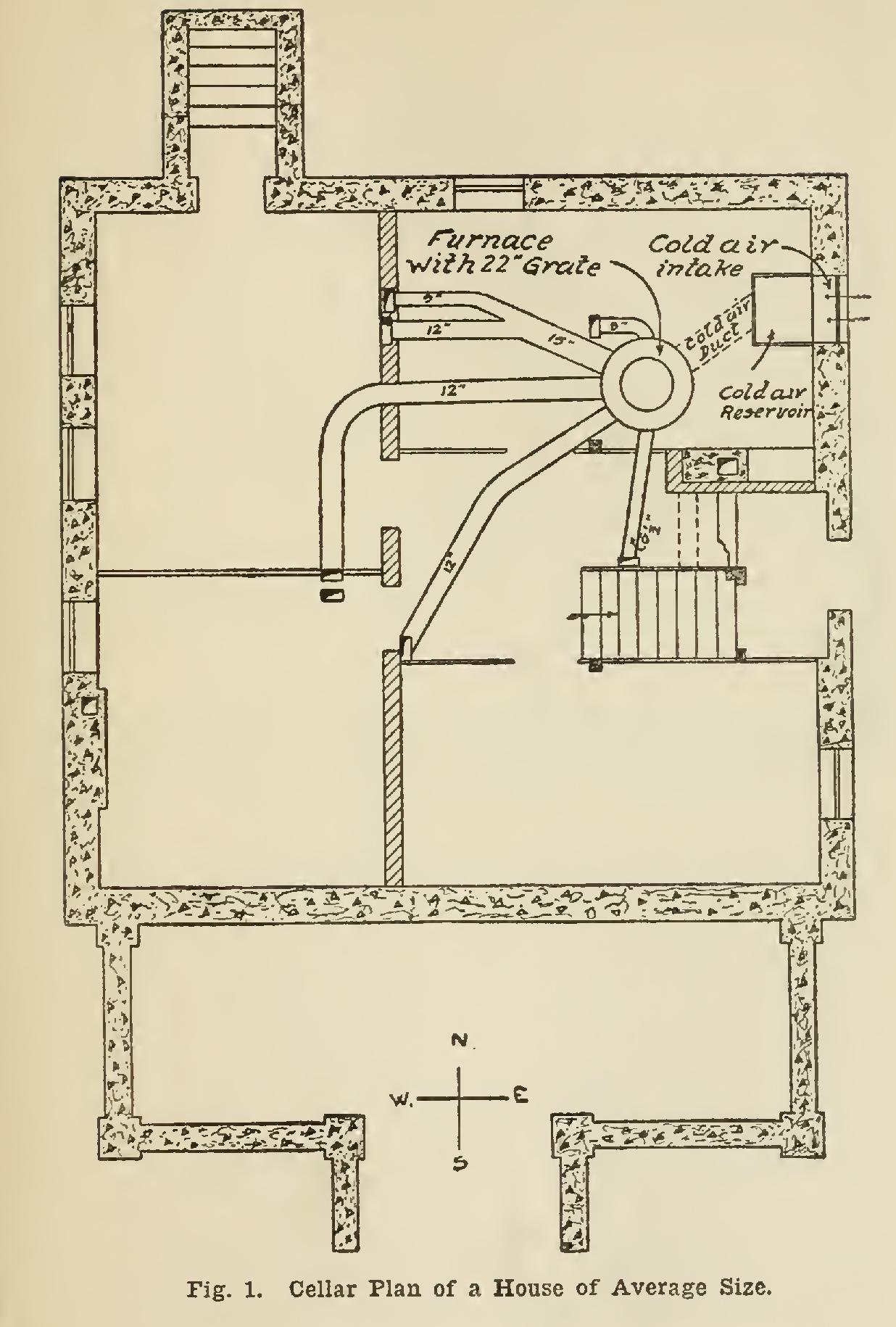
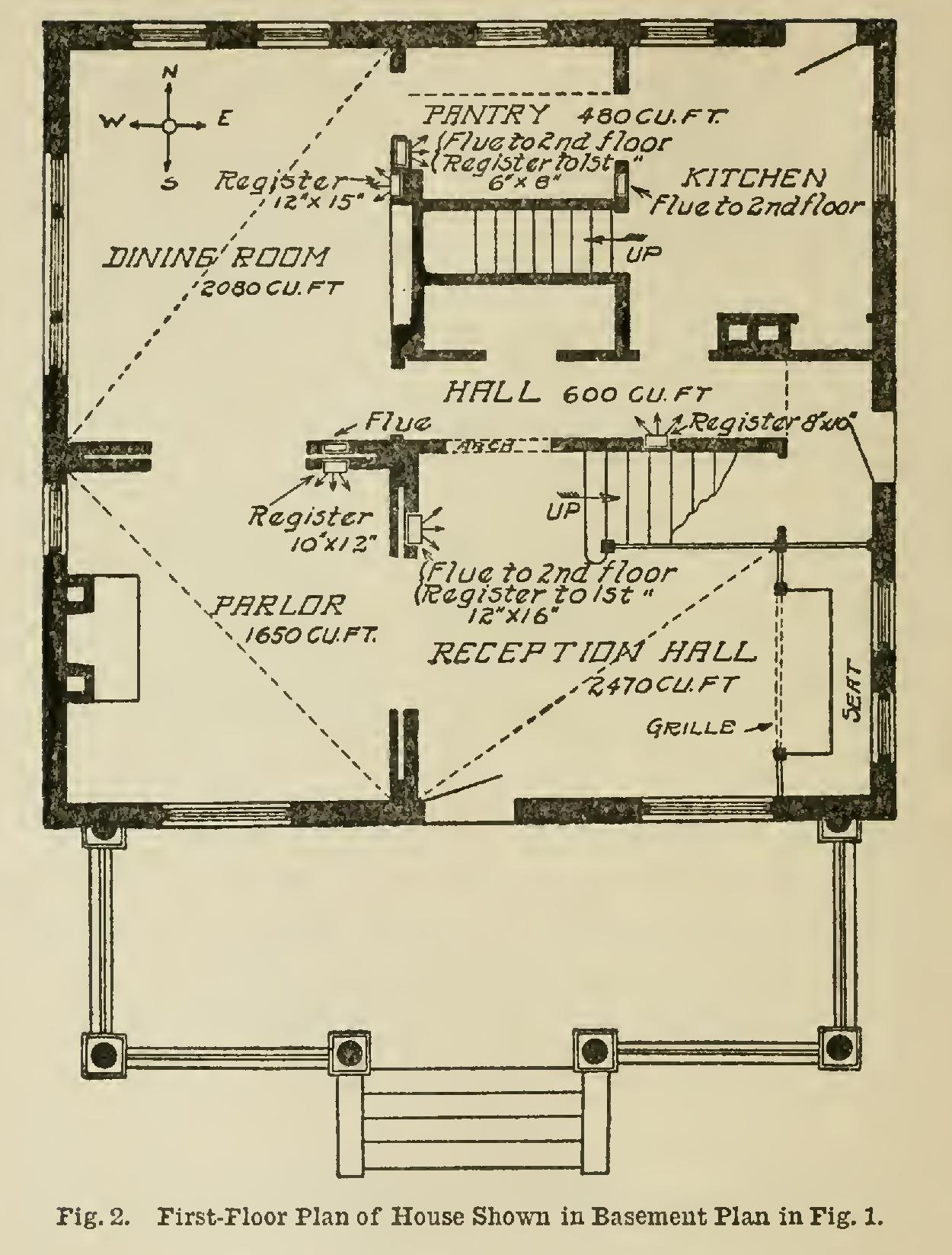
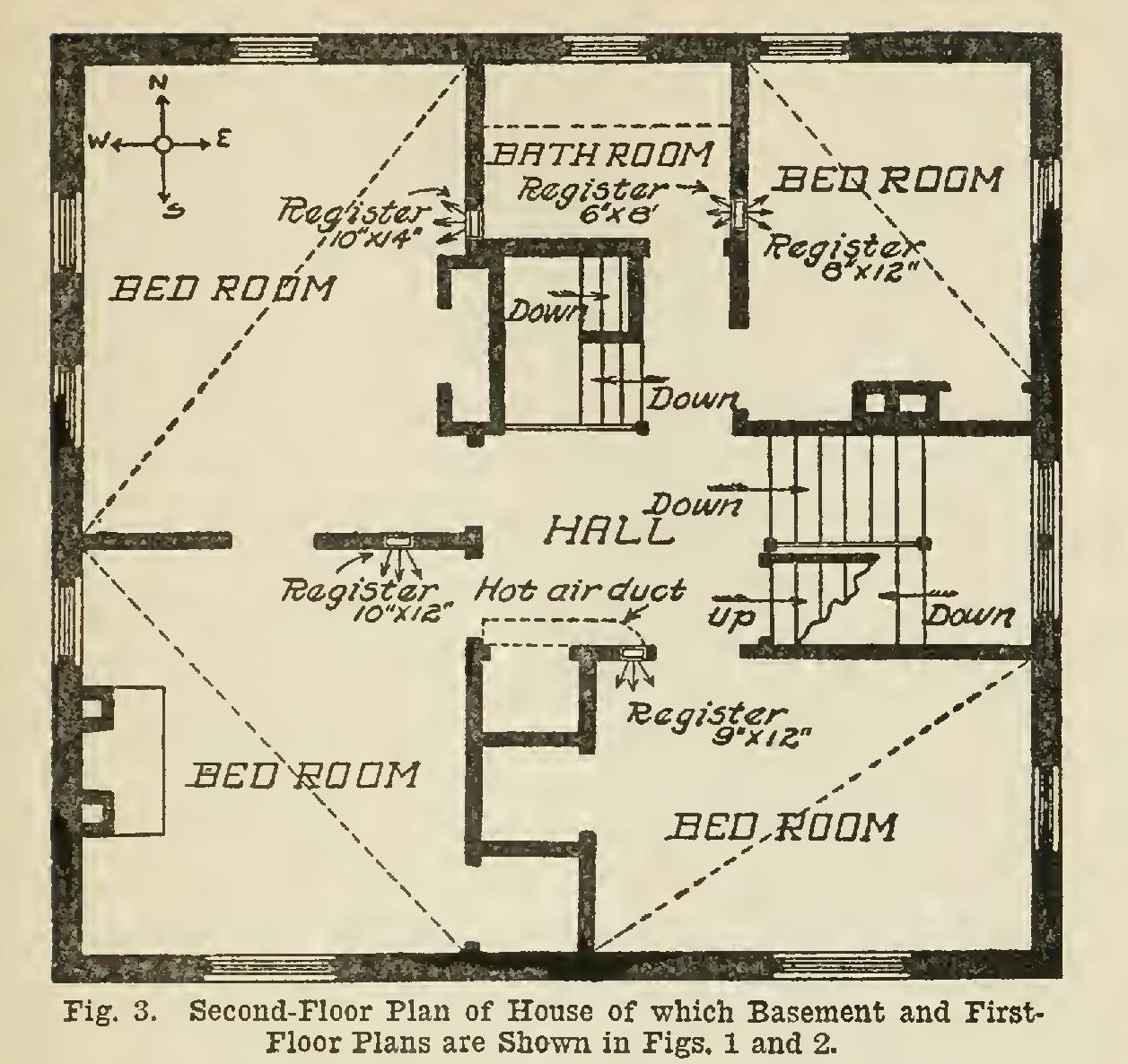
To illustrate the proper method of installing a hot-air furnace, we shall consider its applica tion to a house of average size. Fig. 1 shows
the cellar plan, Fig. 2 the first floor, and Fig. 3 the second floor plan of such a house.
Size of Furnace Required. Having deter mined upon the installation of a furnace, the first thing to consider is the size necessary. For arriving at this conclusion, there are several methods that can be adopted. We shall assume that it is desired to have an apparatus of suffi cient capacity to heat all rooms (excepting the kitchen) to 70° F. in zero weather. An excellent rule, formulated by Mr. Charles S. Prizer, is as follows: "Find the cubic feet of space in room by multiplying the length by the width, and this product by the height. To the actual cubic feet of space in the room, add 75 cubic feet for each square foot of glass surface (outside doors to be figured as glass), and 8 cubic feet for each square foot of outside or exposed wall surface. For either a northern or western exposure, add 10 per cent to the glass surface and 10 per cent to the wall surface. For either a southern or eastern exposure, deduct 10 per cent from the exposed glass and wall sur face. Should double doors or storm doors be used, count outside doors as exposed wall instead of exposed glass surface. Add together the figures or all rooms to be heated, and the total will be the equivalent cubic feet of space to be provided for by the furnace." This rule, it will be observed, takes into account the various exposures of each and every room. In the event of the house being located in a section where a temperature of 10° to 12° above zero is the extreme degree of cold weather, 10 per cent may be deducted from the "equiva lent cubic feet." For locations where the extreme degree of cold weather is 10° below zero, add 10 per cent to the equivalent cubic feet; for 20° below zero, add 15 per cent; and for 30° below zero, add 20 per cent.
Select a furnace having one square inch of grate area for each 150 equivalent cubic feet of space to be heated.