Hot-Water Supply
water, tank, heater, steam, cold, gas, thermostat and temperature
This type of heater is made in sizes that will give from 1 to 9 gallons per minute, heated from the ordinary temperature of cold water to a tem perature about 110° to 120'; but is seldom used when water of a higher temperature is desired. Heaters of this type are very extensively em ployed for heating water for bathing purposes during the summer months in private houses, and give universal satisfaction. They are fur nished in plain finish and also nickel-plated, and there are a number of good makes on the market.

Fig. 58 shows an electric water-heater. A represents the hot-water outlet of a 1-inch pipe; B is the air and steam vent-pipe and valve; C is a 15-gallon galvanized-iron tank (cut away in part to show the steam can); D is the steam can, which is closed at the top and open at the base, and partly cut away in the figure to show the position of the electrodes; E represents the two electrodes which consist of pieces of 1-inch iron pipe, sketched here in section to show the method by which the current-supply wires are connected. F shows the concave bottom of the main tank; 0 is a removable plate with a water tight gasket; II II are stuffing-boxes; I I are extra-insulated rubber wires supplying current to the electrodes; and J is the 1-inch pipe through which cold water is supplied to the tank.
The construction is based on the principle of a water rheostat operated under an inverted tank or can, all being enclosed in an outer tank, the water in which is either under pressure or otherwise as may be desired. The inner or in verted can contains electrodes, marked E E in the diagram, which are separated a distance of an inch and one-quarter and on which is main tained a pressure of 500 volts in 60-cycle alter nating current. Obviously, any steam formed by the heating of the water will rise within this inner can; and, as its pressure increases, it drives the water therein downwards, hence off the elec trodes, thus automatically controlling the cur rent consumption and keeping the can filled nearly full of steam, which in turn maintains the temperature of the water in the outer tank at a point near boiling.
This heater is not on the market. One of this type, however, has been in operation for a little over three years, and has given good satisfac tion. It is interesting to note that while its maximum consumption of energy is approxi mately five kilowatts when both tanks are filled with cold water, this consumption decreases gradually as the temperature of the water rises and its position in the inner tank lowers, until it reaches a minimum of three-tenths of a kilowatt.
The capacity of the outer tank is 15 gallons, and it is but partially protected from the cold air. At A is located a small valve by means of which trapped air may be let out from the inner can, or, if desired, steam may be blown from it in order to hasten the heating of the water in the outer tank if an extra amount of hot water is wanted quickly. The steam can and electrode are mounted on the bottom plate of the main tank, to which they are attached by cap screws.
It is desirable that the tank should be insu lated, and that its inlet and outlet pipes should consist of rubber hose to prevent the grounding of the current supply. While the plumber will not be called upon to install a heater of this de scription, still it is well to know how water can be heated successfully by means of electricity. Heating water by electricity is a commercial possibility of the future, and the pl imber who understands it is abreast of his calling.
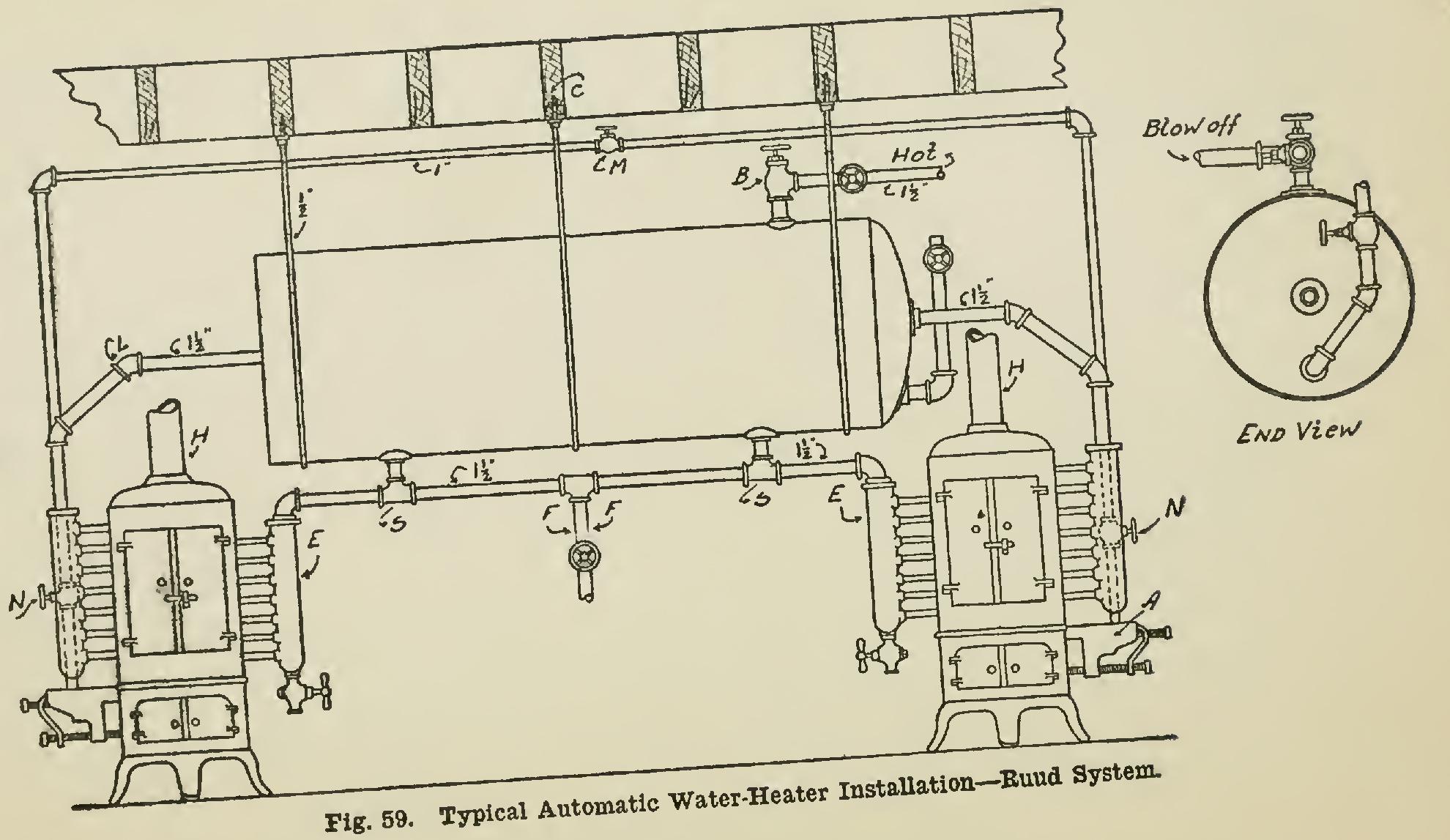
Automatic Water-Heaters. These are made in a number of styles. Fig. 59 illustrates a typi cal installation, the type of heater shown being known as the "Ruud." These heaters consist of a series of copper coils arranged one above the other, underneath which is a cluster of Bunsen burners. They are operated by a thermostat valve which acts as follows: When the hot-water faucet at the sink or some other fixture is opened, cold water passes over the thermostat, causing it to contract and open the gas-valve, which admits a large quan tity of gas to the burners. This is ignited by a pilot light maintained by a small by-pass in the valve. This large volume of gas, burning up through the coils, instantly raises the tempera ture of the water to the desired heat. The tem perature is regulated by the volume of gas ad mitted to the heater through the thermostat. As long as cold water is being drawn, gas is burning, and of course hot water flows. When the faucet is closed, the flow of water into the heater and through the thermostat ceases, caus ing the thermostat to heat and expand and there by closing off the flow of gas to the heater, with the exception of the small amount required for the pilot light, which burns constantly.