California
miles, mountains, land, san, valley, coast and gold
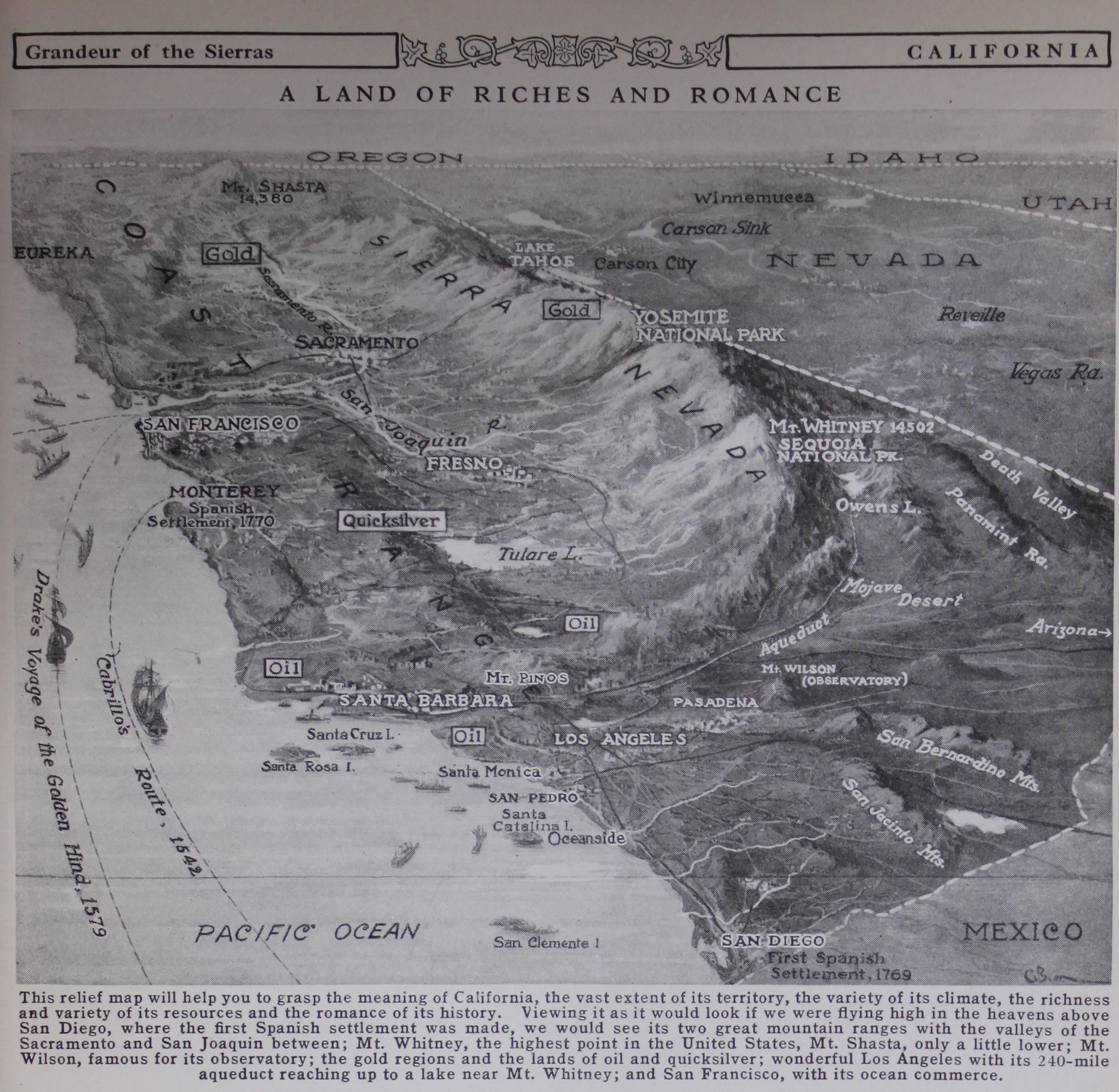
CALIFORNIA. "The Golden State," the second largest state in the Union, and two and a half times as large as all New England, is the sun-child of the nation— a warm smiling land blessed with a variety of climate, crops, and minerals without parallel in North America. It fronts nearly 1,000 miles upon the waters of the Pacific, from Oregon to Mexico, and averages 250 miles in width, between the ocean and the filmy crests of the Sierra Nevada Mountains, which form its eastern wall and boundary.
Long ranges of mountains stripe the state from north to south, as though a mighty plow had furrowed it. Forty miles from the sea are the ridges of the Coast Range, and between them and the great Sierra Nevadas to the east lies the trough, 400 miles long, known as the Great Valley of California. Only in one place is the western wall of this trough broken down—at the Golden Gate of San Francisco where the waters of the Sacramento and San Joaquin have cut a mile-wide channel to the ocean.
What wonders, what contrasts, are held in this mountain-ribbed land ! Mt. Whitney, a lovely Cali fornian peak, 14,502 feet high, is one of the highest points of land in the United States (excluding Alaska), and the famous Death Valley, only about 60 miles away, is the lowest land, nearly 300 feet below sea level (see Death Valley). In southeastern California lies a blazing tawny desert, with never more than the lightest sprinkling of rain, often burning at 120 degrees in the shade. And nearly a thousand miles off in the northwestern corner, the green, cathedral-like forests of Del Norte County grow thick and dark through the dripping days. Scenes of indescribable grandeur abound along the western face of the Sierras, where rushing torrents have worn great canyons like that of the Yosemite, as they plunge on their way to join the Sacramento and San Joaquin.
Thousands of tourists visit California every year.
They come to treasure up the austere wisdom of the majestic sequoias, old as the pyramids; the peace of far white mountains; the graceful courage of plunging waterfalls; the glassy blue of glacial lakes; the perilous beauty of sheer canyon walls—all the unnumbered marvels of this favored land.
Naturally, in a country where the rain pours down so inches annually in one place, and where the sun burns and desolates the soil in another, and where flat rich valleys adjoin pine-covered mountains, all sorts of crops may be grown, many industries flourish, and enormous grist is sent to the mill of the world.
Lumbering is the industry of the northern coast, where the tall spires of the giant redwoods and sequoias have been pointing sunward for centuries (see Sequoia). Glossy dairy herds feed in the sweet green meadows of the middle coast, where dairymen— many of them immigrants from Switzerland, Italy, and Portugal—produce great quantities of appetizing butter and cheese.
The Fairyland along the Sea The luxurious winter resorts, with their fairyland of bathing beaches, wild mountain scenery, fruit groves, and continual flowers, are to be found along the southern coast. The southern interior east of this region is California's reclaimed desert, where irri Palestine and the Sahara, places that provide the required setting can be found within a short journey (see Los Angeles).
In the vast central valley of the Sacramento and San Joaquin rivers flourish wheat, alfalfa, rice, barley, potatoes, grapes, fruit, hops, and vegetables of all kinds. Every sort of crop that grows in temperate climates thrives here, as many tropical products do in the south, with the result that California's crops are more diversified than those of any other state.
The Gold in the Mountains and Streams Besides the fruits and grains and lumber that grow up from the good Californian earth, much yellow gold is dug from its mountains and washed from the streams. Since 1849 California has yielded more gold than all the rest of the country combined. Silver and lead are found in the south; copper in the north; mercury, iron, talc, graphite, and many other stones and metals in various parts of the state, not to men tion precious stones, marble, and onyx in profitable quantities. The dashing mountain streams not only attract the fisherman with their trout and the beauty lover with the glitter of their gay white waters, but they also turn the wheels for valuable electric power plants, a tireless muscle to labor in Californian in dustry.