California
miles, united, gold, valley, rice, story and leading
Little Bits about a Great State There is so much of nov elty and importance to be said of this golden state to day that only a summary of the interesting facts can be set down, as follows: California is the longest of the states.
Every variety of climate found in North America may be found somewhere in California. The return Japan cur rent, swinging south from Alaska, washes the northern half of the coast and aids in making it cooler than the southern half. Mountains protect the state from the Arctic winds while trade winds from the southwest help to moderate the climate.
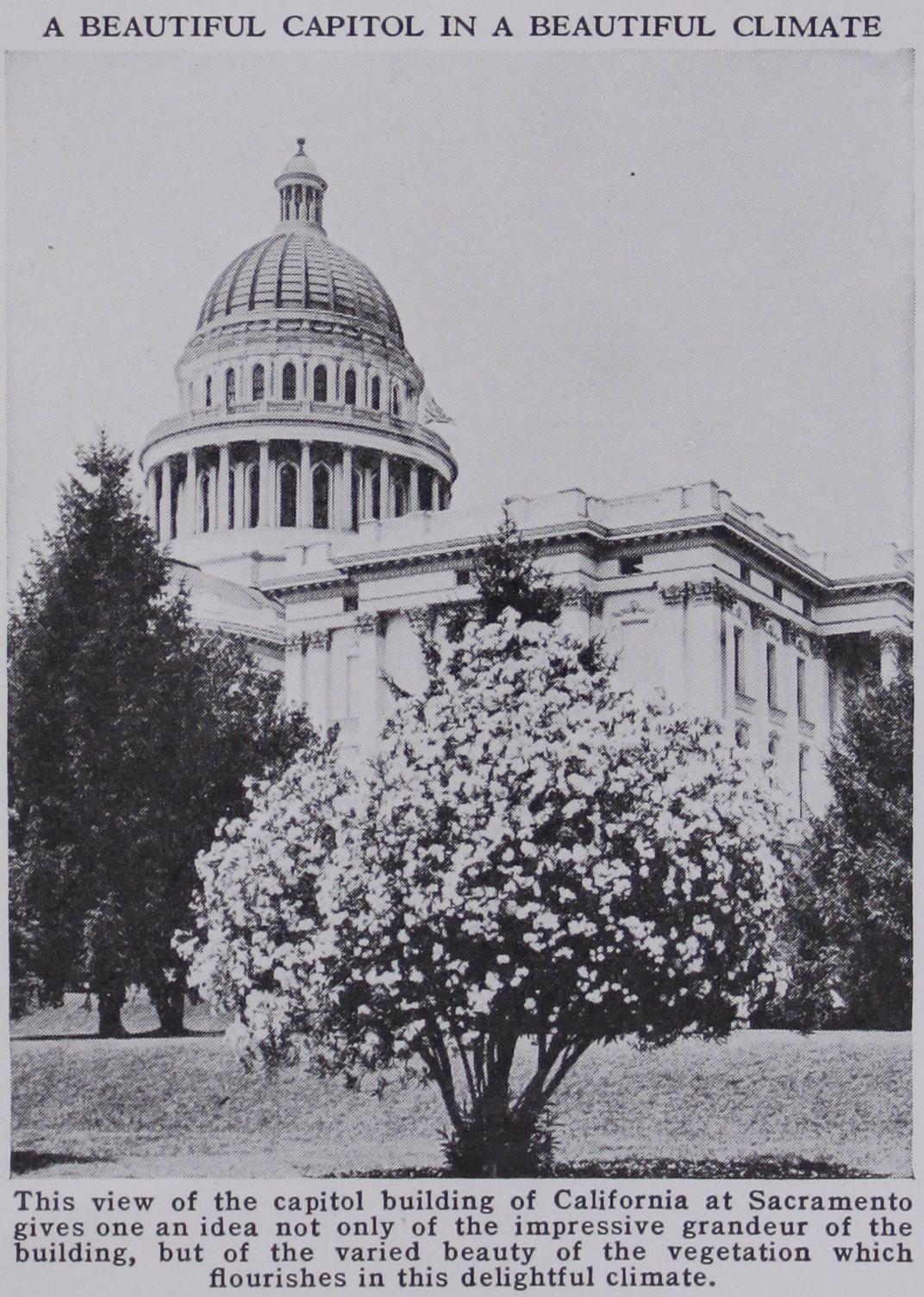
The Great Central Valley, containing the basins of the Sacramento and San Joaquin rivers and their tributaries, is about as large as Massachu setts, New Jersey, and Dela ware combined (18,000 square miles).
The highest waterfall in the world is the Yosemite (2,670 feet) in the Sierra Nevadas (see Yosemite Valley).
California's forests are fifth in area and second in stand of timber in the United States. They cover an area almost as great as the whole state of Pennsylvania (44,700 square miles).
In February and March one can travel 400 miles through the Great Valley, treading on flowers at every step.
California has only two seasons, the wet and the dry. For six months after May 1, rain is practically unknown.
In the vicinity of Los Angeles you may bathe in the warm Pacific in midwinter and an hour later enjoy a toboggan slide down the snowy slopes of the mountains 12 miles away.
Many of the low-lying lakes of the state are without outlet and are more or less salty.
California was the first suc cessful grower of sugar beets, and now ranks among the leading states in production.
The total area of California farms is greater than the total combined areas of Indiana and Massachusetts (46,000 square miles).
More than 35 per cent of the farms are under irrigation. California's hay, grain, and alfalfa fields cover an area nearly equal to that of Connecticut and Delaware; its fruit farms are more than five times as large in area as Rhode Island.
California grows more raisin grapes than any other section of the world; it produces more than three-fourths of the oranges of the United States, and 95 per cent of the walnuts and almonds. It is the only state 'of the United States that grows the olive in commercial quantities. Of dried fruits
its output is greater than that of any other state.
In the Great Valley, especially along the Sacramento River from Yolo County north, rice growing has become one of the chief industries. Land that was formerly con sidered of no value has recently become a great rice section.
Mills have been built to prepare the rice for market at Sacramento and other places, and California will soon pro duce enough rice to supply the whole of the United States.
California has the greatest range of mineral production of all the states. It has produced more gold than all the rest of the United States put together. In annual output it is first in gold, first in borax and soda, first in quicksilver, and among the leading states in petroleum and copper. It produces two-fifths of the world's quicksilver.
California leads the world in the long-distance transmis sion of electric power from mountain streams.
There are only four natural harbors on the whole Cali fornia coast: San Francisco, Monterey, Eureka, and San Diego. An artificial harbor has been built at Los Angeles.
California is one of the two or three leading states in fish packing.
There are about 16,000 Indians in the state. They live principally on three reservations and support themselves by farming and basket-making.
The Chinese population has decreased from 75,000 in 1880 to about 27,000. There are nearly 72,000 Japanese, according to the 1920 Federal census.
you ever hear the old Greek story of Jason and his companions who sailed away in the good ship Argo to find the Golden Fleece? Many people think this is a story of the world-old hunt for gold mines, for almost every nation has some such story in its history.
Our own country's search for the Golden Fleece began with the discovery of gold in California in 1848. Many of your grandfathers can remember the exciting days when marvelous tales filtered through to the East of the great riches awaiting anyone brave enough to undertake the journey across the continent. Some of them were Jasons themselves and sailed away in " prairie schooners" in search of gold—not ships at all, these schooners, but large covered wagons drawn by horses and oxen, and the sea they sailed through was a sea of waving prairie grass.