Modifications of Mitosis
division and spindle
its historical origin. But although traces of mitotic division were seen in the Infusoria by Balbiani ('58—'61), Stein ('59), and others long before it was known in the higher forms, it is still imperfectly understood on account of the practical difficulties of observation. Within a few years, however, our knowledge in this field has rapidly advanced, and we have already good ground for some important conclusions.
Mitotic division has now been observed in many of the main divisions of Protozoa and unicellular plants ; but in the present state of the subject it must be left an open question whether it occurs in all.
The essential features of the process appear to be here of the same nature as in the higher types, but show a series of minor modifications that indicate the origin of mitotic division from a simpler type. Four of these modifications are of especial importance, viz. :— ( ) The centrosome or its equivalent lies as a rule inside the nucleus, thus reversing the rule in higher forms.
(2) The nuclear membrane as a rule remains intact and does not disappear at any stage.
In
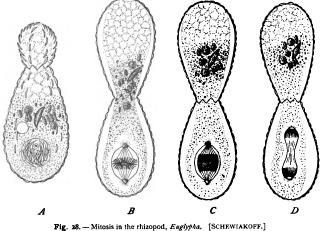
this form the body is surrounded by a firm shell which prevents direct constriction of the cell-body. The latter therefore divides by a process of budding from the opening of the shell (the initial phase shown at A); the nucleus meanwhile divides, and one of the daughter-nuclei afterwards wanders out into the bud.
A. Early prophase ; nucleus near lower end containing a nucleolus and numerous chromosomes. B. Equatorial plate and spindle formed inside the nucleus ; pole-bodies or pole-plates (i.e. attraction-spheres or centrosomes) at the spindle-poles. C. Metaphase. D. Late anaphase, spindle dividing; after division of the spindle the outer nucleus wanders out into the bud.
(3) The asters attain but a slight development, and in some cases appear to be entirely absent (Infusoria).
(4) The arrangement of the chromatin-granules to form chromosomes appears to be of secondary importance as compared with higher forms, and the essential feature in nuclear division appears to be the fission of the individual granules.
The basis of our knowledge in this field was laid by Richard Hertwig through his studies on an infusorian, Spirochona ('77), and a rhizopod, Actinosphorium ('84). In both these forms a typical spindle and equatorial plate are formed inside the nuclear membrane by a transformation of the nuclear substance. In Spirochona (Fig. 27,
A—C) a hemispherical " end-plate " or " pole-plate " is situated at either pole of the spindle, and Hertwig's observations indicated, though they did not prove, that these plates arose by the division of a large " nucleolus." Pole-plates of a somewhat different form were also described in Actinosph'erium, and somewhat later by Schewiakoff ('88) in Euglypha (Fig. 28). Their origin through division of the " nucleolus " has since been demonstrated by Keuten in Euglena A. Preparing for division ; the nucleus contains a " nucleolus " or nucleolo-centrosome surrounded by a group of chromosomes. B. Division of the " nucleolus " to form an intra-nuclear spindle. C. Later stage. D. 'The nuclear division completed.
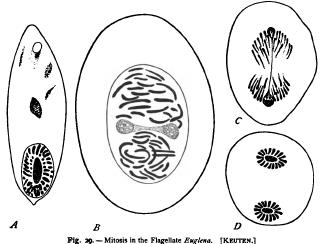
(Fig. 29) and Schaudinn in Amoeba. There can therefore be little doubt that the " nucleolus " in these forms represents an intranuclear centrosome, and that the pole-plates are the daughter-centrosomes or attraction-spheres. Richard Hertwig's latest work ('95) indicates that a similar process occurs in the micronuclei of Paramcccium, which at first contain a large " nucleolus " and afterwards a conspicuous pole-plate at either end of the spindle (Fig. 27, D—H). The origin of the pole-plates was not, however, positively determined.
These facts indicate, as Richard and Oscar Hertwig have concluded, that the centrosome, in its most primitive form, is an intranuclear structure, which may have arisen through a condensation or differentiation of the " achromatic " constituents. Noctiluca, the diatoms, and Actinosphceriun seem to represent transitions to the higher types. In the latter form Brauer discovered a distinct centrosome lying in the late anaphase outside the nuclear membrane at the centre of a small but distinct aster and soon dividing into two, precisely as in higher forms (Fig. 31, I, 7). This centrosome, however, as Brauer infers, lies within the nucleus during the resting state and the earlier stages of division, and only migrates out into the cytoplasm during the late anaphase, afterward returning to the nucleus and lying in the " poleplate." In the diatoms Biitschli discovered an extra-nuclear centrosome and attraction-sphere, and Lauterborn has traced the formation of a central spindle from it. This spindle, at first extra-nuclear, is asserted to pass subsequently into the interior of the nucleus.