Modifications of Mitosis
mitoses and asymmetrical
Kiebs first pointed out the occurrence of asymmetrical mitoses in carcinoma cells, where they have been carefully studied by HanseA. Asymmetrical mitosis with unequal centrosomes. B. Later stage, showing unequal distribution of the chromosomes. C. Quadripolar mitosis. D. Tripolar mitosis. E. Later stage. F. Tri-nucleate cell resulting.
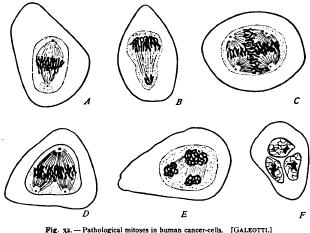
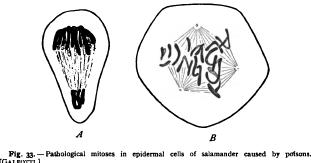
mann and Galeotti. The inequality is here often extremely marked, so that one of the daughter-cells may receive more than twice as much chromatin as the other (Fig. 32). Hansemann, whose conclusions are accepted by Galeotti, believes that this asymmetry of mitosis gives an explanation of the familiar fact that in cancer-cells many of the nuclei are especially rich in chromatin (hyper-chromatic cells), while others are abnormally poor (hypochromatic cells). Lustig and Galeotti ('93) showed that the unequal distribution of chromatin is correlated with and probably caused by a corresponding inequality in the centrosomes which causes an asymmetrical development of the amphiaster. A very interesting discovery made by Galeotti ('93) is that asymmetrical mitoses, exactly like those seen in carcinoma, may be artificially produced in the epithelial cells of salamanders (Fig. 33) by treatment with dilute solutions of various drugs (antipyrin, cocaine, quinine).
Normal multipolar mitoses, though rare, sometimes occur, as in the division of the pollen mother-cells and the endosperm-cells of flowering plants (Strasburger); but such mitotic figures arise through the union of two or more bipolar amphiasters in a syncytium and are due to a rapid succession of the nuclear divisions unaccompanied by fission of the cell-substance. These are not to be confounded with pathological mitoses arising by premature or abnormal division of the centrosome. If one centrosome divide, while the other does not, triasters are produced, from which may arise three cells or a triA. Asymmetrical mitosis after treatment with o.o5% antipyrin solution. B. Tripolar mitosis after treatment with 0.5% potassic iodide solution.
nucleated cell. If both centrosomes divide tetrasters or polyasters are formed. Here again the same result has been artificially attained by chemical stimulus (cf. Schottlander, '88). Multipolar mitoses are also common in regenerating tissues after irritative stimulus (Strobe); but it is uncertain whether such mitoses lead to the formation of normal tissue.' The frequency of abnormal mitoses in pathological growths is a most suggestive fact, but it is still wholly undetermined whether the abnormal mode of cell-division is the cause of the disease or the reverse. The latter seems the more probable alternative, since normal mitosis is certainly the rule in abnormal growths ; and Galeotti's I The remarkable polyasters formed in polyspermic fertilization of the egg are described at p. 147.
experiments suggest tjiat the pathological mitoses in such growths may be caused by the presence of deleterious chemical products in the diseased tissue, and perhaps point the way to their medical treatment.