General Sketch of the Ovum
egg and fertilization
GENERAL SKETCH OF THE OVUM Among the unicellular plants and animals, fertilization is effected by means of conjugation, a process in which two or more individuals permanently fuse together, or in which two unite temporarily and effect an exchange of nuclear matter, after which they separate. In all the higher forms fertilization consists in the permanent fusion of two germ-cells, one of paternal and one of maternal origin. We may first consider the fertilization of the animal egg, which appears to take place in essentially the same manner throughout the animal kingdom, and to be closely paralleled by the corresponding process in plants.
Leeuwenhoek, whose pupil Hamm discovered the spermatozoa (1677), put forth the conjecture that the spermatozoon must penetrate into the egg ; but the process was not actually seen until nearly two centuries later (1854), when Newport observed it in the case of the frog's egg ; and it was described by Pringsheim a year later in one of the lower plants, cEdogonium. The first adequate description of the process was given by Hermann Fol, in though many earlier observers, from the time of Martin Barry ('43) onwards, had seen the spermatozoa inside the egg-envelopes, or asserted its entrance into the egg.
In many cases the entire spermatozoon enters the egg (mollusks, insects, nematodes, some annelids, Petromyzon, axolotl, etc.), and in such cases the long flagellum may sometimes be seen coiled within the egg (Fig. 64). Only the nucleus and middle-piece, however, are concerned in the actual fertilization ; and there are some cases (echinoderms) in which the tail is left outside the egg. At or near — . - A. The entire spermatozoon lies in the egg, its nucleus at the right, flagellum at the left, while the minute sperm-amphiaster occupies the position of the middle-piece. The first polar body has been formed, the second is forming. B. The enlarged sperm-nucleus and sperm-amphiaster lie near the centre ; second polar body forming and the first dividing. The egg-centrosomes and asters afterwards disappear, their place being taken by those of the spermatozoon.
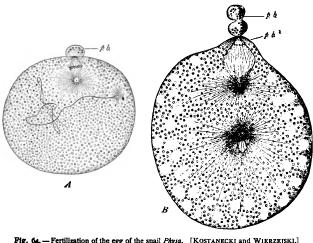
the time of fertilization, the egg successively segments off at the upper pole two minute cells, known as the polar bodies (Figs. 64, 65, 89) or directive corpuscles, which degenerate and take no part in the subsequent development. This phenomenon takes place, as a rule, immediately after entrance of the spermatozoon. It may, however, occur before the spermatozoon enters, and it forms no part of the process of fertilization proper. It is merely the final act in the process of maturation, by which the egg is prepared for fertilization, and we may defer its consideration to the following chapter.