General Sketch of the Ovum
cleavage and centrosomes
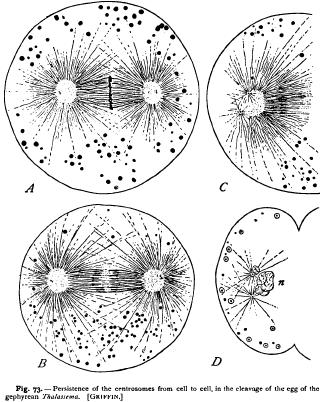
Such an array of evidence, derived from the study of so many diverse groups, places Boveri's conception of fertilization (p. 141) on a very strong foundation, and justifies the conclusion that the origin of the first cleavage-centrosomes from the spermatozoon alone is a phenomenon of very wide, if not of universal, occurrence. The descendants of these centrosomes may be traced continuously into later cleavage-stages, and there can be little doubt that they are the progenitors of all the centrosomes of the adult body. Boveri and Van Beneden, followed by a number of later observers,' have followed the daughter-centrosomes through every stage of the first cleavage into the blastomeres of the two-cell stage, where they persist and give rise to the centrosomes of the four-cell stage, and so on in later stages. This is beautifully shown in the egg of Thalassema (Fig. 73), which has been carefully followed out in my laboratory by Mr. B. B. Griffin. The centrosome is here a minute granule at the focus of the spermaster, which divides to form an amphiaster soon after the entrance of the spermatozoon. During the early anaphase of the first cleavage each centrosome divides into two, passes to the outer periphery of the centrosphere, and there forms a minute amphiaster for the second cleavage before the first cleavage takes place (Fig. 73) ! The minute centrosomes of the second cleavage are therefore the direct descendants of the sperm-centrosome ; and there is good reason to believe that the continuity is not broken in later stages. An exactly similar process is described by Kostanecki and Wierzejski in the egg of Physa. We thus reach the following remarkable conclusion : During cleavage the cytoplasm of the blastomeres is derived from that of the egg, the centrosomes from the spermatozoon, while the nuclei (chromatin) are A. Mitotic figure for the first cleavage ; the centrosome already double in each centrosphere (the small black bodies are deutoplasin-spheres). B. Early anaphase ; migration of the centrosomes to the periphery of the centrosphere. C. Middle anaphase (only one-half of the mitotic figure shown); daughter-amphiaster already formed. D. Telophase ; the egg dividing and nuclei reforming; the old amphiaster has disappeared, leaving only the daughter-amphiaster in each cell.
equally derived from both germ-cells; and certainly it would be hard to find more convincing evidence that the chromatin is the controlling factor in the cell by which its specific character is determined.
We now proceed to a more detailed and critical examination of fertilization.