General Sketch of the Ovum
aster and sperm-nucleus
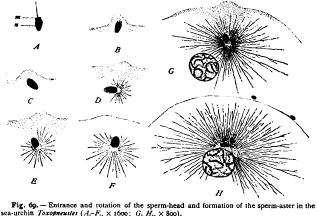
nomena in the sea-urchin Toxopneustes (Fig. 69). As described at p. 146, the tail is in this case left outside, and only the head and middle-piece enter the egg. Within a few minutes after its entrance, and while still very near the periphery, the lance-shaped sperm-head, carrying the middle-piece at its base, rotates through nearly or quite so that the pointed end is directed outward and the middlepiece is turned inward (Fig. 69 During the rotation a minute aster is developed about the middle-piece as a centre, and at the A. The egg-nucleus (E) and sperm-nucleus (S) approaching after formation of the polar bodies ; the latter shown above (P.B.); each germ-nucleus contains sixteen chromosomes ; the sperm-amphiaster fully developed. B. The mitotic figure for the first cleavage nearly established; the nuclear membranes have disappeared leaving the maternal group of chromosomes above the spindle, the paternal below it.
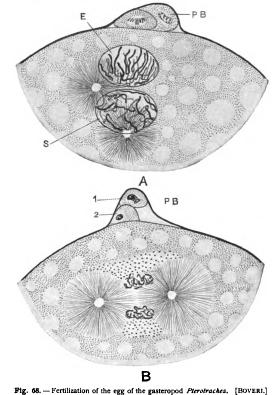
1 The first, as far as I know, to observe the rotation of the sperm-head was Flemming in the echinoderm-egg ('81, pp. 17-19). It has since been clearly observed in several other cases, and is probably a phenomenon of very general occurrence.
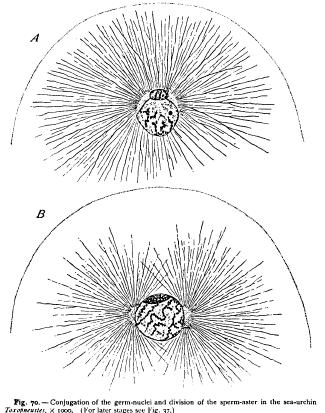
central point a minute intensely staining centrosome may be As the sperm-nucleus advances, the aster leads the way, and at the same time rapidly grows, its rays extending far out into the cytoplasm and finally traversing nearly an entire hemisphere of the egg. The central mass of the aster comes in contact with the egg-nucleus, divides into two, and the daughter-asters pass to opposite poles of the egg-nucleus, while the sperm-nucleus flattens against the latter and assumes the form of a biconvex lens (Fig. 70). The nuclei now fuse to form the cleavage-nucleus. Shortly afterwards the nuclear membrane fades away, a spindle is developed between the asters, and A. Sperm-head before entrance; a, nucleus; m, middle-piece and part of the flagellum. B. C. Immediately after entrance, showing entrance-cone. D.—F. Rotation of the sperm-head, formation of the sperm-aster about the middle-piece (the minute centrosome not shown). G. H. Approach of the germ-nuclei; growth of the aster.
a group of chromosomes arises from the cleavage-nucleus. These are 36 or 38 in number ; and although their relation to the paternal and maternal chromatin cannot in this case be accurately traced, owing to the apparent fusion of the nuclei, there can be no doubt on general grounds that one-half have been derived from each germnucleus. Throughout these changes no trace of an egg-centrosome is to be discovered. This centrosome, though present in earlier stages,
has been lost after the polar bodies were formed by the ovarian egg.
I was unable to find such a centrosome in Toxotneustes, but the observations of Roved and Hill prove that it is certainly present in other sea-urchins, and I now believe my own account to have been at fault in this respect.
The facts just described are now known to be typical of a large number of cases. We may, however, distinguish two types of ferti.4. Union of the nuclei, extension of the aster. B. Flattening of the sperm-nucleus against the egg-nucleus, division of the aster.
lization according as the polar-bodies are formed before or after the entrance of the spermatozoon. In the first case, well illustrated by the sea-urchin (Fig. 69), the germ-nuclei conjugate immediately after entrance of the spermatozoon. In the second and more frequent case (Ascaris, Fig. 65 ; Physa, Fig. 64; Nereis, Fig. 71 ; Cyclops, Fig. 72), the sperm-nucleus penetrates for a certain distance, often to the centre of the egg, and then pauses while the polar bodies are formed. It then conjugates with the reformed egg-nucleus. In this case, the sperm-aster always divides to form an amphiaster before conjugation of the nuclei, while in the first case the aster may be still undivided at the time of union. This difference is doubtless due merely to a difference in the time elapsing between entrance of the spermatozoon and conjugation of the nuclei, the amphiaster having, in the second case, time to form during extrusion of the polar bodies.
It is an interesting and significant fact that the aster or amphiaster always leads the way in the march towards the egg-nucleus ; and in many cases it may be far in advance of the Boveri ('88, r) has observed in sea-urchins that the sperm-nucleus may indeed be left entirely behind, the aster alone conjugating with the eggnucleus and causing division of the egg without union of the germnuclei, though the sperm-nucleus afterwards conjugates with one of the nuclei of the two-cell stage. This process, known as " partial fertilization," is undoubtedly to be regarded as abnormal. It affords, however, a beautiful demonstration of the fact that it is the centrosome alone that causes division of the egg, and it is therefore the fertilizing element proper (Boveri, '87, 2). We may therefore conclude that the end of fertilization is the union of the germ-nuclei and the equal distribution of their substance, while the active agent in this process is the centrosome.