Growth and Differentiation of the Germ-Cells
egg and cells
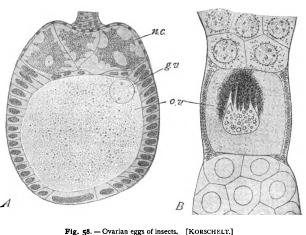
GROWTH AND DIFFERENTIATION OF THE GERM-CELLS. The Ovum (a) Growth and Nutrition. — Aside from the transformations of the nucleus, which are considered elsewhere, the story of the ovarian history of the egg is largely a record of the changes involved in nutrition and the storage of material. As the primordial germ-cells enlarge to form the mother-cells of the eggs, they almost invariably become intimately associated with neighbouring cells which not only support and protect them, but also serve as a means for the elaboration of food for the growing egg-cell. One of the simplest arrangements is that occurring in coelenterates, where the egg lies loose either in one of the general layers or in a mass of germinal tissue, and may crawl actively about among the surrounding cells like an More commonly, a definite association is established between the egg and the surrounding cells. In one of the most frequent arrangements the ovarian cells form a regular layer or follicle about the ovum (Figs. 58, 6o), and there is very strong reason to believe that the follicle-cells are immediately concerned with the conveyance of nutriment to the ovum. A number of observers have maintained that the follicle-cells may actually migrate into the interior of the egg, and this seems to be definitely established in the case of the Such cases are, in any case, extremely rare ; and, as a rule, the material elaborated by the nutritive cells is passed into the egg in solution. Very curious and suggestive conditions occur among the annelids and insects. In the annelids, the nutritive cells often do not form a follicle, but in some forms each egg is accompanied by a single nurse-cell, attached to its side, with which it floats free in the body-cavity. In Ophryotrocha, where it has been carefully described by Korschelt, the nurse-cell is at first much larger than the egg itself, and contains a large, irregular nucleus, rich in chromatin (Fig. 57). The egg-cell rapidly grows, apparently at the expense of the nurse-cell, which becomes reduced to a mere rudiment attached to one side of the egg and finally disappears. There can hardly be a doubt, as Korschelt maintains, that the nurse-cell is in some manner connected with the elaboration of food for the growing egg-cell ; and the intensely chromatic character of the nucleus is well worthy of note in this connection.
Somewhat similar nurse-cells occur in the insects, where they have been carefully described by Korschelt. The eggs here lie in a series in the ovarian " egg-tubes " alternating with nutritive cells variaously
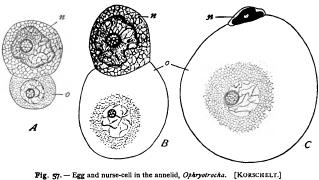
arranged in different cases. In the butterfly Vanessa, each egg is surrounded by a regular follicular layer of cells, a few of which at one end are differentiated into nurse-cells. These cells are very large and have huge amceboid nuclei, rich in chromatin (Fig. 58, A). In the ear-wig, Forficula, the arrangement is still more remarkable, and recalls that occurring in Ophryotrocha. Here each egg lies in the egg-tube just below a very large nurse-cell, which, when fully developed, has an enormous branching nucleus as shown in Fig. 115. In these two cases, again, the nurse-cell is characterized by the extraordinary development of its nucleus— a fact which points to an intimate relation between the nucleus and the metabolic activity of the Cell. Young stage, the nurse-cell (a), larger than the egg (o). B. Growth of the ovum. C. Late stage, the nurse-cell degenerating. In all these cases it is doubtful whether the nurse-cells are sistercells of the egg which have sacrificed their own development for the sake of their companions, or whether they have had a distinct origin from a very early period. That the former alternative is possible is shown by the fact that such a sacrifice occurs in some animals after the eggs have been laid. Thus in the earthworm, Lumbricus terrestris, several eggs are laid, but only one develops into an embryo, and the latter devours the undeveloped eggs. A similar process occurs in the marine gasteropods, where the eggs thus sacrificed may undergo certain stages of development before their dissolution.' A. Egg of the butterfly, Vanessa, surrounded by its follicle ; above, three nurse-cells (n.c.) with branching nuclei ; ,g.o. germinal vesicle. B. Egg of water-beetle, Dyleseus, living; the egg (0.0.) lies between two groups of nutritive cells; the germinal vesicle sends amceboid processes into the dark mass of food-granules.