Growth and Differentiation of the Germ-Cells
yolk-nucleus and described
those of myriapods, having the form of a single well-defined spheroidal mass which appears at a very early period and persists throughout the later ovarian history. At the other extreme are "diffused yolk-nuclei " having the form of numerous irregular and ill-defined masses scattered through the cytoplasm, as described by Stuhlmann ('86) in the eggs of insects and more recently by Calkins and Foot in earthworms. An intermediate form is represented in the amphibia (Jordan, '93) and myriapods (Balbiani, '93), where the egg contains a number of fairly well defined yolk-nuclei. In Lumbricus the "yolknucleus " first appears as a single irregular deeply staining body closely applied to the nucleus and afterwards breaks up into numerous smaller bodies (Calkins, '95).
The most diverse accounts have been given of the structure and origin of these problematical bodies. This is in part owing to the fact, recently pointed out by Mertens, that two entirely different structures have been confounded under the one term. One of these is the attraction-sphere of the young egg with its centrosome. Such a " yolk-nucleus " has been described by Balbiani in the eggs of the myriapod Geophilus (Fig. 59, B). The other is a body, variously described as arising from the nucleus or in the cytoplasm, which is not improbably concerned in some manner with the constructive metabolism involved in the growth of the egg-cytoplasm and perhaps indirectly concerned with the formation of deutoplasm. It seems clear that the latter form alone should receive the name of yolknucleus, if indeed the term is worth retaining.
Mertens ('93) has recently described the ova of a number of birds and mammals (including man) as containing a very distinct attraction-sphere containing one or more intensely staining centrosomes (Fig. 6o). This has, however, nothing to do with the true yolknucleus which may sometimes be seen in the same egg, lying beside the attraction-sphere (Fig. 6o, D). The latter sooner or later fades away and disappears. The yolk-nucleus, on the other hand, may long persist. This observation probably explains the strange result reached by Balbiani in the case of myriapods (Geophilus), where the " yolknucleus " is described as arising by a budding of the nucleus, yet is identified with an attraction-sphere ! The " yolk-nucleus " of Balbiani has here the typical appearance of an attraction-sphere, surrounded by rays and containing two or several centrosomes or centrioles.
Besides this, however, the egg contains several other bodies which are described as arising by budding off from the nucleus and perhaps represent the true yolk-nuclei (Fig. 59, B).
The origin of the yolk-nucleus proper appears to differ in different cases. Jordan's observations on the newt seem to leave no doubt that the bodies described as yolk-nuclei in this animal arise in situ in the cytoplasm ; and a similar origin of the yolk-nucleus has been described by a number of earlier observers. On the other hand, a number of observers have asserted its origin from the nucleus, either by a process of nuclear budding, by a casting out of the nucleolus of separate chromatin-rods, or of portions of the chromatic reticulum. That such a casting-out of nuclear substance occurs during the ovarian history of some eggs appears to be well established ; but it is uncertain whether the bodies thus arising have the same physiological significance as the "yolk-nuclei " of cytoplasmic origin. Calkins ('95, r), working in my laboratory, has brought forward strong evidence that the " yolk-nucleus " of Lumbricus is derived from a substance nearly related with chromatin (Fig. 61). The yolk-nucleus A. Very early stage ; the irregular yolk-nucleus (y. n.) closely applied to the germinal vesicle and staining like chromatin. B. Later stage ; the yolk-nucleus separating from the germinal vesicle and changing its staining-power. C. Still later stage ; the yolk-nucleus broken up into rounded bodies staining like the cytoplasm.
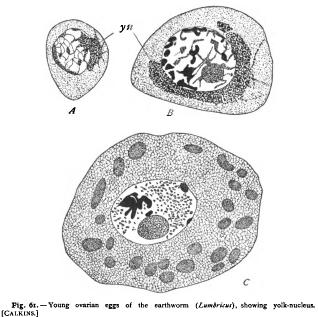
here first appears as an irregular granular body lying directly on the nuclear wall, which in some cases appears to be interrupted, as if yolknucleus and chromatin were directly in continuity. Later the yolknucleus separates from the germinal vesicle and lies beside it in the cytoplasm. It finally breaks up into a considerable number of secondary yolk-nuclei scattered through the egg. The action of differential stains at different periods indicates that the substance of the yolk-nucleus is nearly related with chromatin, if not directly derived from it. When treated with the Biondi-Ehrlich mixture (basic methyl green, acid red fuchsin), the yolk-nucleus at first stains green like the chromatin, while the cytoplasm is red, and this is the case even after the yolk-nucleus has quite separated from the nuclear membrane. Later, however, as the yolk-nucleus breaks up, it loses its nuclear staining power, and stains red like the cytoplasm.