Growth and Differentiation of the Germ-Cells
derived and cytoplasm
Diametrically opposed, moreover, to the results of Platner and Field are those of Hermann ('89) and Calkins ('95, 2) on amphibia and earthworms, and both these observers have devoted especial attention to the origin of the middle-piece. The evidence brought forward by the lastnamed author, whose preparations I have critically examined, seems perfectly conclusive that the attrac tio n-sp here or centrosome passes into the middle-piece. The " Nebenkern," which is rarely present, appears in this case to take no part in the formation of the flagellum, but degenerates without further change. In the salamander the origin of the middlepiece has been carefully studied by Flemming and Hermann. The latter ('89) has traced the middle-piece back to an " accessory body " (Ncbenkorper), which he believes to be not a " Nebenkern " (derived from the spindle-fibres), but an attraction-sphere derived from the aster of the preceding division, as in L um bricus. This body differs greatly from an ordinary attraction-sphere, consisting of the following three parts lying side by side in the cytoplasm (Fig. 63). These are : (a) a colourless sphere, (b) a minute rounded body which stains red with saffranin like the nucleoli or plasmosomes of the spermatid-nucleus, (c) a ring-shaped structure staining purple with gentian violet, like the chromatin. The colourless sphere ultimately vanishes, the red rounded body gives rise to the middlepiece, while the ring gives rise to the envelope (fin) of the flagellum. The apex or spur is developed from the nuclear membrane.' Hermann's results on the mouse agree in a general way with those on the salamander ; but the apex (head-cap) is here derived from the cytoplasm. A " Nebenkorper" lies in the cytoplasm, consisting of a pale sphere and a smaller deeply staining body. From the latter arises the " end-knob," which Hermann accordingly homologizes with the middle-piece of the salamander spermatozoon, and from it the axial filament appears to grow out into the flagellum. The colourless sphere disappears as in the salamander, and the envelope of the axial filament is derived from the cytoplasm. Moore
('95) describes the flagellum of elasmobranchs as growing out from the attraction-sphere (archoplasm) of the spermatid (Fig. 62, A).
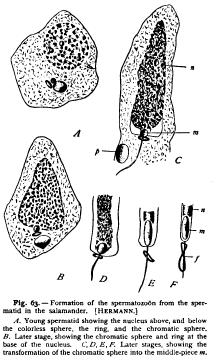
foregoing account shows that our positive knowledge of the formation of the spermatozoon still rests upon a somewhat slender basis. But despite the discrepancies in existing accounts, all agree that the spermatozoon arises by a direct metamorphosis of the spermatid, receiving from it a nucleus and a small amount of cytoplasm containing a centrosome or attractionsphere. All agree, further, that the middle-piece is of archoplasmic origin, being derived, according to some authors, from a true attraction-sphere (or centrosome); according to others, from a " Nebenkern " formed from the spindle-fibres. The former account of its origin is certainly true in some cases. The latter cannot be accepted without reinvestigation, since it stands in contradiction to what is known of the middle-piece in fertilization, and is possibly due to a confusion between attraction-sphere and " Nebenkern." Similar doubts exist in regard to the origin of the apex, which is variously described as arising from the nuclear membrane, from the general cytoplasm, from the " Nebenkern," and from the centrosome.
Most late observers agree, further, that the flagellum is developed in intimate relation with the archoplasmic material (attraction-sphere or " Nebenkern "). This conclusion tallies with that of Strasburger, who regards the flagella of plant-spermatozoids as derived from the " kinoplasm " (archoplasm), and it is of especial interest in view of Van Beneden's hypothesis of the contractility of the archoplasmfibrillae. It is, however, possible that the axial filament may be derived from the nucleus, in which case it would have an origin comparable with that of the spindle-fibres in many forms of mitosis.
1 Flemming described the as arising inside the nucleus ; but Hermann's observations leave no doubt that this was an error.