Growth and Differentiation of the Germ-Cells
centrosome and middle-piece
As the spermatid develops into the spermatozoon it assumes an elongate form, the nucleus lying at one end while the cytoplasm is drawn out to form the flagellum at the opposite end. The origin of the axial filament is still in doubt. Many authors (for example, Flemming and Niessing) have described it as growing out from the nucleus; but more recent work by Hermann, Moore, and others, shows that this is probably an error and that the axial filament is derived from the substance of the attraction-sphere.
The greatest uncertainty relates to the origin of the middle-piece and the apex. By one set of authors the centrosome is believed to pass into the point of the spermatozoon (Platner, Field, Benda, Prenant) ; by another set, into the middle-piece (Hermann, Wilcox, Calkins). That the latter is a correct view is absolutely demonstrated by the fact that during fertilization the centrosome in every accurately known case is derived from the middle-piece (amphibia, echinoderms, tunicates, earthworm, insects, mollusks, etc.). The observations of Platner and others in support of the other view are, however, too detailed to be rejected on this ground alone, and it is not impossible that the position of the centrosome may vary in different forms. The uncertainty is due to the difficulty of tracing out the fate of the centrosome and archoplasmic structures of the spermatid. It is certain that each spermatid receives a centrosome or attraction-sphere from the preceding amphiaster. But besides the centrosome (attractionsphere) the spermatid may also contain a second " achromatic" body known as the paranucleus (Nebenkern) or mitosome, which has undoubtedly been mistaken for the attraction-sphere in some cases 1 and to this circumstance the existing confusion may be in part due. The concurrent results of La Valette St. George, Platner, and several others have shown that the " Nebenkern " is derived from the remains of the spindle-fibres ; but the most divergent accounts of its later history have been given by different investigators. According to Platner's studies on the butterfly Pygara ('89), it consists of a larger posterior and a smaller anterior body, which he calls respectively the large and small mitosoma (Fig. 62, C). The former gives rise to the investment of the axial filament of the tail, the latter to the middlepiece, while the " centrosome " lies at the anterior end of the nucleus at the " apex" (Fig. 62, D). Field ('95) reaches an essentially similar
result in the echinoderm spermatozoon, the single " Nebenkern " forming the middle-piece, while the " centrosome" lies at the tip (Fig. 62, B). Benda describes the " Nebenkern " in the mammals as consisting of two parts, one of which passes backward and takes part in the formation of the tail-envelope, while the other passes forward to form the apex (head-cap or apical knob) and represents the attraction-sphere (archoplasm). A somewhat similar account was given by Platner of the " Nebenkern " of pulmonates. According to the more recent work of Moore on elasmobranchs, both middle-piece and apex are derived from the attraction-sphere, the centrosome passing into the former (Fig. 62, A).
The work of Platner and Field appears to have been carefully A. Late stage of spermatid of the shark Scyllium. [MOORE.] B. Spermatid of starfish Chcetaster. [FIELD.] C. Spermatid of butterfly 1)pura. D. Young spermatozoon of the same. [PLATNER.] a. apical body ; a..f axial filament ; c. " centrosome; " c. envelope of tail; m. middle-piece (" small mitosoma" of Platner); W. nucleus ; p. paranucleus (" Nebenkern," or " large mitosoma " of Platner).
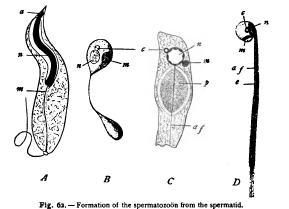
done, yet there is good reason to believe that both these observers are in error, since their results are contradicted by the history of the spermatozoon in fertilization. As regards the insects, Henking's observations on the fertilization of the butterfly Picris leave little doubt that the sperm-centrosome is here derived from the middlepiece ; and, moreover, in the grasshopper Caloptcnus, Wilcox ('95) has traced the centrosome of the spermatid into the middle-piece. In the case of echinoderms, Boveri, Mathews, and myself, confirmed by several later observers, have independently traced the sperm-centrosome to the middle-piece. during fertilization, and have shown that Fol was in error in referring it to the tip. Field's conclusion is therefore almost certainly erroneous, and he has probably confounded the centrosome with the " Nebenkern " or paranucleus.