Growth and Differentiation of the Germ-Cells
nucleus and cytoplasm
(b) of the Cytoplasm and Deposit of Deutoplasm. In the very young ovum the cytoplasm is small in amount and free from deutoplasm. As the egg enlarges, the cytoplasm increases enormously, a process which involves both the growth of the protoplasm and the formation of passive deutoplasm-bodies suspended in the protoplasmic network. During the growth-period a peculiar body known as the yolk-nucleus appears in the cytoplasm of many ova, and this is probably concerned in some manner with the growth of the cytoplasm and the formation of the yolk. Both its origin and its physiological role are, however, still involved in doubt.
The deutoplasm first appears, while the eggs are still very small, in the form of granules which seem to have at first no constant position with reference to the egg-nucleus, even in the same species.
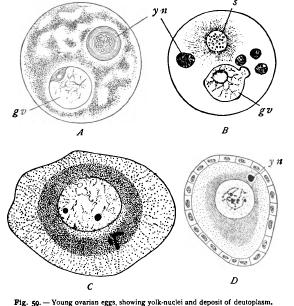
A. Myriapod (Geophilus) with single " yolk-nucleus " (perhaps an attraction-sphere) and scattered deutoplasm. [BALBIANI.] B. The same, with several yolk-nuclei, and attraction-sphere, s. [BALBIANI.] C. Fish (Scorperna), with deutoplasm forming a ring about the nucleus, and an irregular mass of "eliminated chromatin" (? yolk-nucleus). [VAN BAMBEKE.] D. Ovarian egg of young duck (3 months) surrounded by a follicle, and containing a " yolknucleus," y.n. [M EaTENs.] Thus Jordan ('93) states that in the newt the yolk may be first formed at one side of the egg and afterwards spread to other parts, or it may appear in more or less irregular separate patches which finally form an irregular ring about the nucleus, which at this period has an approximately central position. In some amphibia the deutoplasm appears near the periphery and advances inwards towards the nucleus. More commonly it first appears in a zone surrounding the nucleus (Fig. 59, C, D) and advances thence towards the periphery (trout, Henneguy ; cephalopods, Ussow). In still others (e.g. in myriapods, Balbiani) it appears in irregular patches scattered quite irregularly through the ovum (Fig. 59, A). In Branchipus the yolk is laid down at the centre of the egg, while the nucleus lies at the extreme periphery (Brauer). These variations show in general no definite relation to the ultimate arrangement —a fact which proves that the eccentricity of the nucleus and the polarity of the egg cannot be explained as the result of a simple mechanical displacement of the germinal vesicle by the yolk, as some authors have maintained. Neither do they support the view that the actual polarity of the egg exists from the beginning. They probably arise rather through the varying physiological conditions under which the eggformation takes place ; but these have not yet been sufficiently analyzed.' The primary origin of the deutoplasm-grains is a question that really involves the whole theory of cell-action and the relation of nucleus and cytoplasm in metabolism. The evidence seems per
fectly clear that in many cases the deutoplasm arises in situ in the cytoplasm like the zymogen-granules in gland-cells. But there is now a great body of evidence that seems to show with equal clearness that a part of the egg-cytoplasm is directly or indirectly derived from the nucleus. There is no question that a large part of the substance of the germinal vesicle is thrown out into the cytoplasm at the time of maturation, as shown with especial clearness in the eggs of amphibia, echinoderms, and some worms (e.g. in Nereis, Fig. 71). A large number of observers have maintained that a similar giving off of solid nuclear substance occurs during the earlier stages of growth ; and these observations are so numerous and some of them are so careful, that it is impossible to doubt that this process really takes place. The portions thus cast out of the nucleus have been described by some authors as actual buds from the nucleus (Blochmann, Scharff, Balbiani, etc.), as separate chromatin-rods (Van Bambeke, Erlanger), as portions of the chromatic network (Calkins), or as nucleoli (Balbiani, Will, Leydig). There is no evidence that such eliminated nuclear materials directly give rise to deutoplasm-granules. They would seem, rather, to have the value of food-matters or formative substances which are afterwards absorbed and elaborated by the cytoplasm, the deutoplasm being a new deposit in the cytoplasmic substance. It is, however, a matter of great interest that formed nuclear elements should be given off into the cytoplasm, in view of the general role of the nucleus as discussed in Chapter VII.
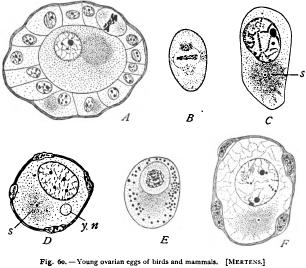
(c) Yolk-nucleus. — The term " yolk-nucleus " has been applied to various bodies or masses that appear in the cytoplasm of the growing ovarian egg ; and it must be said that the word has at present no well-defined meaning. We may distinguish two extreme types of " yolk-nuclei " which are connected by various transitional forms. At one extreme is the yolk-nucleus proper, as originally described by von Wittich (45) in the eggs of spiders and later by Balbiani (93) in A. Egg of-young magpie (8 days), surrounded by the follicle and containing germinal vesicle and attraction-sphere. B. Primordial egg (oOgonium) of new-born cat, dividing. C. Egg of new-born cat containing attraction-sphere (s), and centrosome. D. Of voting thrush surrounded by follicle and containing besides the nucleus an attraction-sphere and centrosome (s), and a yolk-nucleus (y. rt.). E. Of young chick containing nucleus, attraction-sphere and fatty deutoplasm-spheres (black). F. Egg of new-born child, surrounded by follicle and containing nucleus and attraction-sphere.