Union of the Germ-Cells
spermatozoon and entrance
UNION OF THE GERM-CELLS It does not lie within the scope of this work to consider the innumerable modes by which the germ-cells are brought together, further than to recall the fact that their union may take place inside the body of the mother or outside, and that in the latter case, both eggs and spermatozoa are as a rule discharged into the water, where fertilization and development take place. The spermatozoa may live for a long period, either before or after their discharge, without losing their fertilizing power, and their movements may continue throughout this period. In many cases they are motionless when first discharged, and only begin their characteristic swimming movements after coming in contact with the water. There is clear evidence of a definite attraction between the germ-cells, which is in some cases so marked (for example in the polyp Renilla) that when spermatozoa and ova are mixed in a small vessel, each ovum becomes in a few moments surrounded by a dense fringe of spermatozoa attached to its periphery by their heads and by their movements actually causing the ovum to move about. The nature of the attraction is not positively known, but Pfeffer's researches on the spermatozoids of plants leave little doubt that it is of a chemical nature, since he found the spermatozoids of ferns and of Selaginella to be as actively attracted by solutions of malic acid or malates (contained in capillary tubes) as by the substance extruded from the neck of the archegonium. Those of mosses, on the other hand, are indifferent to malic acid, but are attracted by cane-sugar. These experiments indicate that the specific attraction between the germcells of the same species is owing to the presence of specific chemical substances in each case. There is clear evidence, furthermore, that the attractive force is not exerted by the egg-nucleus alone, but by the egg-cytoplasm ; for, as the Hertwigs and others have shown, spermatozoa will readily enter egg-fragments entirely devoid of a nucleus.
In naked eggs, such as those of some echinoderms, and coelenterates, the spermatozoon may enter at any point ; but there are some cases in which the point of entrance is predetermined by the presence of special structures through which the spermatozoon enters (Fig. 74). Thus, the starfish egg, according to Fol, pos
sesses before fertilization a peculiar protoplasmic " attraction-cone " to which the head of the spermatozoon becomes attached, and through which it enters the egg. In some of the hydromedusae, on the other hand, the entrance point is marked by a funnel-shaped depression at the egg-periphery (Metschnikoff). When no preformed attractioncone is present, an " entrance-cone " is sometimes formed by a rush of protoplasm towards the point at which the spermatozoon strikes the egg and there forming a conical elevation into which the spermhead passes. In the sea-urchin (Fig. 74) this structure persists only a short time after the spermatozoon enters, soon assuming a A. Spermatozoon of Toropneuiles, x woo; a, the apical body, x, nucleus, m, middle-piece, flagellum. B. Contact with the egg-periphery. C. D. Entrance of the head, formation of the entrance-cone and of the vitelline membrane (v), leaving the tail outside. E. F. Later stages. G. Appearance of the sperm-aster (s) about 3-5 minutes after first contact ; entrance-cone breaking up. H. Entrance of the spermatozoon into a preformed depression. I. Approach of the spermatozoon, showing the preformed attraction-cone.
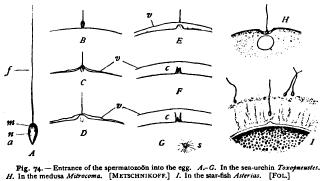
ragged flame-shape and breaking up into slender rays. In some cases the egg remains naked, even after fertilization, as appears to be the case in many coelenterates. More commonly a vitelline membrane is quickly formed after contact of the spermatozoon,— e.g. in Amphioxus, in the echinoderms, and in many plants, — and by means of this the entrance of other spermatozoa is prevented. In eggs surrounded by a membrane before fertilization, the spermatozoon either bores its way through the membrane at any point, as is probably the case with mammals and amphibia, or may make its entrance through a micropyle.