Union of the Germ-Cells
chromosomes and paternal
A Partial List Showing The Number Of Chromosomes Characteristic Of The Germ-Nuclei And Somatic Nuclei In Various Plants And Animals.
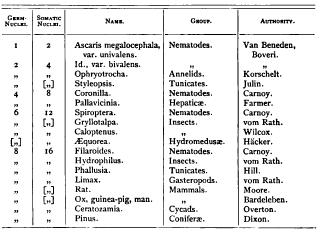
1 Indeed, Boveri has found that in Ascaris both modes occur, though the fusion of the germ-nuclei is exceptional. (Cf. p. 216.) 2 The above table is compiled from papers both on fertilization and maturation. Numbers in brackets are inferred.
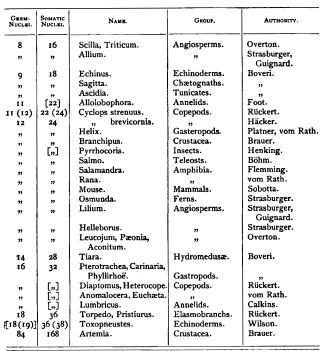
The above data are drawn from sources so diverse and show so remarkable a uniformity as to establish the general law with a very high degree of probability. The few known exceptions are almost certainly apparent only and are due to the occurrence of plurivalent chromosomes. This is certainly the case with Ascaris (cf. p. 6i). It is probably the case with the gasteropod Anion, where, as described by Platner, the egg-nucleus gives rise to numerous chromosomes, the sperm-nucleus to two only ; the latter are, however, plurivalent, for .Garnault showed that they break up into smaller chromatin-bodies, and that the germ-nuclei are exactly alike at the time of union.' We may here briefly refer to remarkable recent observations by Ruckert .and others, which seem to show that not only the paternal and maternal chromatin, but also the chromosomes, may retain their individuality throughout development.' Van Beneden, the pioneer observer in this direction, was unable to follow the paternal and maternal chromatin beyond the first cleavage-nucleus, though he surmised that they remained distinct in later stages as well ; and Rabl and Boveri brought forward evidence that the chromosomes did not lose their identity, even in the resting nucleus. Ruckert ('95, 3) and Hacker ('95, 1) have recently shown that in Cyclops, the paternal and maternal chromatin-groups not only remain distinctly separated during the anaphase, but give rise to double nuclei in the two-cell stage (Fig. 105). Each half again gives rise to a separate group of chromosomes at the second cleavage, and this is repeated at least as far as the blastula stage. Herla and Zoja have shown furthermore that if in Ascaris the egg of variety bivalens, having two chromosomes, be fertilized with the spermatozoon of variety univalens having one chromosome, the three chromosomes reappear at each cleavage, at least as far as the twelve-cell stage (Fig. Io6); and according to Zoja, the paternal chromosome is distinguishable from the two maternal at each step by its smaller size. We have thus what must be reckoned as more than a possibility, that every cell in the body of the child may receive from each parent not only half of its chromatin substance, but one-half of its chromosomes, as distinct and individual descendants of those of the parents.