Union of the Germ-Cells
membrane and spermatozoa
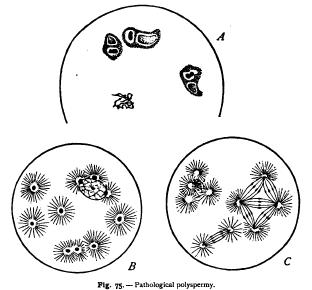
In some forms only one spermatozoon normally enters the ovum, as in echinoderms, mammals, many annelids, etc., while in others several may enter (insects, elasmobranchs, reptiles, the earthworm, Petromyzon, etc.). In the former case more than one spermatozoon may accidentally enter (pathological polyspermy), but development is then always abnormal. In such cases each sperm-centrosome gives rise to an amphiaster, and the asters may then unite to form the most complex polyasters, the nodes of which are formed by the A. Polyspermy in the egg of Ascaris; below, the egg-nucleus ; above, three entire spermatozoa within the egg. [SALA.] B. Polyspermy in sea-urchin egg treated with o.005% nicotine-solution; ten sperm-nuclei shown, three of which have conjugated with the egg-nucleus. C. Later stage of an egg similarly treated, showing polyasters formed by union of the sperm-amphiasters. [0. and R. HERTWIG.] centrosomes (Fig. 75). Such eggs either do not divide at all or undergo an irregular multiple cleavage and soon perish. If, however, only two spermatozoa enter, the egg may develop for a time. Thus Driesch has determined the interesting fact, which I have confirmed, that sea-urchin eggs into which two spermatozoa have accidentally entered undergo a double cleavage, dividing into four at the first cleavage, and forming eight instead of four micromeres at the fourth cleavage. Such embryos develop as far as the blastula stage, but never form a gastrula.' In cases where several spermatozoa normally enter the egg (physiological polyspermy), only one of the sperm-nuclei normally unites with the egg-nucleus, the supernumerary sperm-nuclei either degenerating, or in rare cases — e.g. in elasmobranchs and reptiles — living for a time and even dividing to form " merocytes " or accessory nuclei. The fate of the latter is still in doubt ; but they certainly take no part in fertilization.
It is an interesting question how the entrance of supernumerary spermatozoa is prevented in normal monospermic fertilization. In the case of echinoderm-eggs Fol advanced the view that this is mechanically effected by means of the vitelline membrane formed instantly after the first spermatozoon touches the egg. This is indicated by the following facts. Immature eggs, before the formation of the polar bodies, have no power to form a vitelline membrane, and the spermatozoa always enter them in considerable numbers. Polyspermy also takes place, as 0. and R. Hertwig's beautiful experiments showed ('87), in ripe eggs whose vitality has been diminished by the action of dilute poisons, such as nicotine, strychnine, and morphine, or by subjection to an abnormally high temperature (31° C.) ; and in these cases the vitelline membrane is only slowly formed, so that several spermatozoa have time to Similar mechanical explanations have been given in various other cases. Thus Hoffman believes that in teleosts the micropyle is blocked by the polar-bodies after the entrance of the first spermatozoon ; and Calberla suggested (Petromyzon) that the same result might be caused by the tail of the entering spermatozoon. It is, however, far from certain whether such rude mechanical explanations are adequate ; and there is considerable reason to believe that the egg may possess a physiological power of exclusion called forth by the first spermatozoon. Thus Driesch found that spermatozoa did not enter fertilized sea-urchin eggs from which the membranes had been removed by In some cases no membrane is formed (some coelenterates), in others several spermatozoa are found inside the membrane (nemertines), in others the spermatozoon may penetrate the membrane at any point (mammals), yet monospermy is the rule.
I For an account of the internal changes, see p. 261.
2 The Hertwigs attribute this to a diminished irritability on the part of the egg-substance. Normally requiring the stimulus of only a single spermatozoon for the formation of the vitclline membrane, it here demands the more intense stimulus of two, three, or more before the membrane is formed. That the membrane is not present before fertilization is admitted by Hertwig on the ground stated at p. 97.
8 On the other hand, Morgan states ('p5, 5, p. 270) that one or more spermatozoa will enter nucleated or enueleated egg-fragments whether obtained before or after fertilization.
I. Immediate Results of Union
The union of the germ-cells calls forth profound changes in both.
(a) The Spermatozoon.— Almost immediately after contact the tail ceases its movements. In some cases the tail is left outside, being carried away on the outer side of the vitelline membrane, and only the head and middle-piece enter the egg (echinoderms, Fig. 74). In other cases the entire spermatozoon enters (amphibia, earthworm, insects, etc., Fig. 64), but the tail always degenerates within the ovum and takes no part in fertilization. Within the ovum the sperm-nucleus rapidly grows, and both its structure and stainingcapacity rapidly change (cf. p. 127). The most important and significant result, however, is an immediate resumption by the sperm-nucleus and sperm-centrosome of the power of division which has hitherto been suspended. This is not due to the union of the germ-nuclei ; for, as the Hertwigs and others have shown, the supernumerary sperm-nuclei in polyspermic eggs may divide freely without copulation with the egg-nucleus, and they divide as freely after entering enucleated egg-fragments. The stimulus to division must therefore be given by the egg-cytoplasm. It is a very interesting fact that in some cases the cytoplasm has this effect on the sperm-nucleus only after formation of the polar bodies ; for when in sea-urchins the spermatozoa enter immature eggs, as they freely do, they penetrate but a short distance, and no further change occurs.
(b) The entrance of the spermatozoon produces an extraordinary effect on the egg, which extends to every part of its organization. The rapid formation of the vitelline membrane, already described, proves that the stimulus extends almost instantly throughout the whole ovum.' At the same time the physical consistency of the cytoplasm may greatly alter, as for instance in echinoderm eggs, where, as Morgan has observed, the cytoplasm assumes immediately after fertilization a peculiar viscid character which it afterwards loses. In many cases the egg contracts, performs amceboid movements, or shows wave-like changes of form. Again, the egg-cytoplasm may show active streaming movements, as in the formation of the entrance-cone in echinoderms, or in the flow of peripheral protoplasm towards the region of entrance to form the germinal disc, as in many pelagic fish-eggs. An interesting phenomenon is the formation, behind the advancing sperm-nucleus, of a peculiar funnel-shaped mass of deeply staining material extending outwards to the periphery. This has been carefully described by Foot ('94) in the earthworm, I I have often observed that the formation of the membrane, in Toxopneustes, proceeds like a wave from the entrance-point around the periphery, but this is often irregular.